Artist Interview 28: Susan Strachan Johnson
Everton, Ontario, Canada
Working with distressed fibres, paper-and-textile combinations and found objects Susan’s work is informed by nature and the rural landscape where she lives. She sees decay, de-construction, repair, re-cycling and regeneration as part of the cycle of life and tries to use each of these methods in her work.
Tell us about your work?
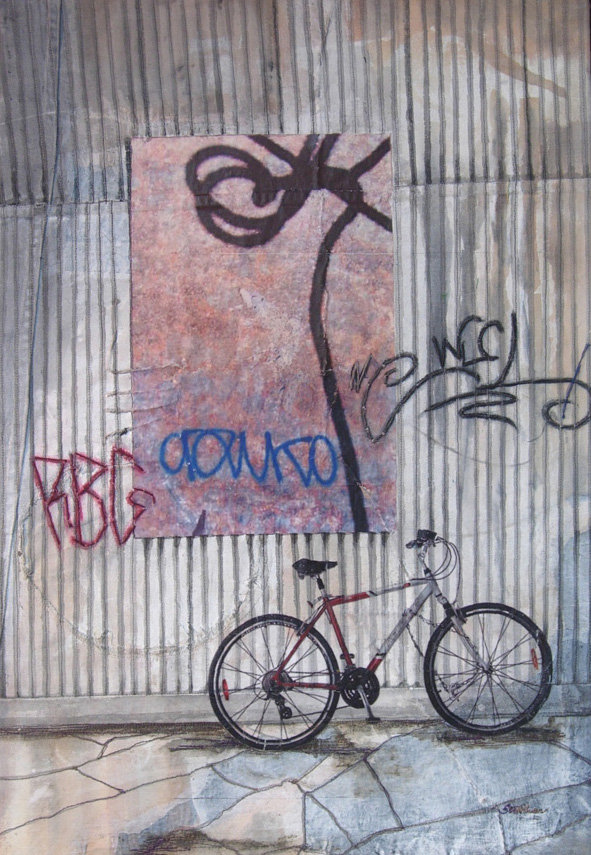
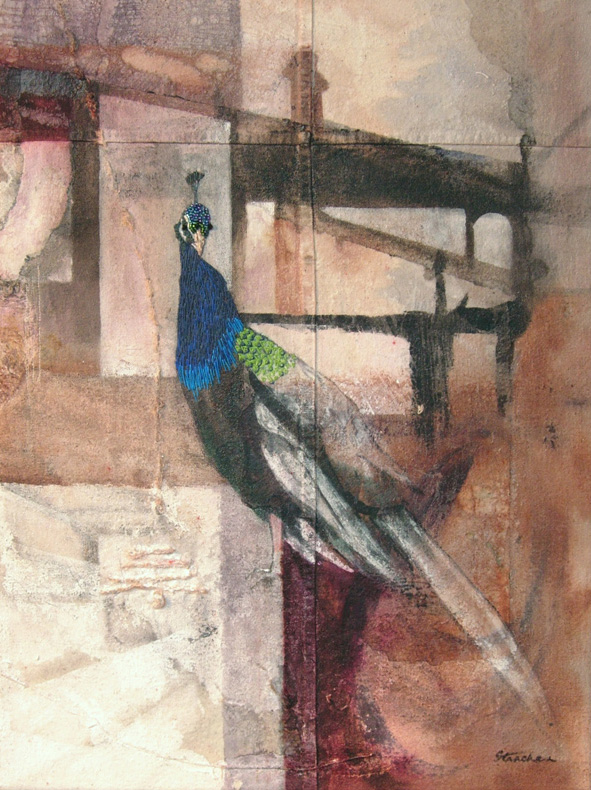
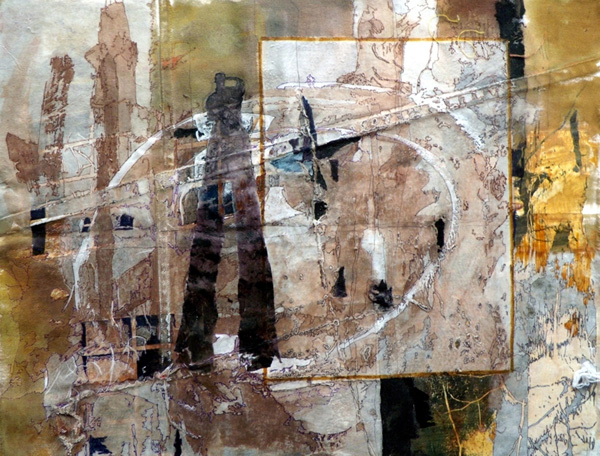
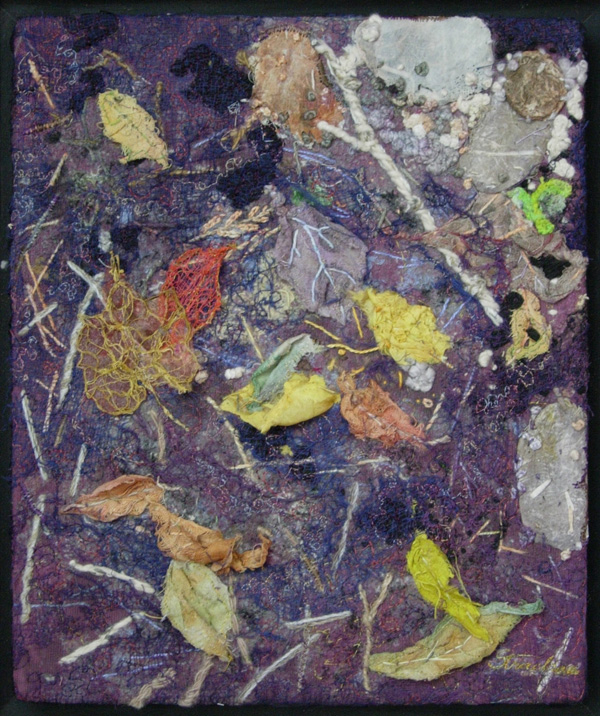
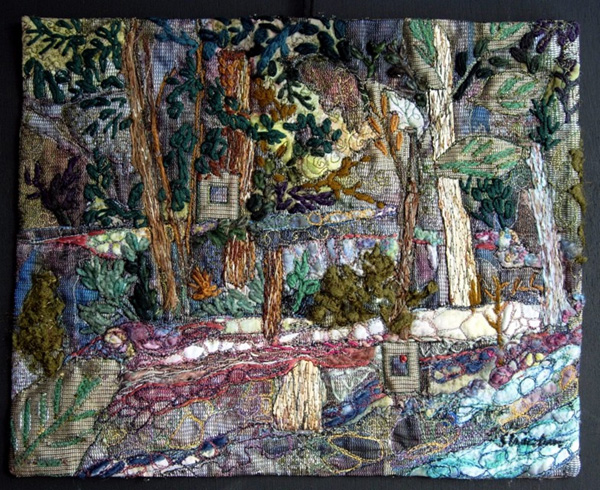
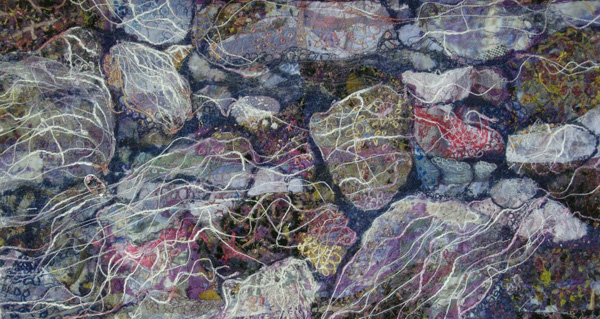
My work is informed by nature and the rural landscape where I live and is only partly abstracted. I want to show how I see the world and each piece invariably has an environmental theme, since I believe artists cannot say too much about how we need to care for our planet, instead of merely using it for our own ends. So my work is always representational in some way. I work with distressed fibres, paper and textile combinations and found objects. I also paint and dye my own materials. I see decay, de-construction, repair, re-cycling and regeneration as part of the cycle of life, so I try to use each of these methods in my work.
Previous World of Threads Exhibitions
Susan Strachan Johnson has been in three Festivals. In Festival 2009 she was in Common Thread International Exhibition Part 3. For Festival 2012 Susan was in the major show De rerum nature (On The Nature of Things). She was also part of Festival 2007 in the Salon de Refusé exhibition.
Where do you get your inspiration?
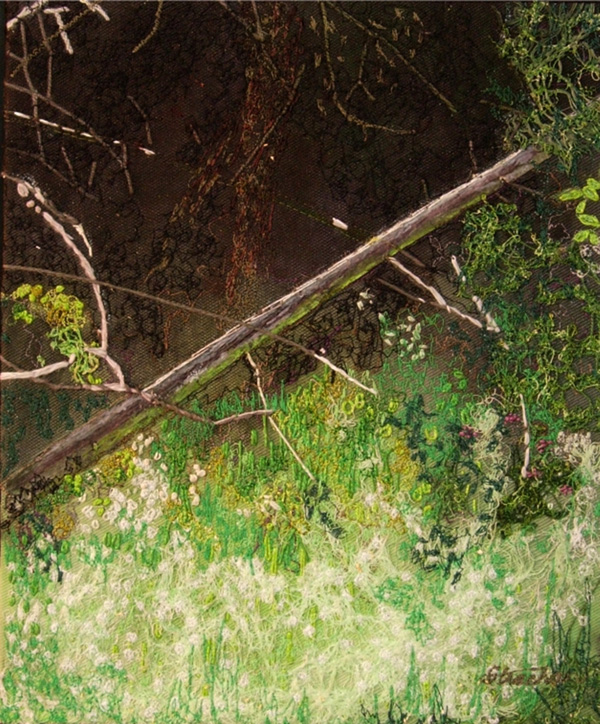
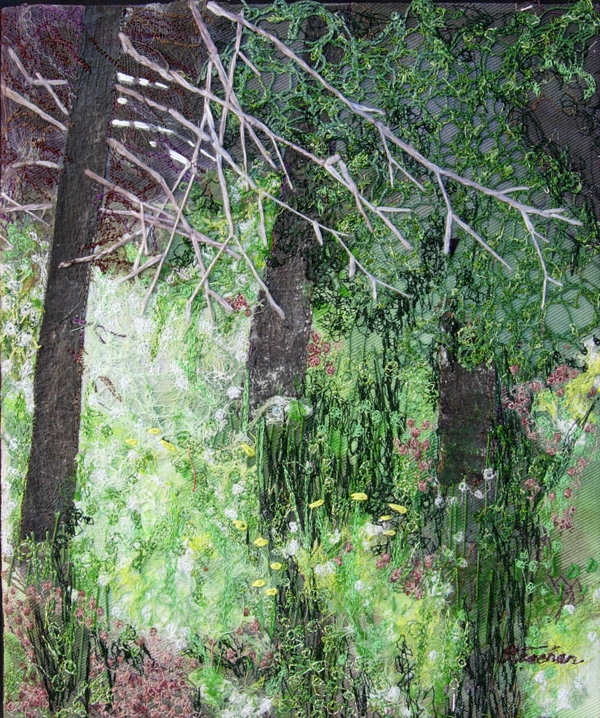
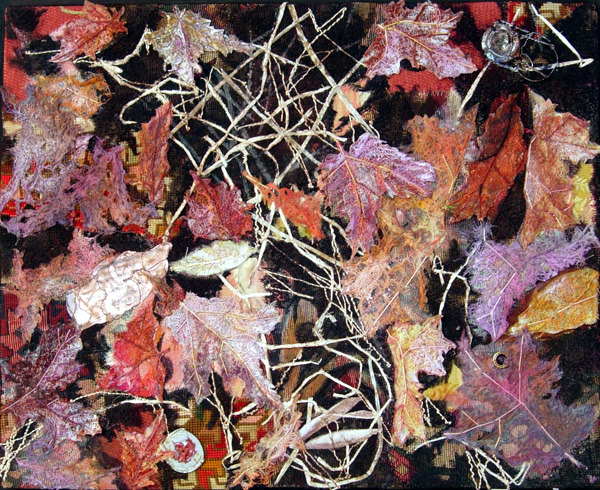
Since I live in a beautiful countryside near a small river, opposite a 200-acre scout camp, my sources of inspiration are endless. I am fascinated by the detail in the mundane, like the varying colours of rotting leaves and vegetation on the forest floor as I walk and the play of light through the cedars. I also use a lot of the organic matter in my pieces - petals, leaves, bark etc. I enjoy the challenge of both using and mimicking them in my work using molded "fabric", my own combination of silk and Japanese tissue.
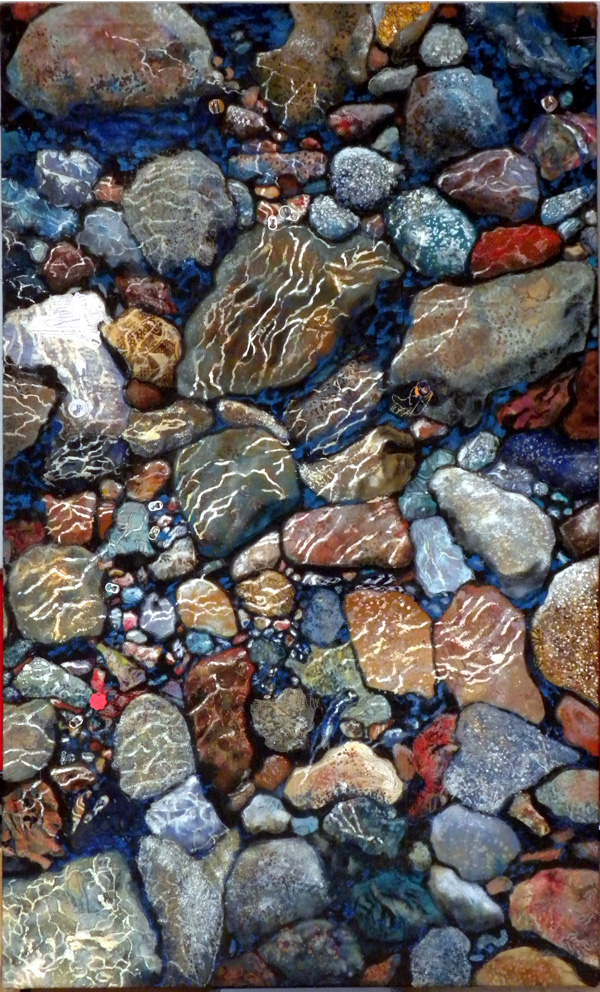
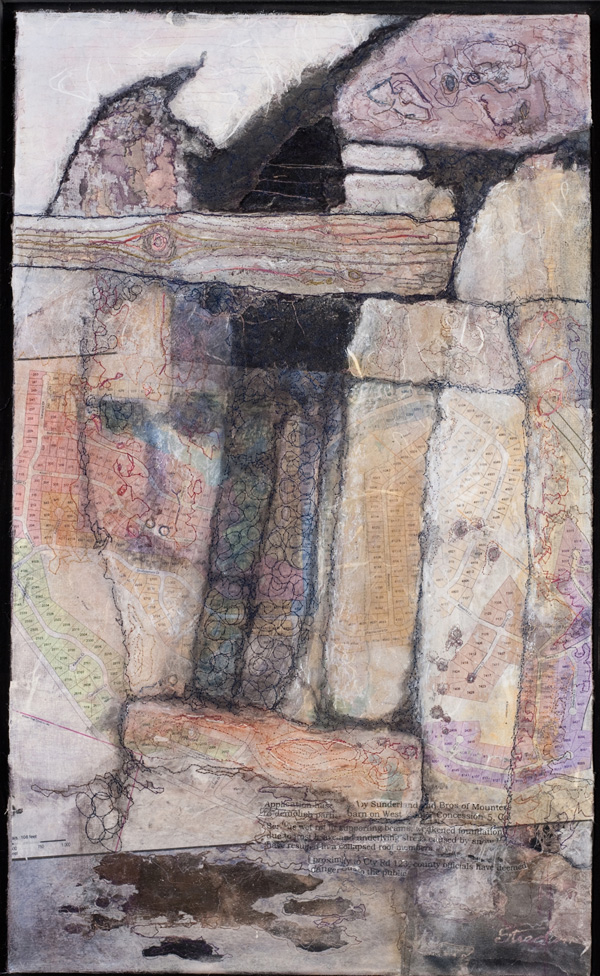
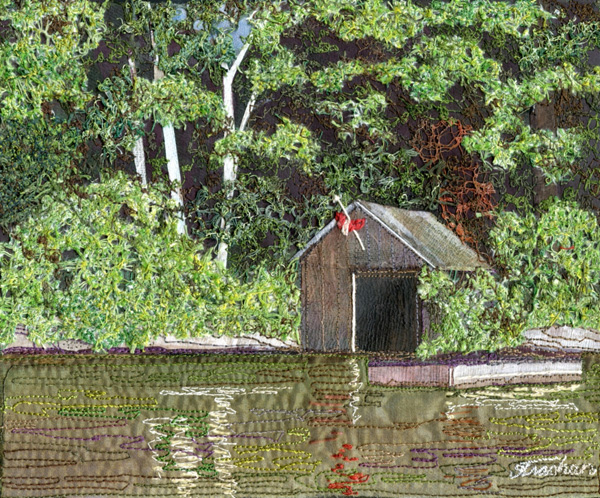
I decided that instead of shipping three large pieces under glass I would just reproduce three of my successful works in textile.
Why did you choose to go into fibre art?
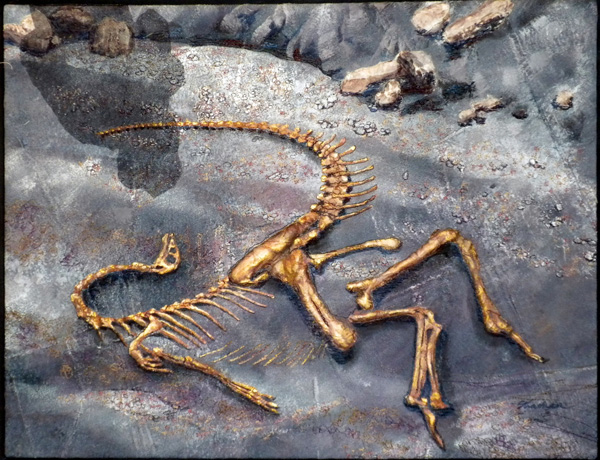
This was quite accidental, in fact. I was working in water-media collage and was invited to take part in the 2003 Florence Biennale. Since I knew it was going to be an expensive trip (I was ready for a holiday in Florence!) I decided that instead of shipping three large pieces under glass (the maximum allowed in ten feet of hanging space), I would just reproduce three of my successful works in textile, roll them up and take them as carry-on luggage. What would be so hard about that? Hah - I had a lot to learn!
Which is your favourite fibre medium?
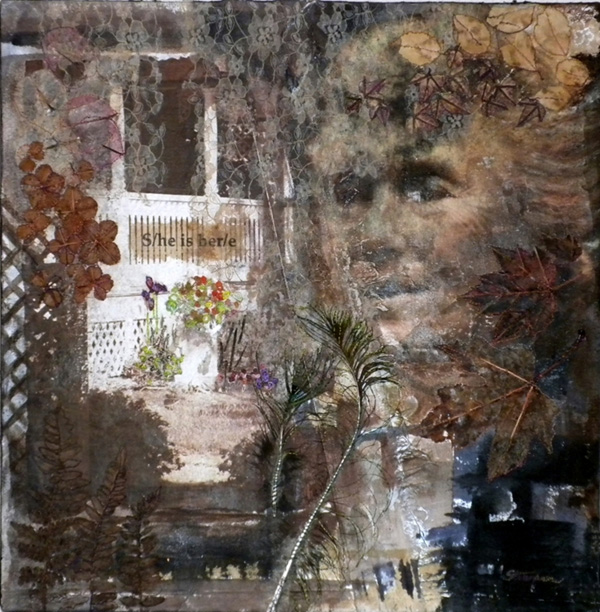
I would say that my medium is "mixed media fibre", which is a catch-all name for "anything goes." There is always a textile ground, usually distressed or re-cycled canvas or denim, and invariably some paper, usually Japanese Kozo tissue. I do use photographs in my work - but they are stripped to a certain level of translucence. I use dyes sometimes, but mostly my colours come from fabric paint, acrylic inks and acrylic paint. Depending on the subject of the piece, I may add recycled materials, and the whole is held together with hand and/or machine stitching.
What other mediums do you work in, and how does this inform your fibre work?
Interesting question! For twenty years, when asked, I have painted water-colour portraits from photographs. I don't advertise (apart from my website), I have many repeat customers as well as referrals and the income helps me pay for what I really love to do. I find that painting in water-colour (and capturing the best from a photograph while leaving out what is distracting or not appealing) keeps my design and colour-mixing skills sharp. It's also very good drawing practice.
What specific historic artists have influenced your work?
I have always loved the 17th century Dutch artists, particularly Vermeer and Rembrandt. I studied them extensively at university, where my professor (Lawrence Gowing) was an expert on Vermeer. I believe their use of colour and light and their drawing skills are still without parallel. My other favourite and significant influence would be Cezanne, who developed his own style alongside, but separate from, his contemporary French Impressionists. His technique of adding colours and other detail on top of a fairly closely sketched out work, built up his canvases in a 3D way, that was not used by any of his contemporaries. That layering technique is one I still strive to use when "balancing" a piece. His brushstrokes also remind me of various stitches! I guess these "off-the-top-of-my-head" choices show that I still think like a painter.
What specific contemporary artists have influenced your work?
I have just completed a Diploma in Stitched Textiles (Embroidery & Design) with the City & Guilds of London, UK. Over the period of study there have been several British artists whose work I have studied, but none more so than Alice Kettle and Cas Holmes. Alice Kettle (b. UK, 1961) makes monumental works in machine stitched embroidery, usually working from the back of the piece, and often using metallic threads. All her work responds to the human condition, so it has to contain depictions of the human figure, in colourful and bold strokes. I find her work lyrical and very moving, with a remarkable spirituality and respect towards humanity, even when depicting scenes of war, as in her huge piece "Odyssey" (which I have seen) which measures 82" x 175". While I rarely use human figures in my work, I do like to use shadows of them, distorting their perspective, or fracturing them in some way. My intention is to bring the human condition into the situation as a watcher, or guardian, or critic of some situation in the world.
Just as Alice Kettle does, I want my work to begin as personal, perhaps even autobiographical, but always end up expressing a universal theme. The other inspiration I get from Kettle is the urge to create ways in which my work can become larger, so that it has more impact. Cas Holmes (graduated 1983, in UK and studied in Japan) is primarily what I would call a collage artist. She approaches textiles and fibre art in the same way as she would approach any other fine art on paper form. However, the way she adds re-cycled and found objects to her work, gives it a fluidity and excitement that could not be achieved by colour on paper alone. In addition, there is always a story, evoking in me at any rate, an emotive response of pathos or poignancy, or sadness or joy, which I also get from Kettle's work. The third thing that appeals to me about Holmes' work is that the recycled and found materials she uses, also have a history of their own. The process of studying and disassembling them, adds to the narrative of each work. This is what makes her work far more than decorative, even though each piece is always pleasing to look at. Because much of her work relates to the environment around her home, this leads her to address issues of sustainable practice and our footprint upon this earth, issues which are close to my heart.
There are many contemporary North American artists whose work I particularly admire, including Dorothy Caldwell and Jane Dunnewold. I have studied with Jane Dunnewold and was fascinated by the way she adds "texture" to her fabrics without adding "layers". However, I prefer to work with paints rather than dyes, and apart from stencilling, I do not use any of her methods in my work. I appreciate Dorothy Caldwell's hand-stitched work and her use of indigo, but again, I would not say it has particularly influenced my work.
But the one who has had the most influence on my work is Fran Skiles (b.1941, BA in Clothing Design, West Virginia). Fran Skiles layers fabrics, paper, photographs, paint and other media onto distressed and repaired canvas, as she constructs each piece, or "skin". It is held together with stitching, embroidery and gloss medium, and the finished piece, unframed and with rough edges, hangs away from the wall. Her colour palette is subtle, even somber and that, combined with the complex textures and occasional sketches in acrylic ink, tell mysterious stories about Mother Nature in a thoroughly contemporary way. While her pieces don't have the narrative that Cas Holmes' works do, I find the design and surface textures very exciting.
What other fibre artists are you interested in?
I have many friends who are fibre artists, including fellow members of Connections Fibre Artists. Most live in Southern Ontario, and I appreciate looking at their latest work. However, I strive not to be too influenced by any of it, because I do not want my work to become derivative in any way. I am still experimenting and finding my voice, but when I do, I want it to be purely my own.
Tell us about your studio and how you work:
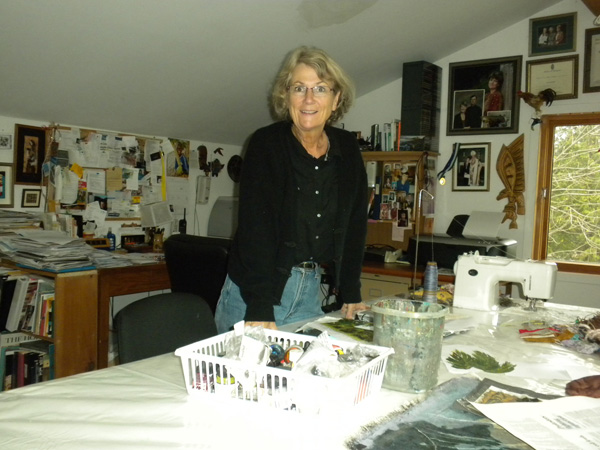
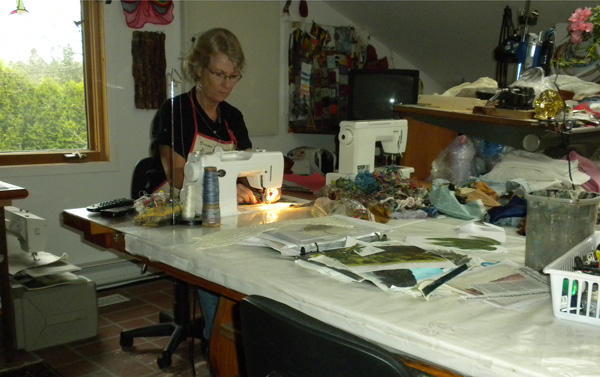
My studio covers about 500 sq ft and is located over the garage. It has skylights facing north east and it contains my computer and desk area as well as a sink area, a large table for sewing and assembly, and plenty of storage. In addition, I have used our garage (The Gallerage, or "Studio Two") for shows, and for painting large works and murals on canvas.
I try to work eight hours every day except Sunday, from 9 to 6, making up time from 7 to 9 in the evening if I have had to shop or go to a meeting during the day. I work steadily preparing for group shows, commissions, experimenting with new techniques, or writing courses or workshops.
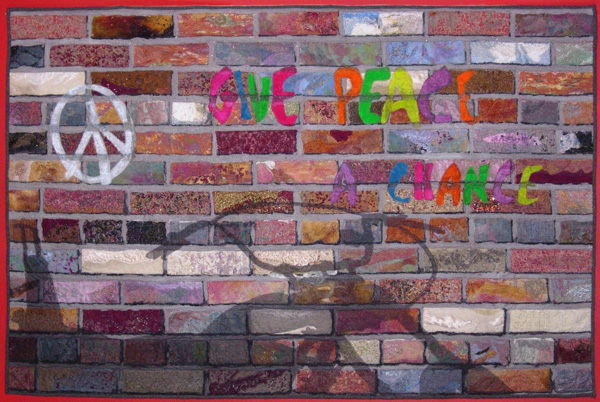
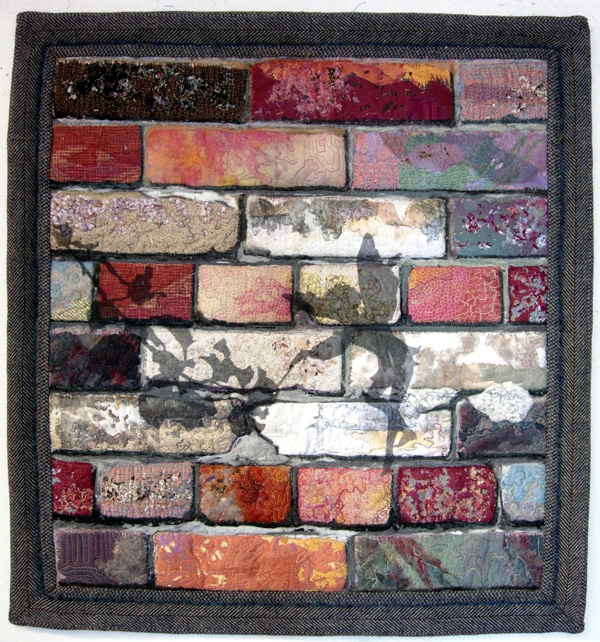
I have heard arguments that fibre art isn't one of the "fine arts"- I just disagree.
What role do you think fibre art plays in contemporary art?
I think fibre art IS contemporary art. When I am in a fibre show, I call my work fibre art; when I want to be in a "contemporary art" show I call it mixed media (and frame it in a shadow box). I think one's viewpoint depends on where one's work comes from - if it comes out of a quilting or stitching background, describing it as art seems to be an uphill battle, working against being a "craft". If one comes out of an art background, it is a new and bold example of contemporary art, just as Oldenburg's "Soft Toilet" was in 1966, or Betty Goodwin's recycled parachutes and Prisoner of War uniforms around about the same time.
I have heard arguments that fibre art isn't one of the "fine arts" (for example in Florence in 2003) - I just disagree and say that, on the contrary, it is on the leading edge of contemporary art, and people should buy it while it is still affordable.