Artist Interview 136: Jacqueline Royal
Ballston Spa, New York, USA
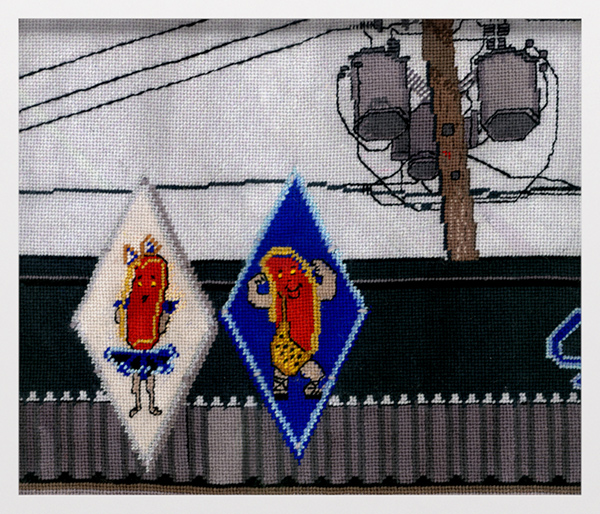
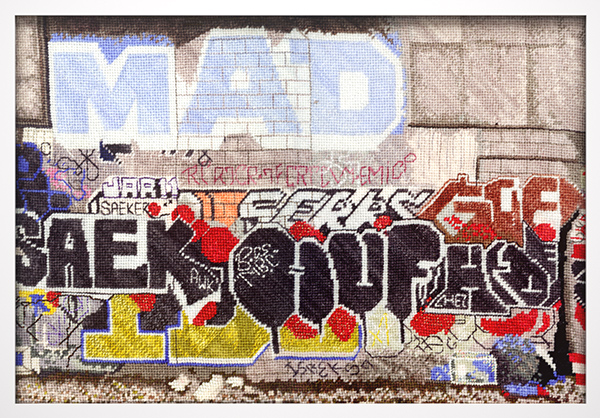
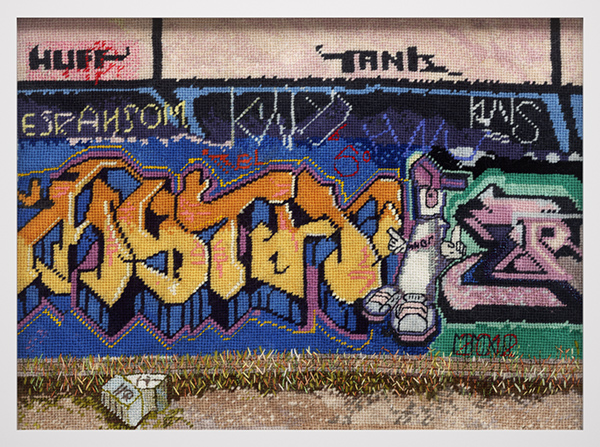
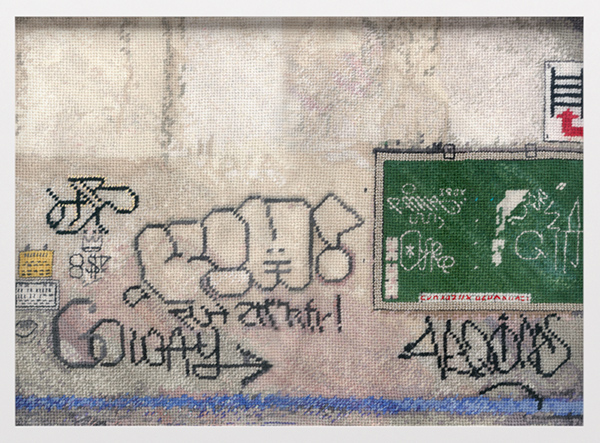
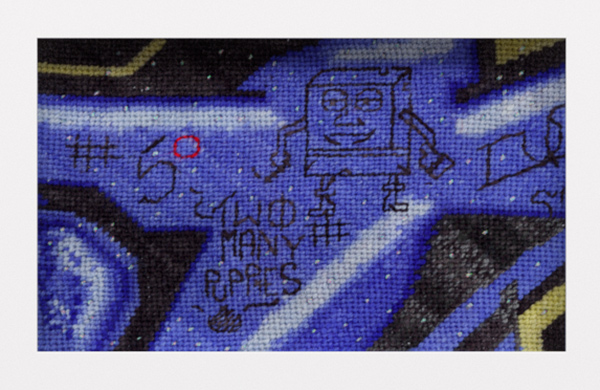
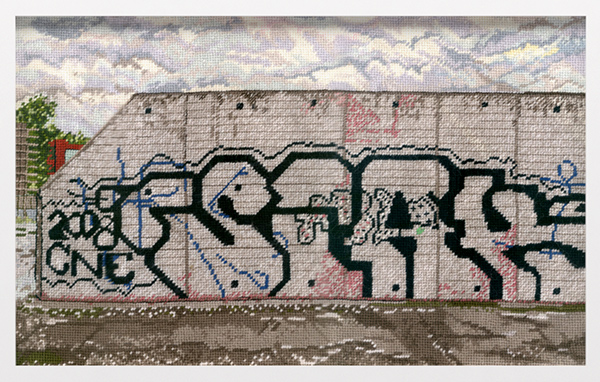
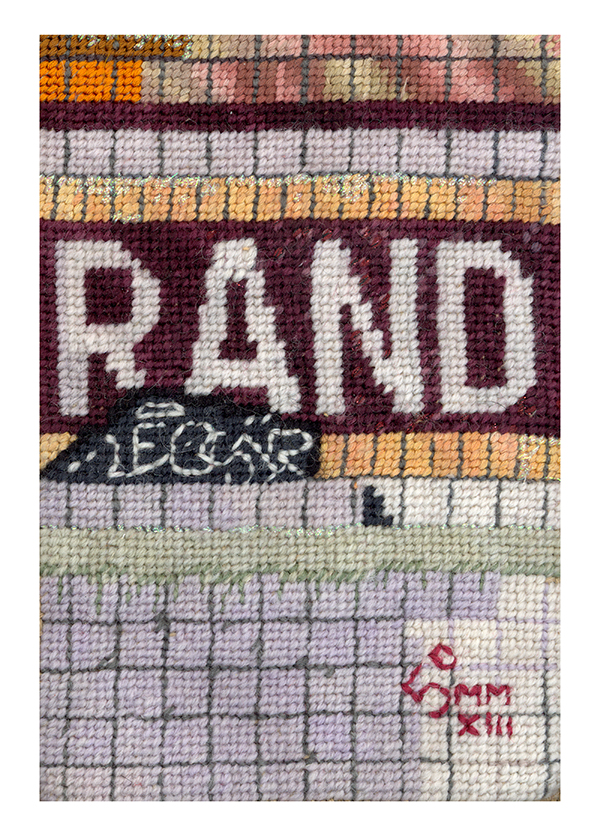
Jacquelyn's work can be described as needlepoint graffiti. Photographs of areas in decline are taken by an architect she knows, who travels for his work. In the midst of dilapidation and despair, inspiration sparks and a vibrant artwork blooms. Nowadays, graffiti has become an acknowledged art form in itself. She is challenged by the idea of the juxtaposition of two such diverse art forms, by two such diverse kinds of artists, coming together and each enhancing the other in an unexpected way.
Tell us about your work:
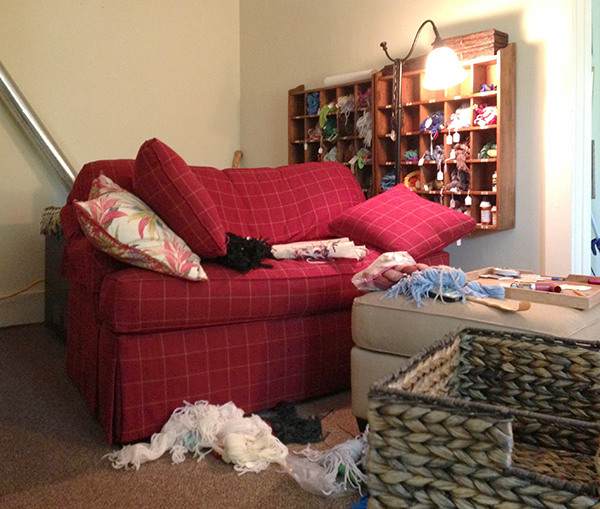
Simply put, I needlepoint. I am always adding to my stash of needlepoint yarns. I have a wall in my studio with a lot of little cubbyholes and I sort the yarns by colour and put them there. They are always in my sight and I find that kind of intimate living with them very useful. On my iPad I have a large folder of graffiti photographs from colleagues who add to this collection. I spend a lot of time looking at them, pulling out some colours that might be interesting, trying to uncover the uniqueness in each photo. I only work on one project at a time. I find it wastes energy to direct my attention sewing more than one canvas at a time. However, as problems are solved on one canvas, I am thinking about the next and soon I am collecting colours in anticipation of beginning a new canvas.
Previous World of Threads Exhibitions
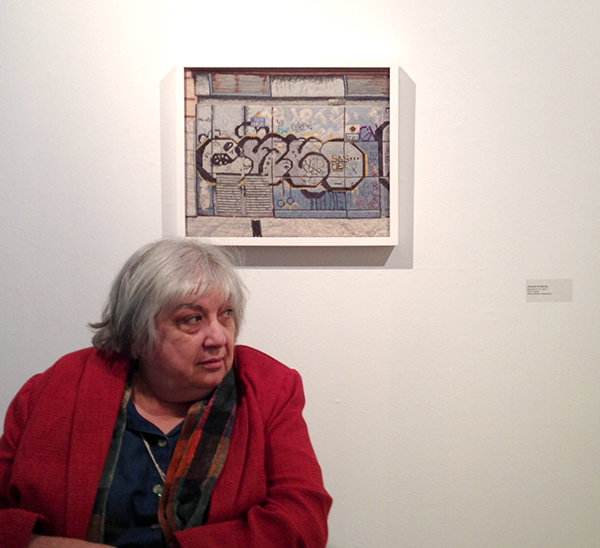
Jacqueline Royal exhibited in Festival 2014 exhibition strung out and undone.
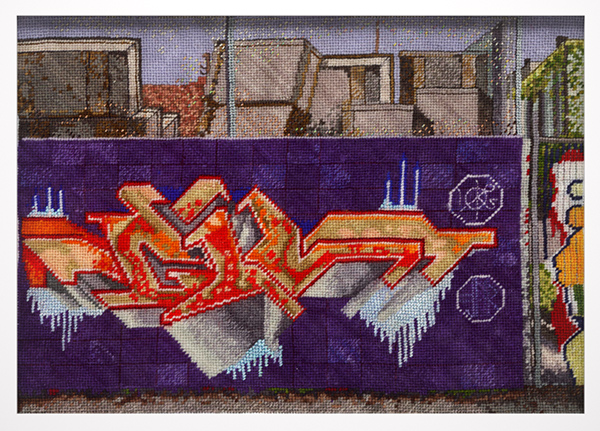
I was challenged by the idea of the juxtaposition of two such diverse art forms...
How did the idea emerge and evolve to adapt your work to a graffiti format?
Although I have been needlepointing since 1970, my use of graffiti in needlepoint evolved about three years ago when I was inspired by the work of an architect who has some interesting ideas about the organic nature of a city and its buildings and the important part graffiti writers play in this evolution. He showed me some photos he had taken of graffiti and I expressed interest in reinterpreting them in needlepoint. I was challenged by the idea of the juxtaposition of two such diverse art forms by two such diverse kinds of artists coming together and each enhancing the other in an unexpected way.
For your “urban needlepoint” studies, did you travel to the places and take the pictures yourself, or how/where did you come by the photographs?
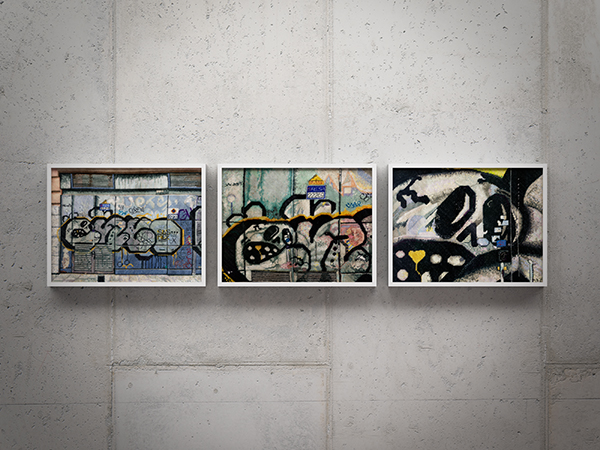
I do not take the photos myself, but rather use the photos of an architect who travels in his work. While in these places, he visits areas in decline and takes pictures of these blighted environments. The photos he takes seek not only to describe the dystopian ruins, but also the graffiti that exists there. To me, that is the most exciting part. In the midst of overwhelming dilapidation and despair, a building, which seems to have outlived its usefulness, inspires an anonymous person, an “outsider” if you will, and the most vibrant, beautiful artwork blooms.
I start throwing yarn on the floor ...
Explain the process you go through to create one of your graffiti pieces:
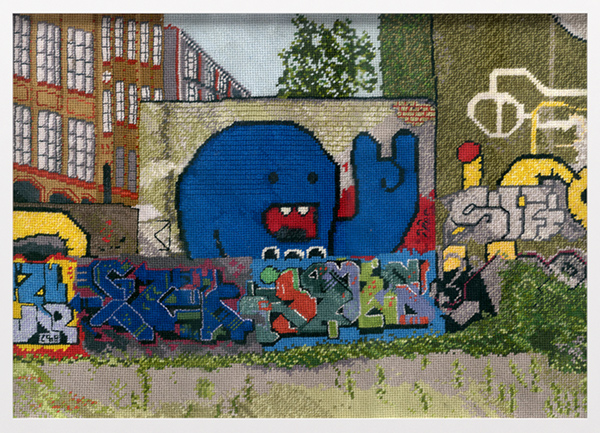
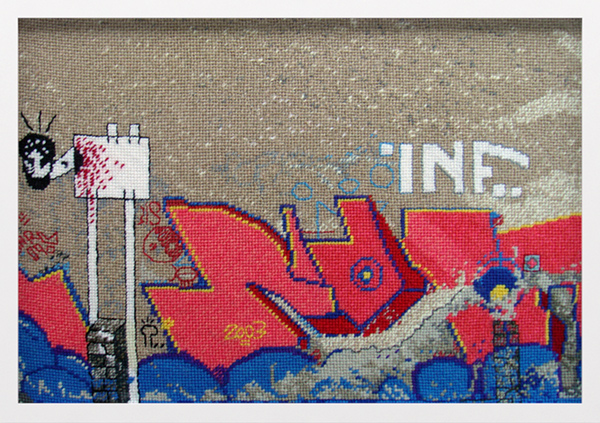
I once watched an artist work. He would come to the studio every day bringing with him a diet soda and the New York Times crossword puzzle. He sat on this old pink faux leather office chair in the middle of the studio. After drinking the diet soda and working the crossword puzzle, he would, he told me, continue to sit on the chair and stare at the blank canvas on the wall until a painting appeared. Then he would get up from the chair and start painting. This was a startling idea to me, but now I find myself doing something similar. I study my folder of photographs over and over until one picture pops out at me, I start throwing yarn on the floor and at some point the pile of yarn looks like the photo and I start sewing.
Why did you pick those studies?
I believe the process takes control and picks itself in a way. The results of this largely unwitting and unexpected act allows the process to take on a life of its own and become art. Each project is for me the resolution of a problem and I allow myself to listen to the work itself for the answer.
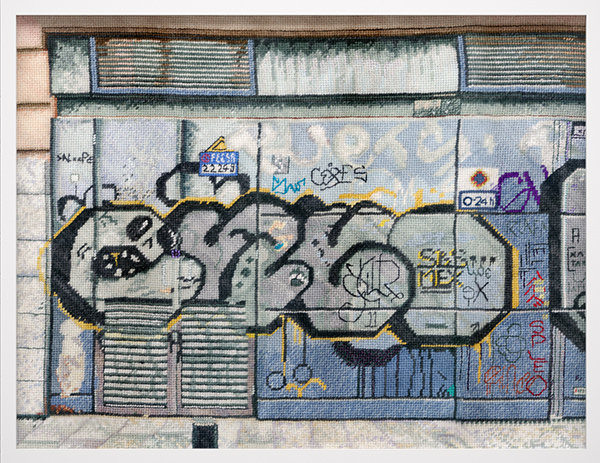
Of course each piece is part of the larger picture, the degradation of the immediate surroundings.
When I look at your pieces, to me most come across as ‘refined’, like newly painted wall graffiti. Have you ever considered creating with a more ‘weathered’ approach?
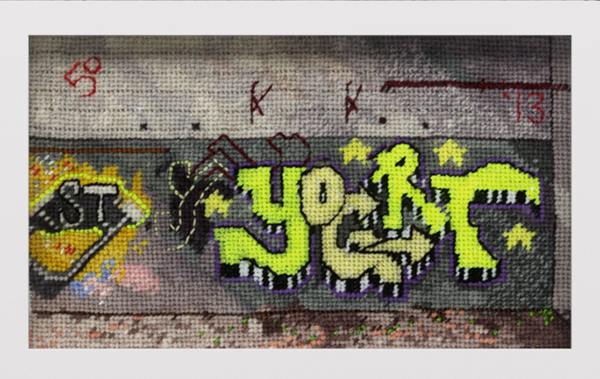
Evoking feelings in one’s audience is a primary goal of all artwork.
Are you attempting to evoke particular feelings in your audience?
Evoking feelings in one’s audience is a primary goal of all artwork. My interest lies in the manipulation of textiles in the service of subverting popular notions about the medium, needlepoint, and my chosen subject matter, graffiti. In my series of urban needlepoint studies, I have sought to shed new light on urban blight by translating its compositional and textural properties to a folk medium with little history for embracing dystopian ideas. It is my hope that this juxtaposition will transform the audience’s perception of both graffiti and needlepoint and help them to see true beauty in what would otherwise be dismissed as banal.
Socrates stated that the unexamined life is not worth living. Many go through life conforming to the ideas that society has imposed upon us, ideas that define for the norm what is good and right and what is corrupt and erroneous. So it is with graffiti. It deserves a closer inspection, revealing a visceral art form using colour and design elements in unique ways. By combining these elements with an art form with a more gentile sensibility, I hope for the observer to see this in graffiti while bringing a new vitality to the process of needlepoint.
You say that you liken your work to a pointillist painter. Tell us about that:
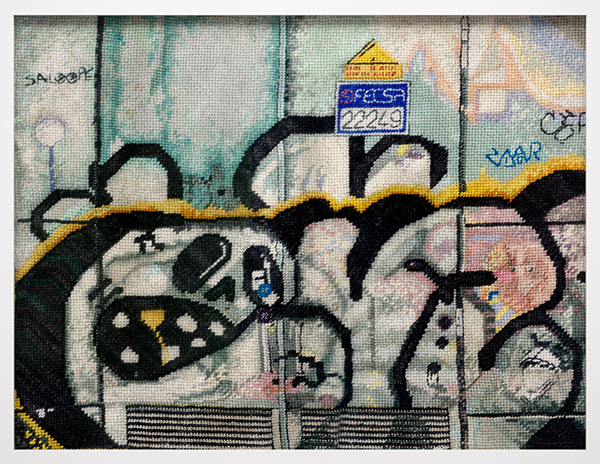
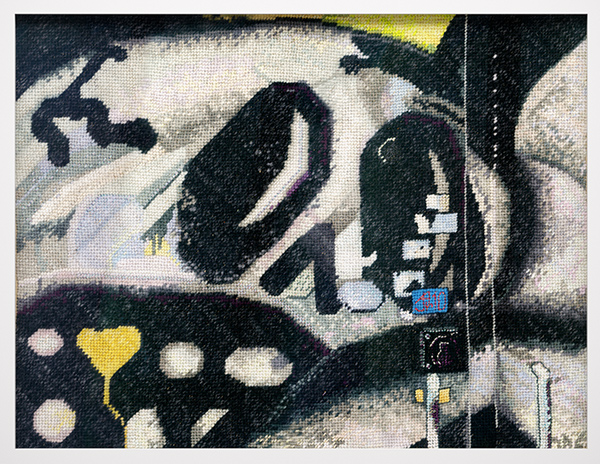
Pointillist painters (Georges Seurat, Vincent van Gogh, Camille Pissarro) use the same technique used in needlepoint, that is, small dots of colour to create larger fields. This technique relies on the mind of the viewer to blend colours into a fuller range of tones. The sky in Tokyo 2 is a good example of this. I could not find a colour that was exactly what I wanted so I took 8 colours of blue and blended them on the canvas to give the effect of a sky at dusk. The wall in Tokyo 1 is another example. It is a white wall that took 16 shades of white.
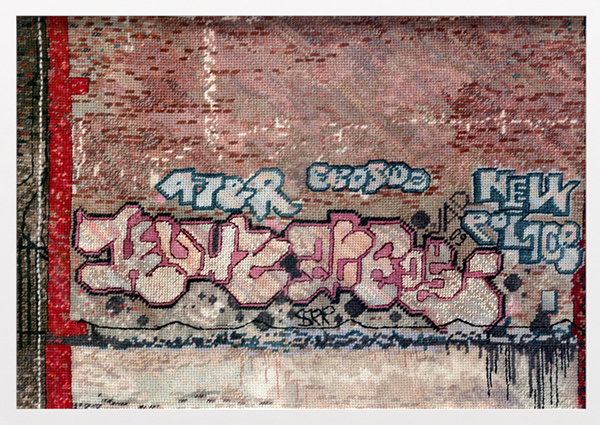
Graffiti was in the not too distant past considered in the same way – an annoying disfigurement on the pristine creations of a city.
Graffiti is considered something scribbled, scratched or sprayed illicitly on a wall or surface, often in a public space ranging from simple written words to elaborate wall paintings. Discuss the similarities/differences between today’s graffiti with the examples of wall art from Ancient Egypt, Greece and the Roman Empire.
Years ago, archeologists among others, considered graffiti as unimportant, the idle ramblings of vandals, something scribbled, scratched, or sprayed illicitly on walls, as you say. But of late, scholars have taken a second look at this work and have come to believe these random acts can tell us much about intimate details of the life of a society. Graffiti was in the not too distant past considered in the same way – an annoying disfigurement on the pristine creations of a city. Recently graffiti has come out into the light and is seen by many to be an important art form created by those we consider to be the “others” or “outside artists”. In fact, it is popular to repurpose graffiti as a commercial tool, taking it out of its natural environment somehow robbing it of some of its vitality. It is my hope that by re-describing this art for what it is, the importance of graffiti in the recasting of blighted environments will be revealed.
After many years of perfecting any “craft,” a person’s work transcends to another level and that is when it becomes art I suppose.
Do you consider yourself an artist, a writer or a craftsperson?
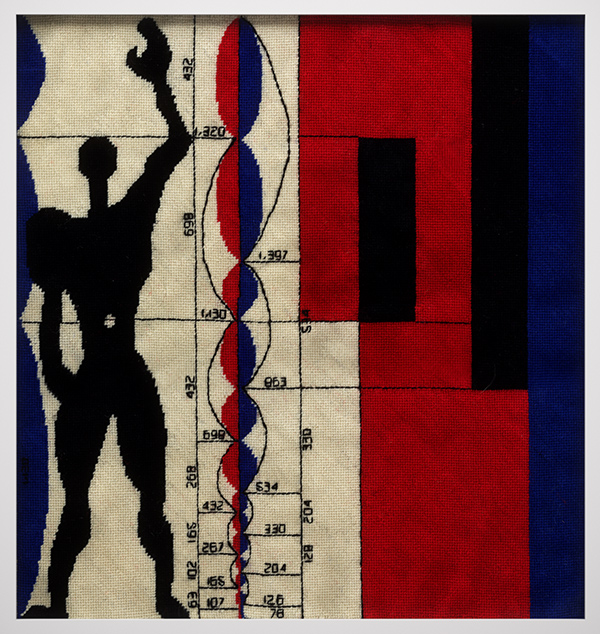
I initially never associated any of these labels with me, or my work. For many years, I just liked handling needlepoint yarn and canvas, seeing the way the colours looked when you filled in all the little holes on the canvas, watching the way the colours danced across the canvas especially where the areas of colour came together. I became interested in using more and more complex arrays of colours and designs. I am embarrassed by how many pillows I inflicted on my family. After many years of perfecting any “craft,” a person’s work transcends to another level and that is when it becomes art I suppose.
Graffiti writers inhabit a world of anonymity and feel the need to create beauty where none is expected.
Do you do any other type of art?
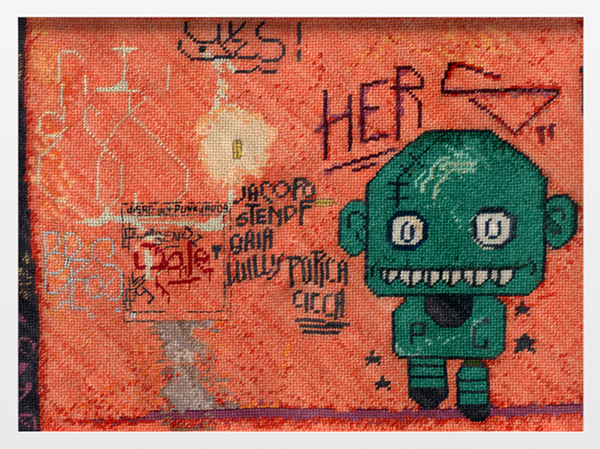
In the past, I worked as a quilter. I had a small business outside Atlanta, Georgia, where I created wall hangings and clothing reinterpreting traditional quilt patterns and techniques. The same thing that fascinates me about graffiti fascinated me about quilting. Both these art forms belong to an under studied, under documented group of artists whose motivation for their work comes from inside themselves. They function for the most part in isolation, are largely untrained, and their use of colour and design therefore is unique and vibrant. Early American quilters were women making objects out of necessity but quilters transcended the realm of the mundane and saw beauty where none existed nor was required to add to the functionality of the item. Similarly, graffiti writers inhabit a world of anonymity and feel the need to create beauty where none is expected.
What exactly is it about graffiti that fascinates you?
Graffiti is an understudied, under documented form of art created largely by outsider artists. It is something that until recently has been the victim of eradication in various forms, and I feel it needs to be documented and preserved as an art form.
Are you only working in graffiti now? And as you have a large collection of photographs on graffiti how long do you anticipate working in this way?
I do indeed have a large collection of photos from many different places and like Monet, I have done a number of studies of one photo. I cannot say how long I will work this way, I suppose for as long as it speaks to me. n the past I have done studies of buildings and that was very interesting. You might say that the graffiti studies came from that, kind of a close-up shot of a building.
What specific historic artists have influenced your work?
I am inspired by two kinds of people. There are those who look at the ordinary and see the extraordinary. These people take ordinary things and moments and translate them into something extraordinary and inspiring. These people open new worlds for us, capturing beauty in a very dystopian world. Through this I have come to see graffiti not as a separate entity but as part of the living, evolving environment in which it exists.
The other kind of person who inspires me is the artist whose work ethic finds him in the studio painting just because he is a painter, no other reason. He paints from inside himself, always keeping true to his own personal vision, undaunted by trying to “find” an audience, and in refusing to be swayed, thereby along the way creating an audience for himself. I have great admiration for a painter who has an ability to combine colour and form into a dynamic mix, which is ever changing, revealing itself anew to the viewer every day.
Are their any other people who inspire you?
I spent three years living in a tree house in the North Georgia mountains and it was there I came to be an admirer of the writer and philosopher Henry David Thoreau. He starts the essay “Walden” with “I went to the woods because I wished to live deliberately, to front only the essential facts of life and if I could not learn what it had to teach, and not when I came to die I discovered that I had not lived.”
People like Thoreau who think and consider life outside themselves inspire me.This is what draws me to graffiti. It is an art of solitary people who create because where we see the ordinary, they see the extraordinary - people with a different vision for the wall.
I truly admire people who create for no other reason than they are compelled to do so.
In a previous interview you mention that people who created religious icons in the 12th and 13th centuries were not called painters, but writers. Please elaborate on that:
In a broader definition, graffiti is an icon, an image that has some well-known significance for a group of people, something of greater significance than the literal meaning. It is interesting to note that people who created religious icons in the 12th and 13th centuries were not called painters, but writers because they felt that what they did came not from them but from the divine. Creators of graffiti also call themselves writers perhaps because they see themselves as being used by something outside themselves to create their art. In their own words graffiti writers confess what they do is feeding their addiction and they can't stop despite the legal and health hazard of their profession. I truly admire people who create for no other reason than they are compelled to do so.
What do you consider to be the key factors to a successful career as an artist?
First you must define for yourself the word “successful.” When you come to terms with the idea that your level of success should not be measured by how much you sell or by the valuation of others, then you can discover your success. We could look through history and list many important artists who did not sell work while they were alive, whose success came only when people could see their work from a distance, taking time not to see the person’s vision merely on the surface but to peel back the layers and see the true meaning. Once you get past this, you can begin to create work from your own heart and it will take on a new significance.
Is there a particular art related book that you refer to on a regular basis or from which you draw inspiration?
There are many books in which I find inspiration. However, none of them are art books. I find inspiration in nineteenth century writers like Henry David Thoreau, Herman Melville, and Leo Tolstoy. Their rich descriptive style is like painting and filled with colour for me.
What interests you about the World of Threads Festival?
This festival is a collaboration among artists from all walks of life and many countries. They work in many different media. The thing that interests me most about this group of people is that like myself, many of them are expatriates from a different life. On the whole they have a broader life experience outside their art community. Many of them participate in the world with charitable work incorporated into their artistic activities, and after all, is it not the purpose of art to bring beauty into the lives of all, not just those of us who frequently museums.