tilleke_background

World of Threads Festival

Artist Interview 89: Tilleke Schwarz

Pijnacker, The Netherlands

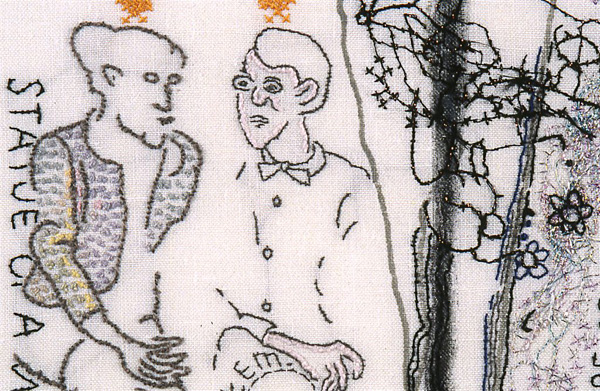
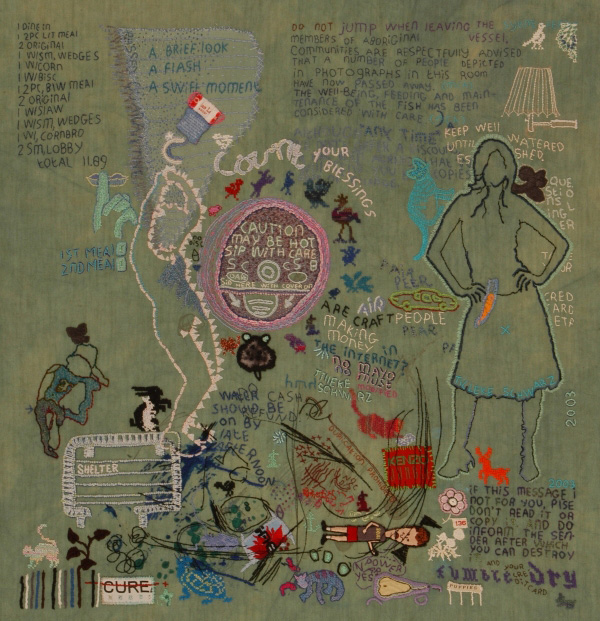
Tilleke’s work looks like finely stitched graffiti and is very suitable for communicating emotions. Including anything that moves, e.g. daily life, and/or mass media, resulting in a mixture of content, graphic quality and fooling around, the viewer is invited to decipher connections or to create them.
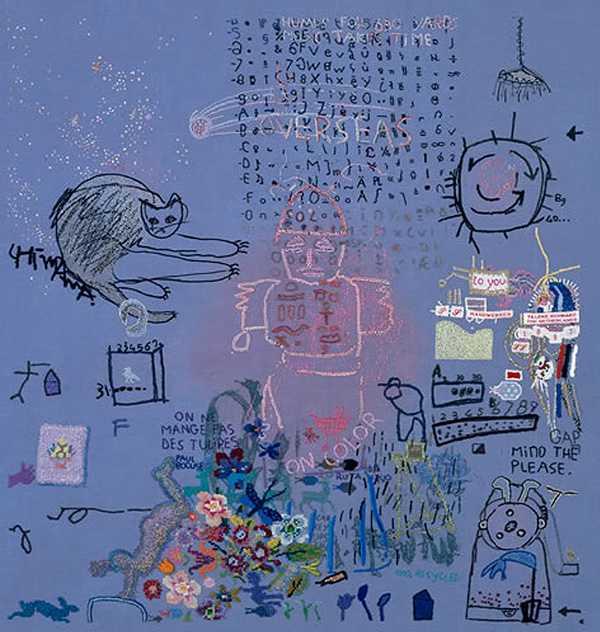
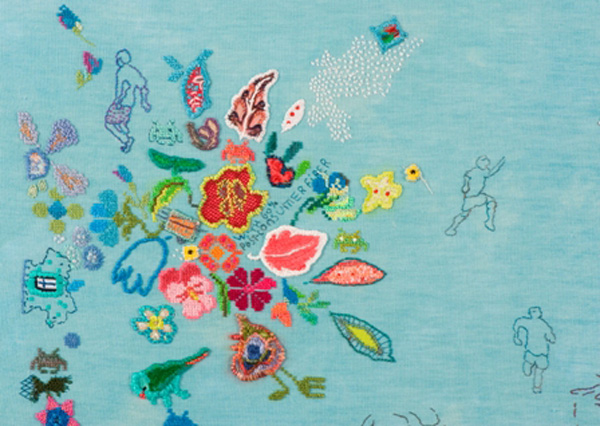
On colour, hand embroidery on fine linen (50 count, evenweave) with a variety of fine threads (cotton, silk, rayon, polyester, metal). 75 x 71 cm. Photo: Rob Mostert.
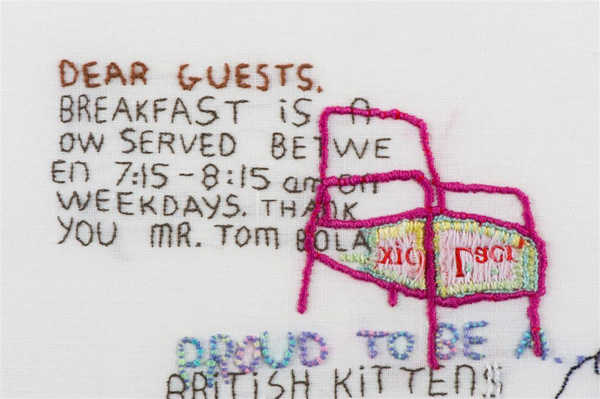
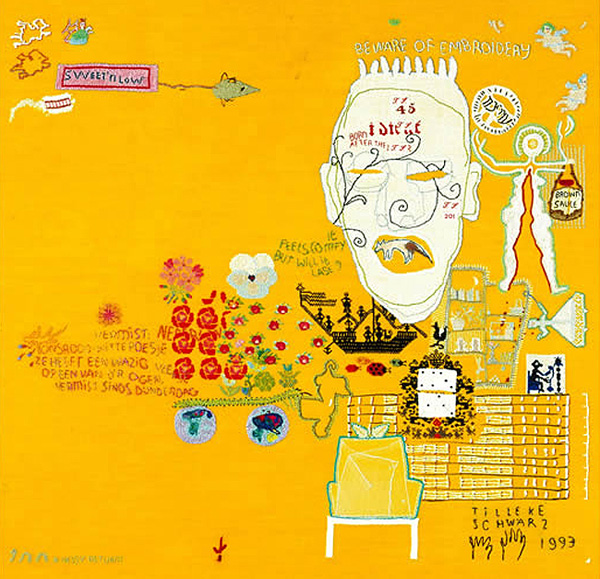
Beware of embroidery, hand embroidery on fine linen (50 count, evenweave) with a variety of fine threads (cotton, silk, rayon, polyester, metal). 70 x 65 cm.Photo: Rob Mostert.

Tell us about your work?

I am an artist and I make hand stitched embroidery pieces (for the wall). My works are a kind of "map of modern life" and look like finely stitched graffiti. I include anything that moves, amazes or intrigues me. For example, daily life, mass media, traditional samplers and cats are all major sources of inspiration. The result is a mixture of content, graphic quality and fooling around. The work could be understood as a kind of visual poetry.

My work contains narrative elements. Not really complete stories, with a beginning, a storyline and an end. On the contrary, the narrative structures are used as a form of communication with the viewer. The viewer is invited to decipher connections or to create them. The viewer may assemble the stories and produce chronological and causal structures. Actually the viewer might step into the role of the "author". It can become a kind of play between the viewer (you!) and me. The sense of humour is typical of my Jewish background: a mixture of a laugh and a tear.

I love textiles because of the tactile looks. Textile generally has a more intimate relationship with the viewer and is very suitable to communicate emotions.
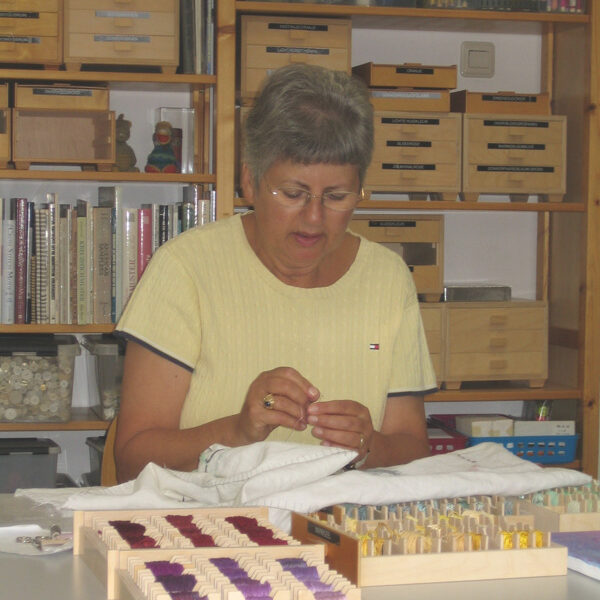
Artist: Tilleke Schwarz.

Where do you get your inspiration?

Everywhere and anywhere! I collect images and texts that intrigue, move or amaze me. Anything can inspire me. Most important are: folk art (especially samplers), cats, daily news and scraps of textiles. Mostly my parents and the way I was brought up influence me. I love folk art (especially Dutch samplers), Pop art, graffiti and contemporary art (after 1980).
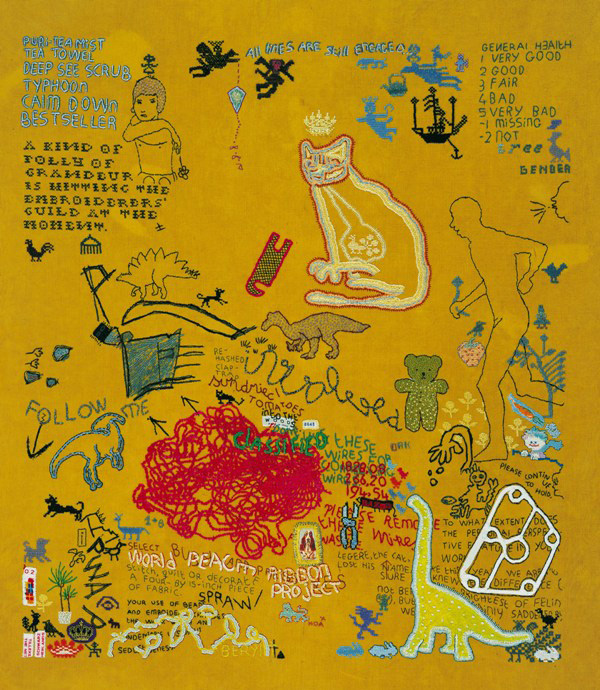
Into the woods, hand embroidery on fine linen (50 count, evenweave) with a variety of fine threads (cotton, silk, rayon, polyester, metal).74 x 66 cm. Photo: Rob Mostert.

What specific historic artists have influenced your work?

A lot of art inspires me, but that does not show in my work. Folk Art and especially traditional samplers from all countries inspire me. Mostly girls and women make these, but I do not know their names.
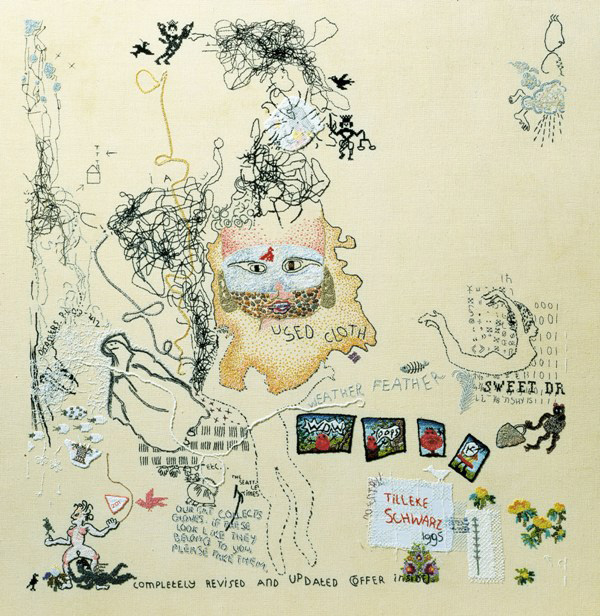
Used cloth, hand embroidery on fine linen (50 count, evenweave) with a variety of fine threads (cotton, silk, rayon, polyester, metal).75 x 70 cm. Photo: Rob Mostert.

What specific contemporary artists have influenced your work? 

I like the Pop Art movement, graffiti and the Fluxus Movement and I am interested in contemporary art (after 1980). ). Sometimes an inspiring work stays on my mind for many years, like the project Nerhagan from 1994 by Finn Aage Andersen and Wenche Kvalstad Eckhoff from Norway. They preserved an old farm by protecting the outside with old and new pieces of wood and inside they covered the floor with potatoes. When the potatoes shot out, the floor had a beautiful 'carpet' of purple sprouts.  Another example is a video by Snezana Skoko from Serbia (1995). It shows a performance of a group of woman in a cellar in Belgrade tearing pieces of cloth apart. It was during their war.
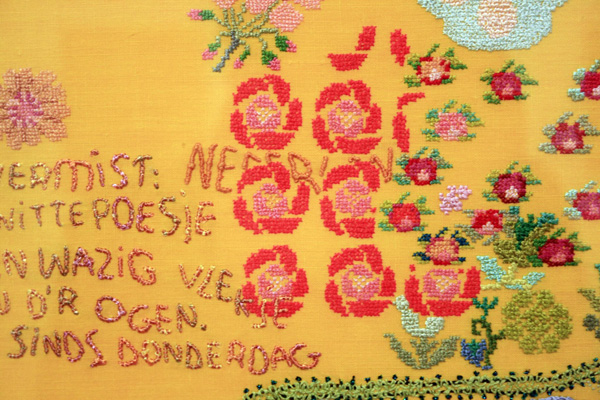
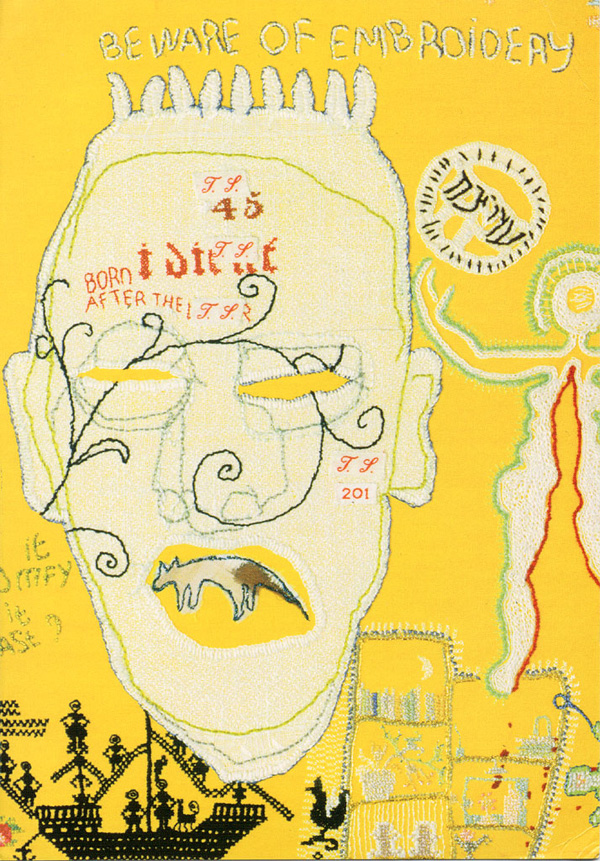
Beware of embroidery, hand embroidery on fine linen (50 count, evenweave) with a variety of fine threads (cotton, silk, rayon, polyester, metal). 70 x 65 cm.Photo: Rob Mostert.
Detail: Beware of embroidery.

Why did you choose to go into fibre art and how did you decide on this medium?

I did not really rationally choose textiles, but just love the material, the feel as well as the looks.
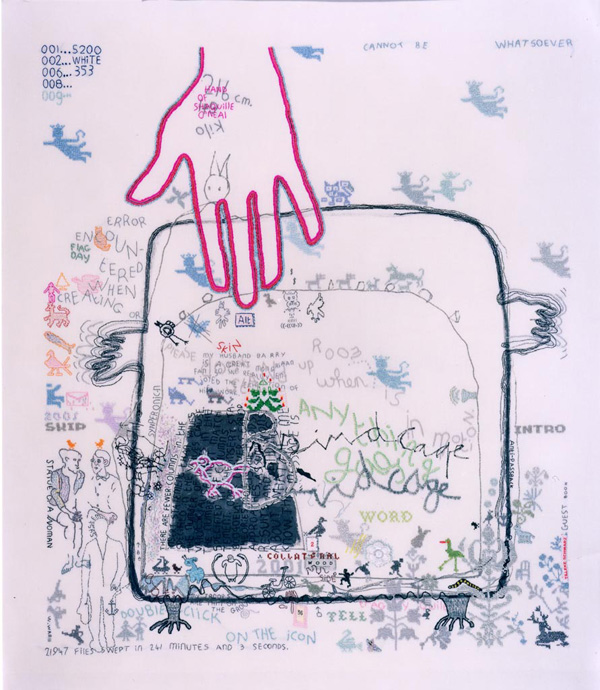
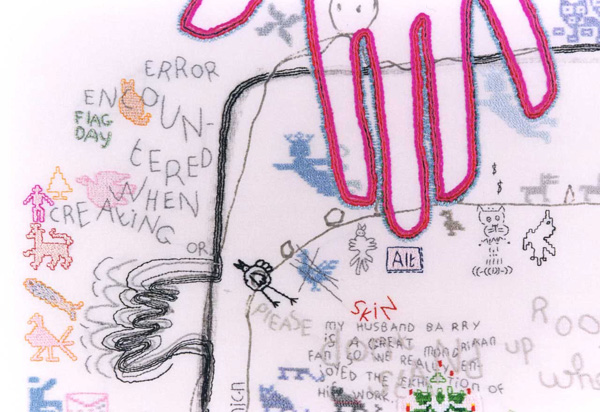
Birdcage, hand embroidery on fine linen (50 count, evenweave) with a variety of fine threads (cotton, silk, rayon, polyester, metal). 74 x 67 cm. Photo: Rob Mostert.
Detail: Birdcage.
Detail: Birdcage.
Detail: Birdcage.
Detail: Birdcage.

When did you first discover your creative talents?

I did not discover something. I have always made drawings and embroidery, from early childhood on. Some of my family also has this interest / talent so I assume it is in our genes.
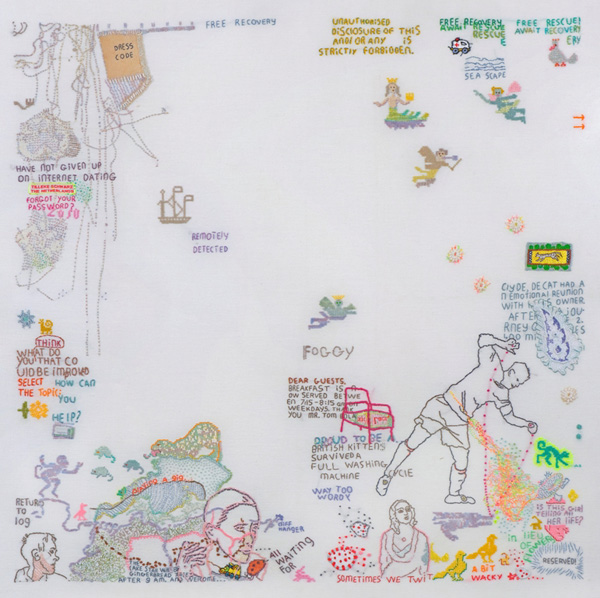
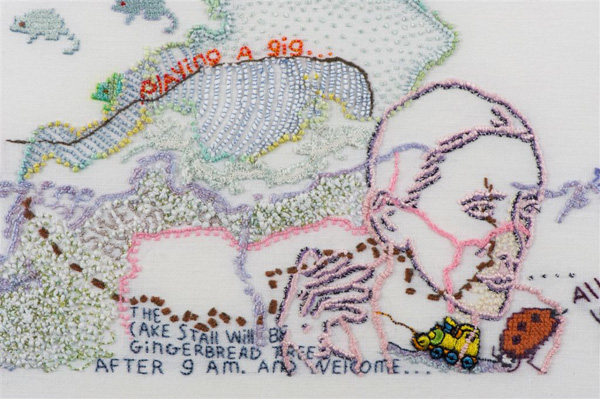
Free Recovery., hand embroidery on fine linen (50 count, evenweave) with a variety of fine threads (cotton, silk, rayon, polyester, metal). 68 x 66 cm. Photo: Rob Mostert.
Detail: Free Recovery.

Please explain how you developed your own style.

This was not a planned or logical process, so it is hard to answer this question. However, I had an art training and did a lot of model drawing and that helped for my sense of composition.
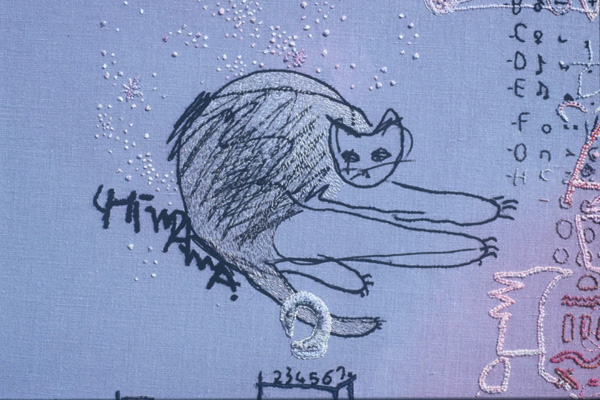
On colour, hand embroidery on fine linen (50 count, evenweave) with a variety of fine threads (cotton, silk, rayon, polyester, metal). 75 x 71 cm. Photo: Rob Mostert.
Detail: On colour.
Detail: On colour.

Is there something/someone in your life, which has influenced your art?

My mother deserves the most credit, as she was an inspiring role model. She always used to stitch tablecloths and pillowcases and she always supported what I was creating.
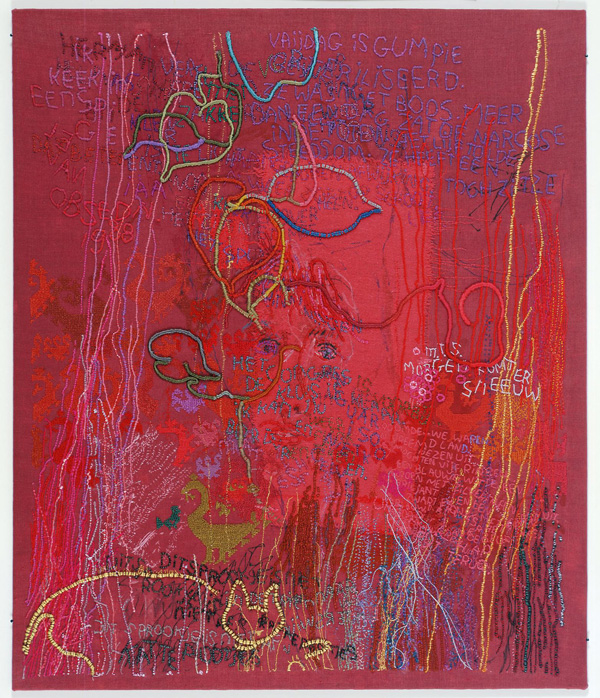
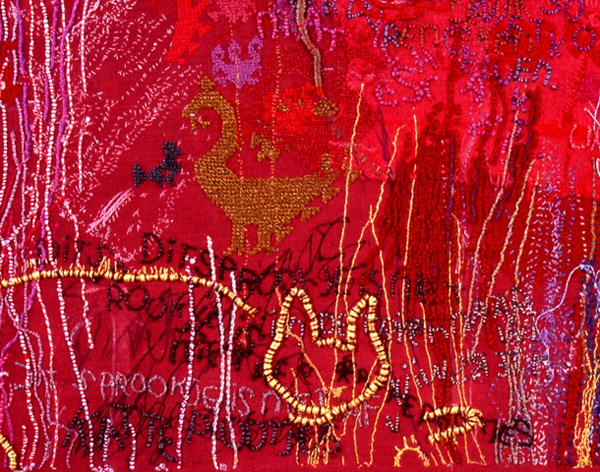
Red, hand embroidery on fine linen (50 count, evenweave) with a variety of fine threads (cotton, silk, rayon, polyester, metal). 50 x 60 cm. Photo: Rob Mostert.
Detail: Red.
Detail: Red.

What do you see as the biggest challenge facing fibre artists?

I do not have many specific any thoughts on this matter, as I do not consider fibre artists very different from any other artist. All artists struggle for an income and for recognition. Many fibre artists are females and like all female artists, they also have difficulties in combining their art with earning an income and taking care of their kids.
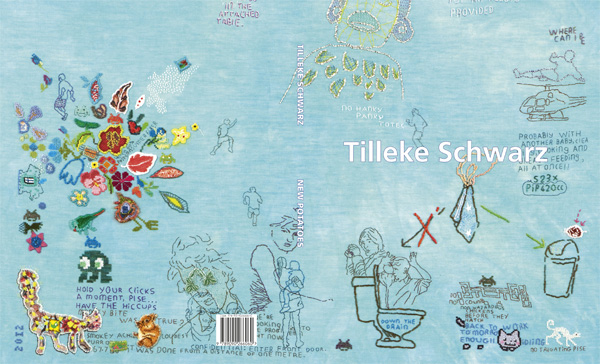
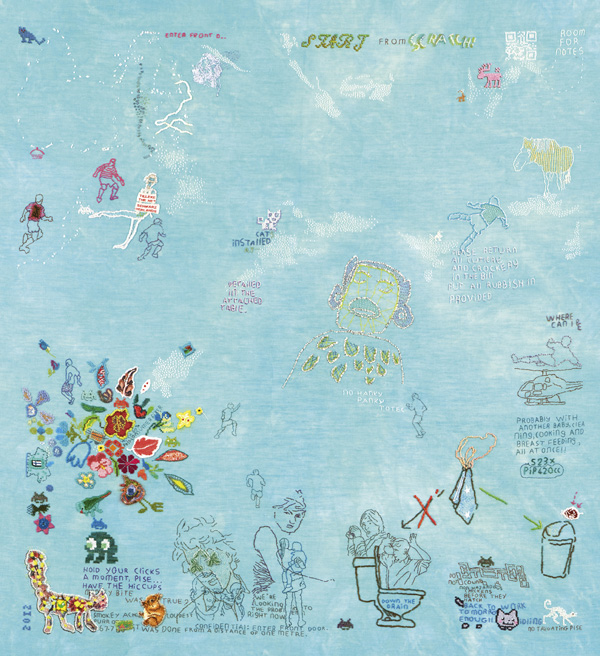
Book cover New Potatoes..
Scratch., hand embroidery on fine linen (50 count, evenweave) with a variety of fine threads (cotton, silk, rayon, polyester, metal). 78 x 70 cm. Photo: Rob Mostert.
Detail: Scratch.
Detail: Scratch.

Have you experienced fluctuations in your productivity through the years?

YES. When I combined my stitching with a paid job (policymaker for the Dutch government) I only made one piece a year. Now I am on an early pension and I can produce more (usually two or three in a year). So I am proud to inform you that I doubled my production.
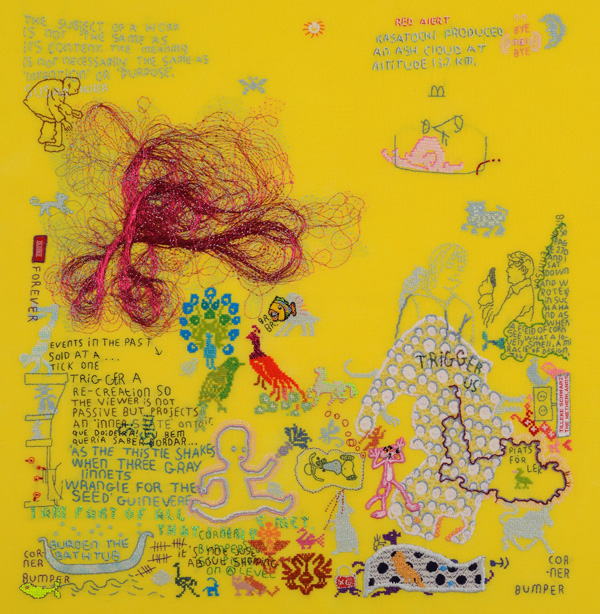
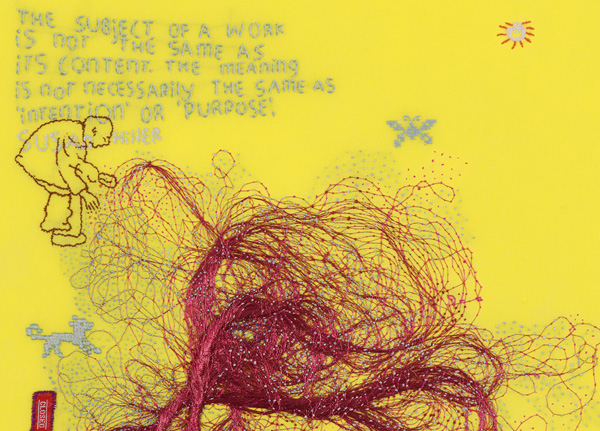
Playground., hand embroidery on fine linen (50 count, evenweave) with a variety of fine threads (cotton, silk, rayon, polyester, metal). 55 x 51 cm. Photo: Rob Mostert.
Detail: Playground.
Detail: Playground.

Through your art, are you attempting to evoke particular feelings in your audience?

Not really. I just enjoy showing some oddities in our modern life.
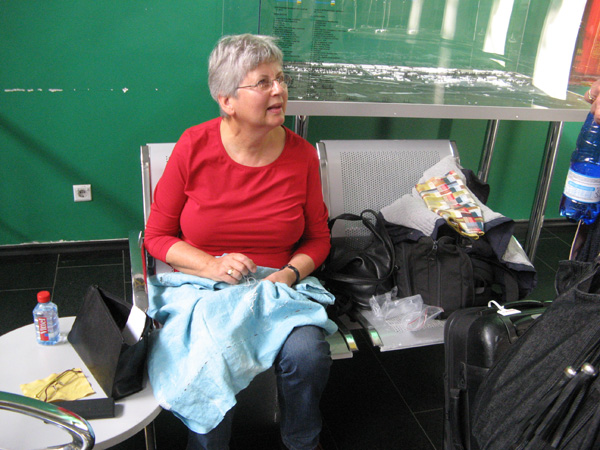
Stitching at the airport in Vilnius in Lithuania. Photo: Iveta Mihalikova.
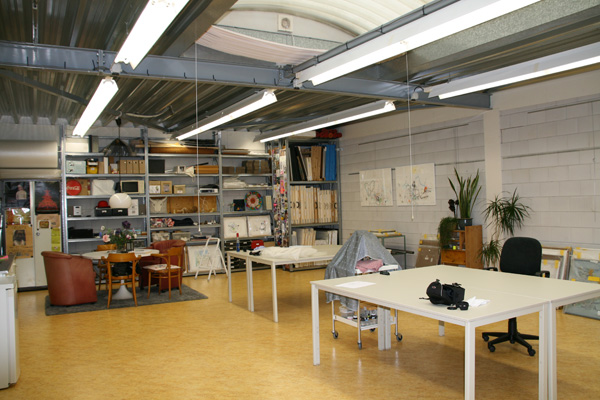
Main studio Tilleke Schwarz. Photo: Tilleke Schwarz.

Tell us about your studio and how you work:

I do have a studio at home and a larger one in a separate building nearby. The larger studio is for drawing and packing and storing my work. I can also teach workshops over there. The smaller one is for my books, threads and administration. I like to stitch everywhere. I just work on one piece of linen at a time and do not use a hoop or a frame. I like to stitch in the living room, or outside in the sun and even in an airplane on a long flight.
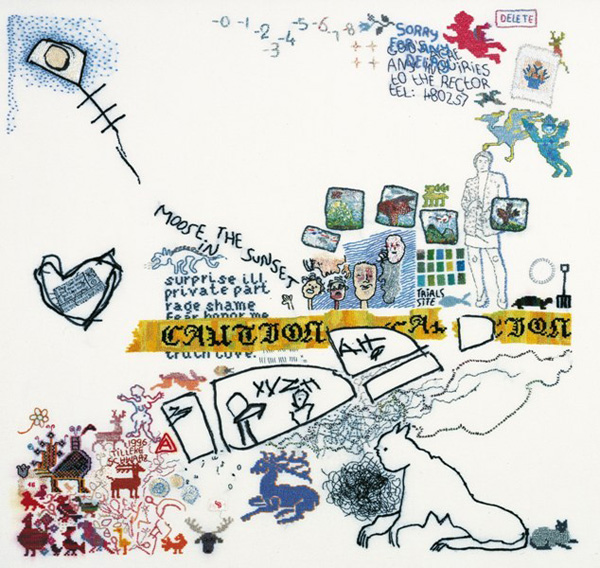
Moose in the sunset, hand embroidery on fine linen (50 count, evenweave) with a variety of fine threads (cotton, silk, rayon, polyester, metal).75 x 70 cm. Photo: Rob Mostert.
Count your blessings., hand embroidery on fine linen (50 count, evenweave) with a variety of fine threads (cotton, silk, rayon, polyester, metal). 67 x 64 cm. Photo: Rob Mostert.

What interests you about the World of Threads festival?

An exciting group of mutual spirits!!!
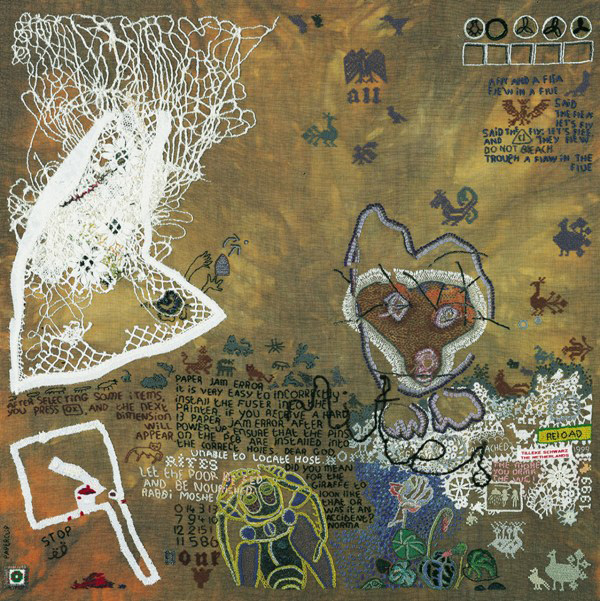
Rites., hand embroidery on fine linen (50 count, evenweave) with a variety of fine threads (cotton, silk, rayon, polyester, metal). 65 x 65 cm. Photo: Rob Mostert.
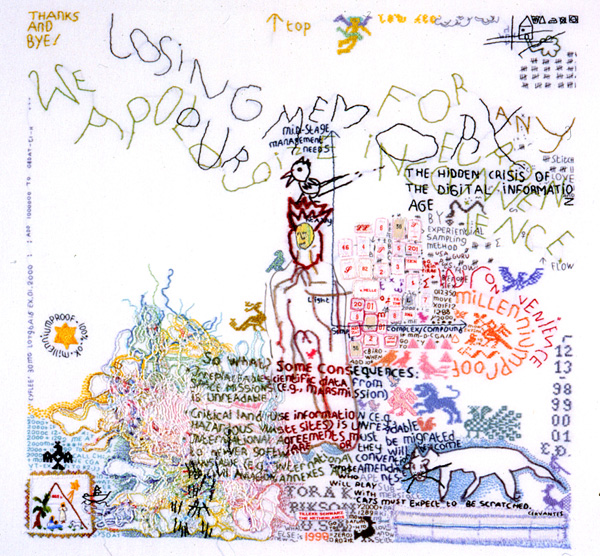
Losing our memory, hand embroidery on fine linen (50 count, evenweave) with a variety of fine threads (cotton, silk, rayon, polyester, metal). 65 x 64 cm. Photo: Rob Mostert.

Dawne Rudman