Artist Interview 81: Alice Vander Vennen
Cobourg, Ontario, Canada
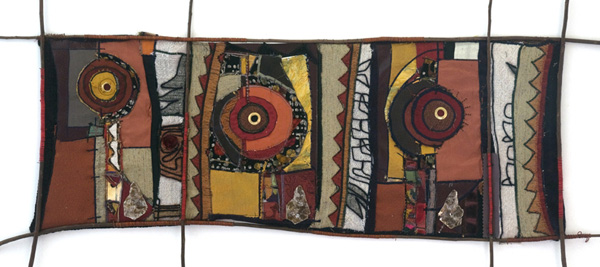
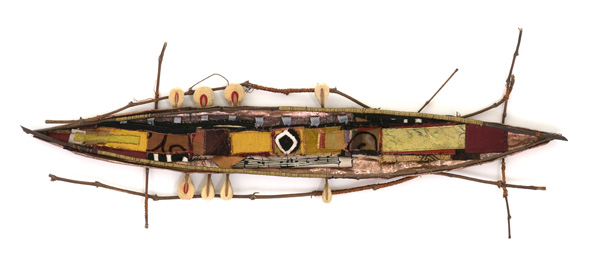
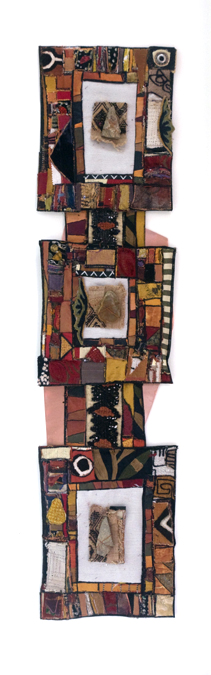
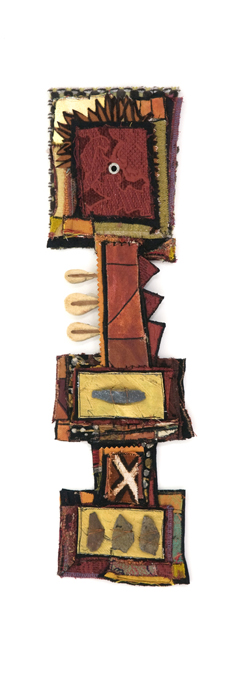
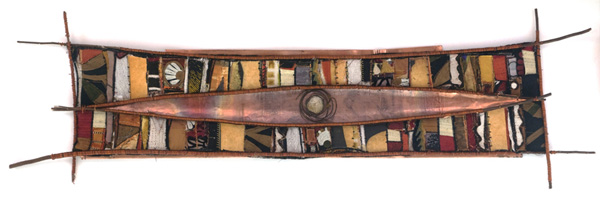
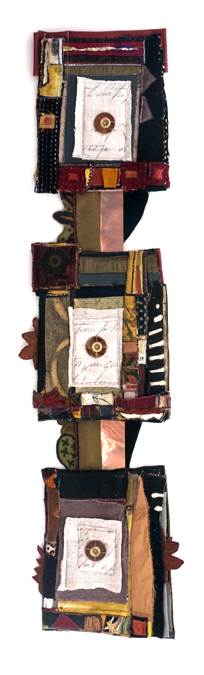
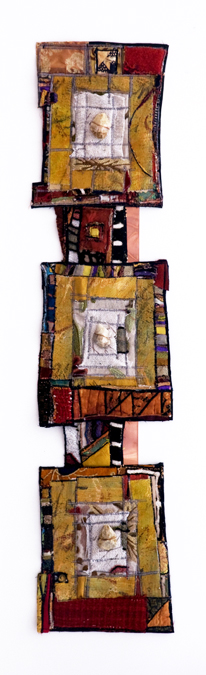
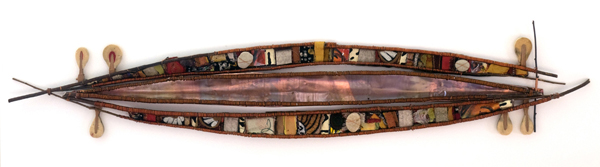
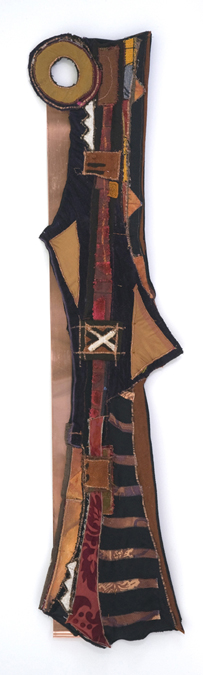
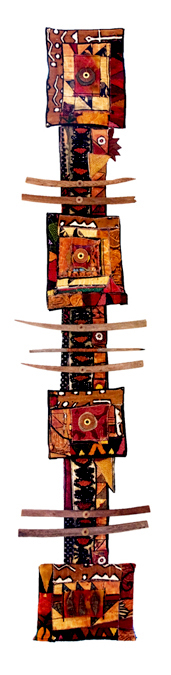
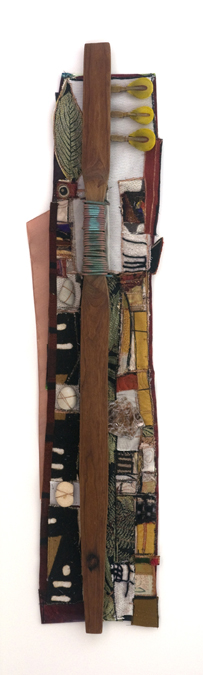
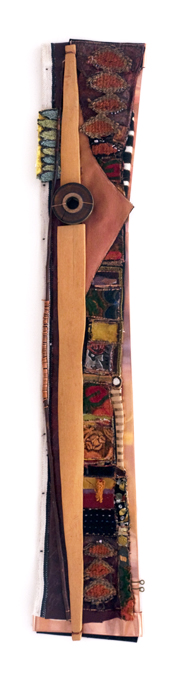
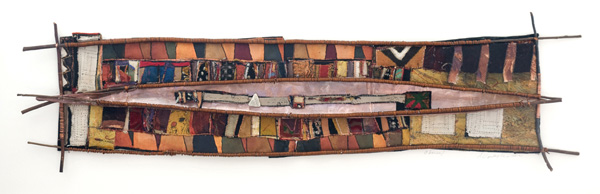
Textile assemblage is how Alice describes her work. She works with multiple fabrics gathered from many places and cultures. Adding branches, wire, copper paper and ceramic shards to her work, as part of a visual language suggesting a story. The story is part of women’s history, the meaning of every day objects and a collection and sorting of intriguing things.
Tell us about your work?
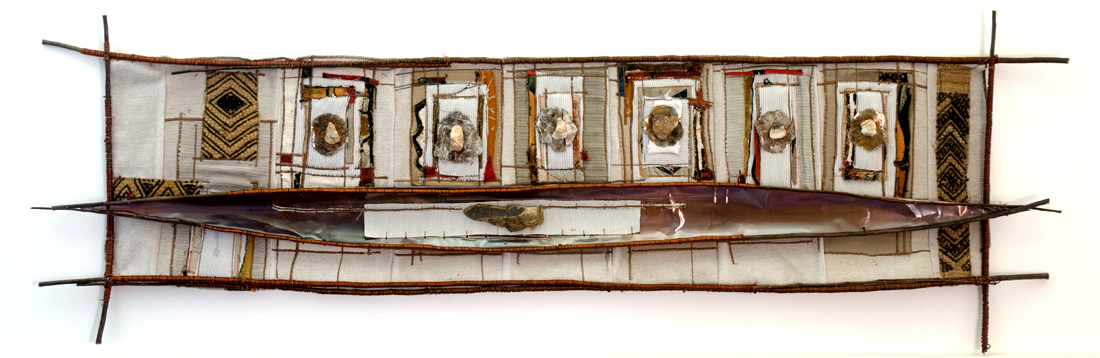
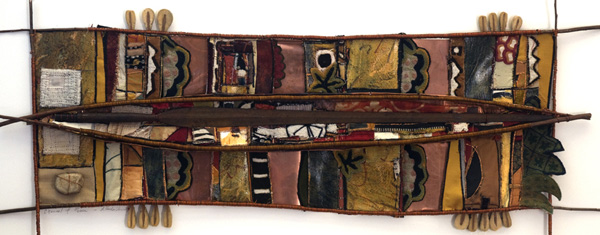
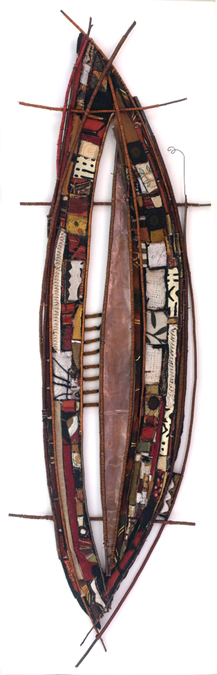
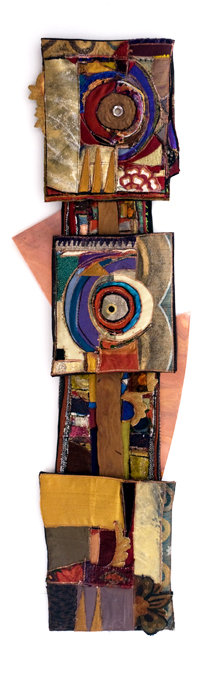
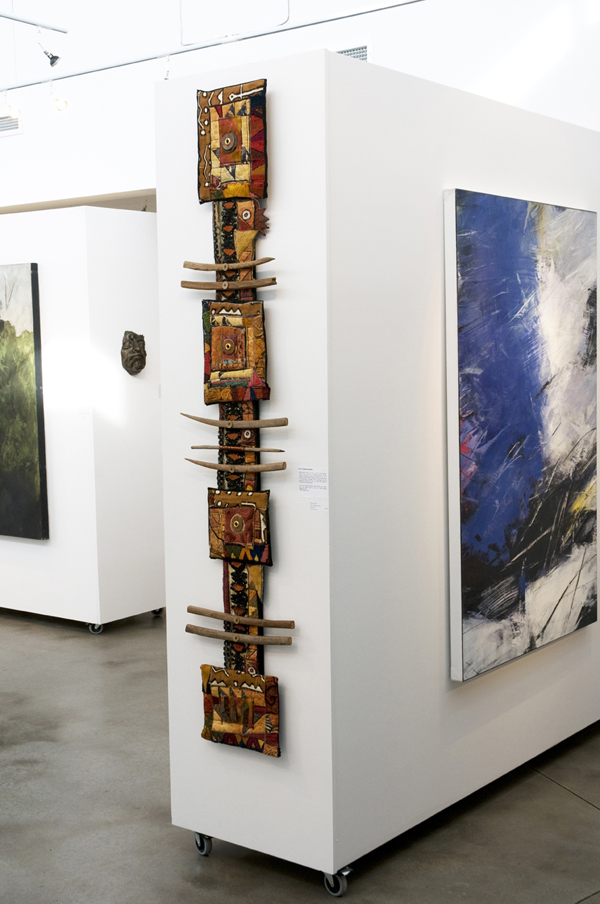
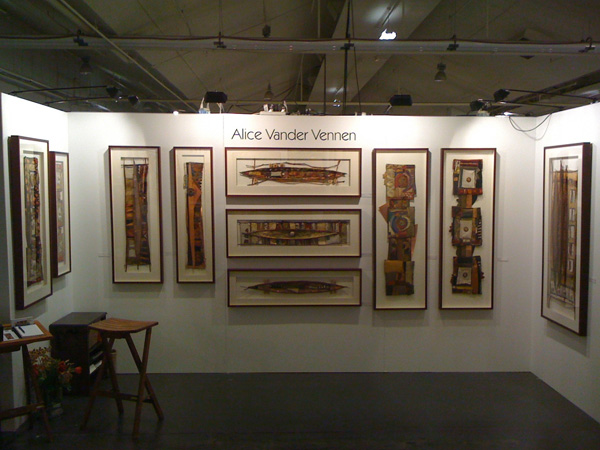
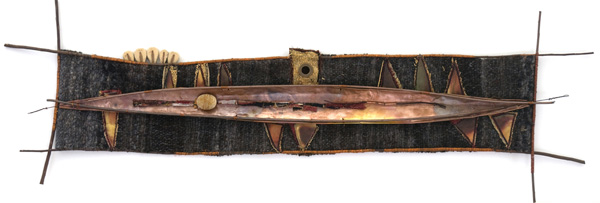
My work can best be described as textile assemblage. I use textile like paint, sewing different fabrics, cutting and repositioning nearly to the point where one would call it an abstract painting. I assemble the textiles with sculptural objects like willow branch, copper, copper wire and stones.
Previous World of Threads Exhibitions
Alice Vander Vennen exhibited in three shows in Festival 2012: Variegated Threads, Fibre Collage and Cutting Edge: New Views of Fibre Art. For Festival 2014 she was in Solo Shows.
Where do you get your inspiration?
The primary source of inspiration is from the fabrics themselves: from the intricate detail, to what happens when one places one piece of fabric alongside of another piece of fabric. There is a sense of surprise that happens, and actually—pure joy in putting it together.
In my career I have worked a lot with children and children's art. Watching how they work, how they put things together and their sense of composition inspires me to do the same. I also love listening to music when I work; in some ways my art feels like music, putting things together to create something new, just as a musician puts sounds and rhythms together to create a new tune. And I love reading—putting words together to form a sentence is much like what I am striving to do in my art. I sometimes think of my work as visual poetry.
So in the end I get my inspiration from any kind of artist, whether a musician, an author, a visual artist, or a child—placing concepts, ideas, colours, words, shapes and rhythms together to create something new. The new is always exciting and inspiring.
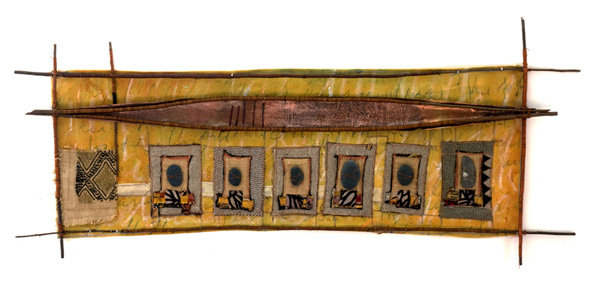
Fabric carries the work and the stories of women, so often silent.
Why did you choose to go into fibre art?
I love fabric because of how rich in information it is. Fabric speaks to so much history. Not only does it have the five elements of art—line, shape, colour, texture, and space—but it also carries such histories. It is imbued with stories of its origins, its maker, its geographic place, its culture—all of those details are "woven" into fabric. So when one works with fabric one immediately has a rich palette of stories, known or unknown.
Also in many cultures, fabric carries the work and the stories of women, so often silent. If we think of the women in our own histories, do we know their stories? What they've gone through? What they've experienced? Even if we don't know their stories, there is a good chance that we have access to some of the work that they have created with their hands. Here I think of my own aunt, "Tante Jantje", who at much risk worked in the underground in the Netherlands during World War 2, hiding people of Jewish descent. Even though this dear woman helped raise me, I didn't hear her full story for many years. So I cherish what she made, for it speaks of who she was. In the same way, I like working with textiles that carry the handprints of so many stories known or unknown.
I also like the medium of fabric simply because it is so available. I trained as a sculptor in the 1970s. I did a lot of welding and bronze casting and worked large-scale. At a certain point I found that those resources were no longer available to me—I had little space, time and resources. It was natural to reach for something so close at hand and so rich in character that would allow me to keep doing my art.
Which is your favourite fibre medium?
My favourite fibre medium is cloth. I like to work with it and cut it, and I like the variety it comes in.
What other mediums do you work in, and how does this inform your fibre work?
Trained as a sculptor, I focused on working with the found object and would create sculpture by assembling these found objects. Found objects still have a prominent place in my work. As an artist, besides sculpture, I have also done a considerable amount of work in ceramic and in tapestry weaving.
What bridges the works that you have created in differing media?
The use of space and composition is one of the bridges that tie them together. Another underlying factor in all of my work is the use of materials that are imbued with history.
What specific historic artists have influenced your work?
In a subliminal way, all of the Old Dutch masters influence my work. My parents immigrated to Canada from Holland after World War 2, and all of their prints, tablecloths and dishes were Dutch-themed. On our kitchen table always lay what I considered a tablecloth. Others, however, consider Dutch tablecloths as rugs—elaborate, woven, rich in Rembrandt colours. I'm surprised how much those colours come through in my work.
Of course I love the work of Hundertwasser—his elaborate use of colour, line, space, texture. I also love the work of Matisse and Jean Miro. In Miro's works one sees an absolutely playful use of colour, as well as making each line count. It is rich in stories; his way of working with the figure is remarkable, both in his sculptures and his paintings. In his work I see the concept of "trying anything"—sometimes even the "ridiculous" becomes beauty. His two large tapestries, one that hangs in a Barcelona museum, and the other that was sadly destroyed in the World Trade Centre, both depict him using fibre and stretching boundaries in the most playful, intense and exaggerated form.
What specific contemporary artists have influenced your work?
I always find myself going back to the work of the sculptor DiSuvrio, in whose work I was taught. What is so ultimately important about his work is the concept of "let the process show" in the piece itself. "Let the nuts and bolts show", we were taught. "Go large". "Let the materials tell the story." DiSuvrio used old beams, bolts and found objects. He constructed them together in such a playful manner that not only was it aesthetically pleasing but it told stories.
The Canadian painter Otto Rogers has also influenced me. His use of space and colour is magnificent, as is the way his pieces are a combination of simple placements and juxtapositions of found objects.
What other fibre artists are you interested in?
I love looking at the work of Lorraine Roy, Dundas, Ontario, Dorothy Caldwell, Hastings Ontario and Mary Karavos, Guelph, Ontario. I love their sense of colour, how they push the boundaries of fabric, as well as Dorothy Caldwell's sense of stitch.
What role do you think fibre art plays in contemporary art?
I think fibre art plays a huge role in contemporary art. Every time I'm at an art show I'm surprised at how well the fibre artwork is received, appreciated and purchased. I think fibre, in and of itself, plays such a huge role in people's lives. One of our first sensations after being born is being wrapped in a blanket. Cloth, fabric and feelings of fabric are so much part of all our past and present moments. We all remember that itchy undershirt, the soft scarf knitted for us, the warm blanket tucked around us. I think when people see fabric art it touches so many of their senses. At a recent show one man came up to me and said, "I don't know why, but I love fabric art."
I think that fabric art also speaks to a cultural setting. One only has to visit the Textile Museum in Toronto to see what a rich part culture plays in textile art. Showing textile art informs the viewer so much about culture.
I think there are still some biases and prejudices to work through: textile art needs to be seen not just as coming from our grandmother's laps but also as occupying a prominent role in contemporary art.
Fabric art is so labour-intensive; it has a way of totally occupying a person.
What does your art mean to you?
My art is a constant source of fascination, inclination and occupation for me. I need my husband to suggest that we do things together, go places, etc. just to keep a balanced life. I'm always pulled to the studio, fascinated and wondering, trying things, sometimes frustrated. Fabric art is so labour-intensive; it has a way of totally occupying a person.
Are you attempting to evoke particular feelings in your audience?
No. I feel that I'm simply playing with colours, shapes, and textures, simply putting them together, sewing, cutting, re-sewing, until a new story emerges, until a "wow-ness" happens that I can't even account for. Sometimes it's not until a show is being hung that I'm able to stand back and look at my work and realize some of the concepts that were happening in the pieces.
When did you first discover your creative talents?
It was something that teachers always said about me and I couldn't quite understand why. It's not like I tried to be creative or different—in fact, I tried quite hard to be the opposite. I was raised poor; my parents would get boxes of wooden blocks cut from constructions sites for our toys. My dad would sand the edges so we wouldn't get splinters. We would walk to the pond on the farm and dig clay, mold it and shape it. In the milk shed, the previous owner had left horse tackle; as a child I would spend endless hours shining up buckles, leather straps, mounting them, or braiding bailor twine, making plans for wall hangings and rugs. As a child, that all seemed like normal play. It just seemed so natural to continue doing that into adulthood and in art school.
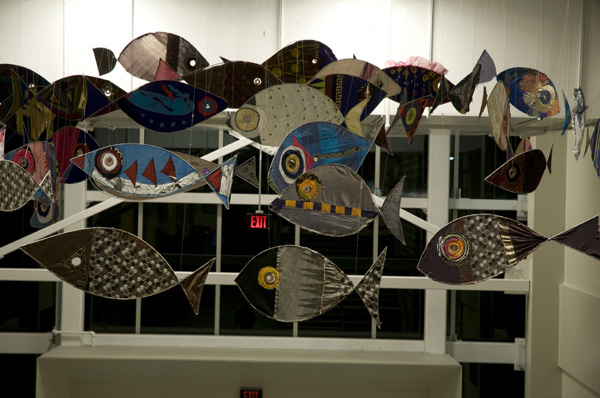
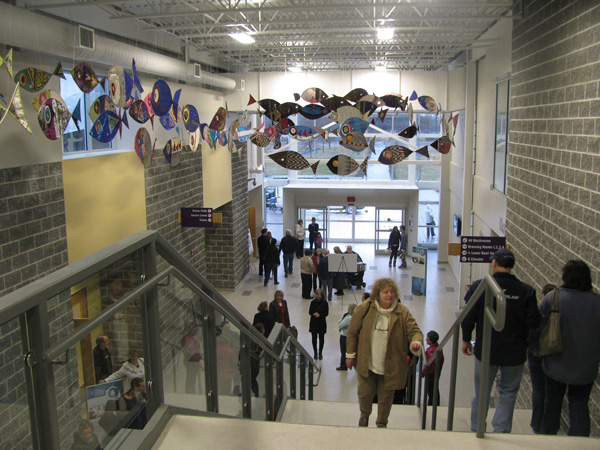
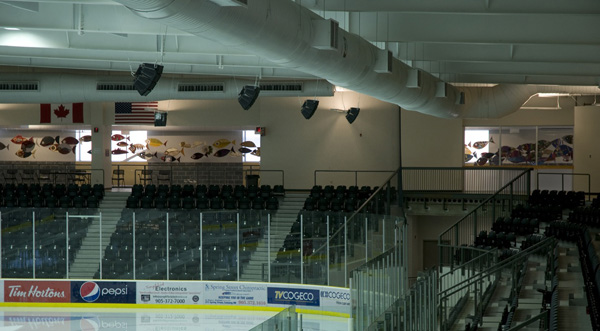
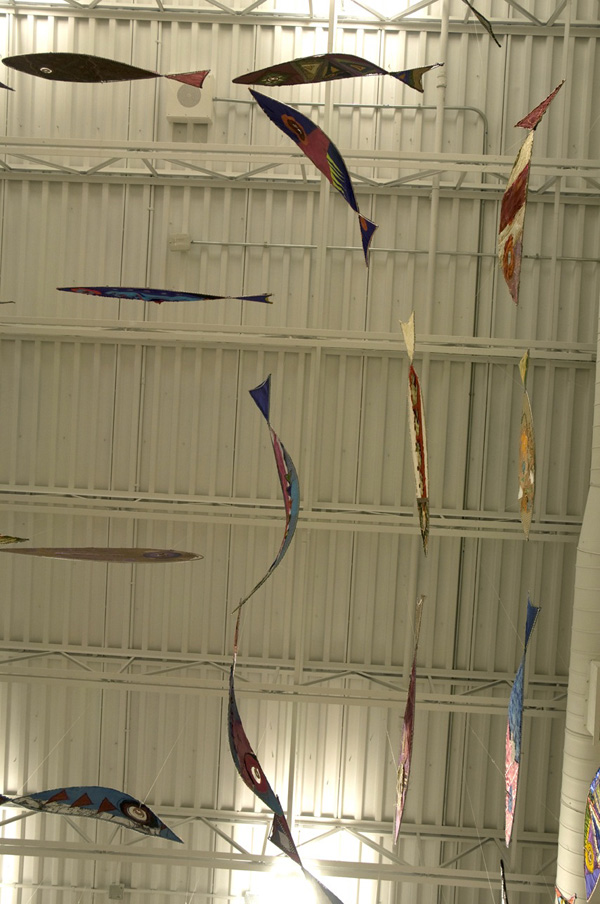
The Floating Fish Sculpture was a commission from the Town of Cobourg, where I live. It was completed in April 2011. A government infrastructure grant supported the Town of Cobourg to build a fantastic new Community Centre, which includes a huge gym, a vibrant seniors centre and two ice rinks, one of which is Olympic size. At any given moment the Centre is packed with people.
The Floating Fish Sculpture hangs above the main entrance and is visible from almost any vantage point in the building. It consists of 100 sculpted fish made of quilted fabric on both sides, stretched across a wire frame. Each fish is about 1 metre long. The 100 fish are hung in fish-school formation and reflect the rhythms of Lake Ontario and the vibrancy of Cobourg (the Town of Cobourg is located on Lake Ontario). The Sculpture was a community project—I held 4 community workshops where people could drop in and work on a fish. Over 50 of the fish were partially designed by community people, from children to seniors. The result is a fantastic visual of community coming together, illustrated through fabric.
Where did you train and how did your training influence your art?
I trained at Calvin College in Grand Rapids, Michigan in the 1970s. They had an outstanding art department at that time. I was trained as a sculptor and had complete access to the sculpture studio there. I still remember a professor saying that if you work in one area it's easy to switch to another area—in other words, composition, colour, etc. carry over from one medium to the other. I find that most of my work is sculptural to this day. It's simply something I love and do.
I also took courses at the Ontario College of Art and Design, where I was introduced to fibre work. I have continued to develop my art in various workshops.
Please explain how you developed your own style.
My style has emerged out of the concept of working with the given. Because I'm trained as a sculptor to work with the found object, fabric itself can be classified as a found object. Once the given is used, it's gone—something new comes along to replace it. I've been very fortunate in that most of what I have created in the last 20 years has been sold. There is nothing like a clear palette, or "the blank canvas", to get going again. It always feels like there are more shows and commissions; I am always working. The work emerges out of the pure number of hours worked in the studio, and every piece makes me excited for the next.
Tell us about your studio and how you work:
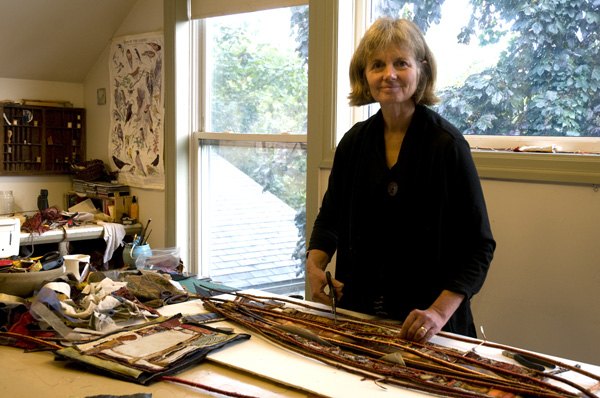
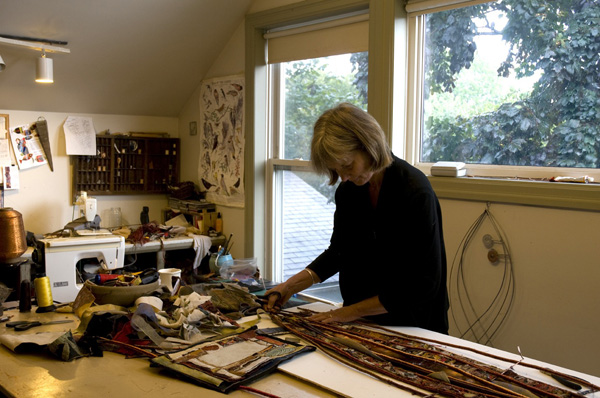
I'm shy about this question. My studio is a fantastic place with beautiful lighting—no workspace could be better. But when I am working it is a tizzy of fabric, colours, threads, and pins and needles, mostly because I never sketch out or draw my plan. I always start with the given—the size I want to work and the fabrics. I simply start by cutting and sewing, and cutting and sewing some more, until I am surprised by what I see. Sometimes that takes many buckets and baskets of fabric being tipped over, rummaged through and discovered. I let this happen and then I tidy up after each show.
I had a sweet coop student help me with the fish project, and at her request I allowed her to organize my studio. I haven't quite recovered from her organization yet. She put things in baskets according to colour. As a result, all my precious fabrics got mixed up with my dull fabrics, and my hand-woven fabrics got mixed up with mass-produced fabrics. You get the picture.
Is there something else you would like us to know about you or your work that we have not covered?
I love teaching and am a Member of the Ontario College of Teachers. I now give workshops in textile art, and I'm always so surprised and full of wonder at everyone's individual response to textiles. It's such a fantastic medium.
A coffee-table book of selected images from my work from 2000 through 2010 has recently been published and is now available. Details are on my website.
What interests you about the World of Threads Festival?
I think it's very exciting that the World of Threads Festival is pulling together so many textile artists. There is something about textile art in that it seems we have to work doubly hard at getting textile art recognized. It seems that the World of Threads—Dawne and Gareth—have worked triply hard to make this happen. It's all very exciting.