Artist Interview 24: Xiaojing Yan
Toronto, Ontario, Canada and Nanjing, China
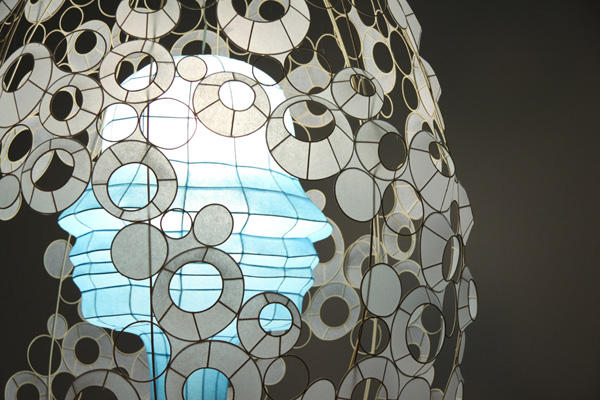
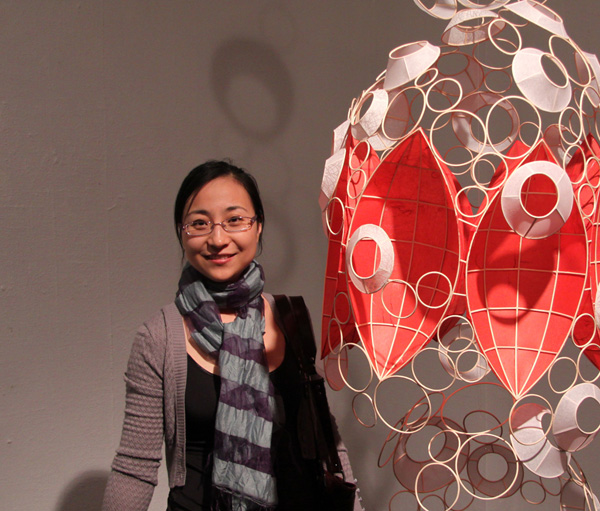
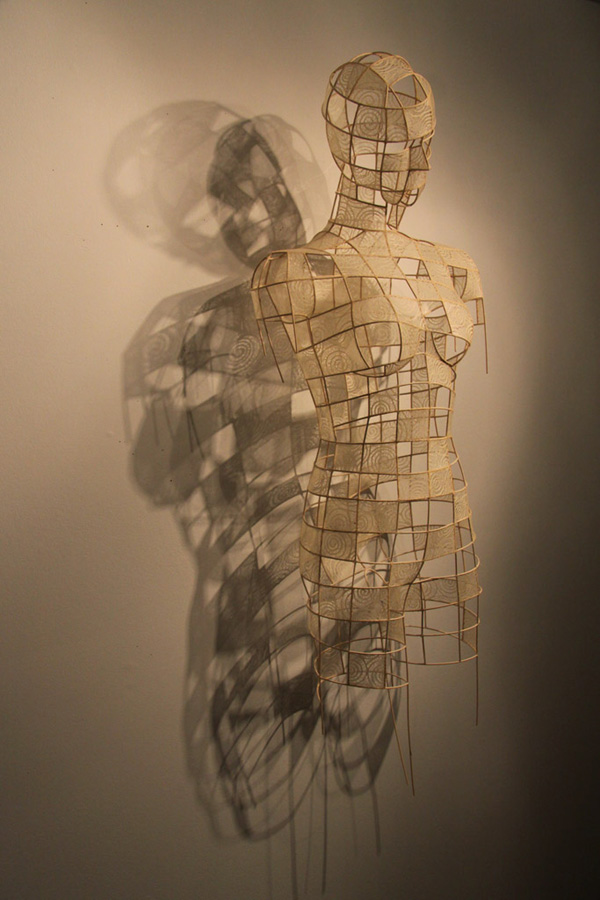
Xiaojing’s artwork explores the state of living and travelling between two cultures, her birth country of China and her adopted country of Canada. She used traditional Chinese materials and techniques and reinvents them within a Western aesthetic and presentation. Working with a broad range of materials and techniques, working with fibre relates to culture and tradition and produces unique works of art.
Tell us about your work?
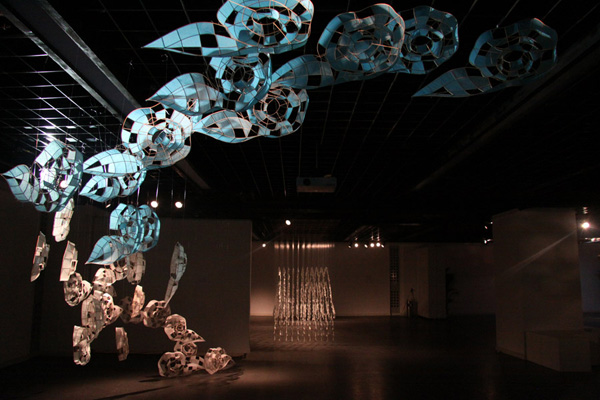
The moving from China to North America has made a great impact on my life and my art as well. After living in Canada and the United States for several years, my soul is no longer all Chinese. In the best of times, I feel I belong to both the culture of my country of birth and to that of my country of adoption. In the worst of times, I belong to nowhere. I no longer wish to completely resolve the duality of my existence. Moreover, I have started to accept this "in-between space". This experience engendered me a "new life", from which I can draw strength and richness. I consider this act of transformation as the process of transmigration in the Buddhist concept—reincarnation.
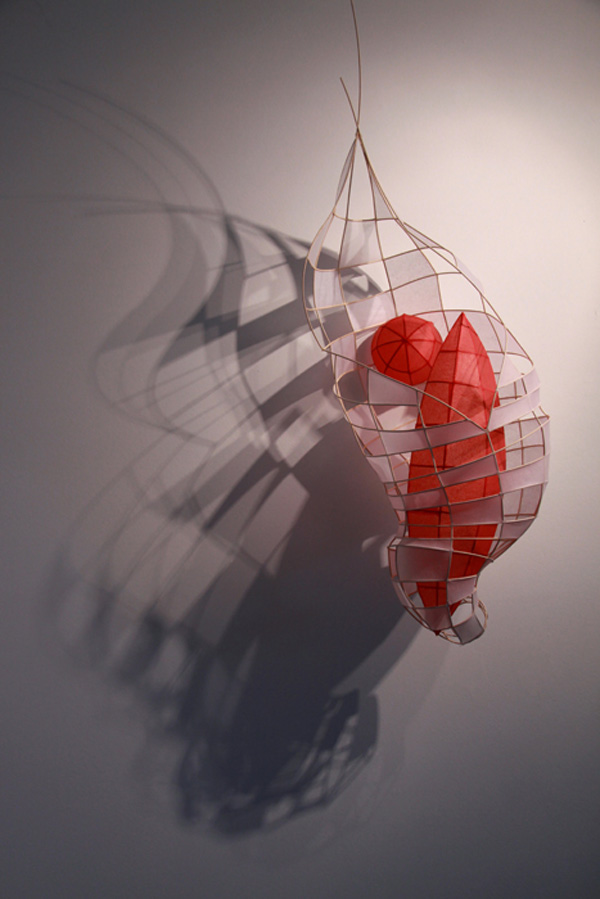
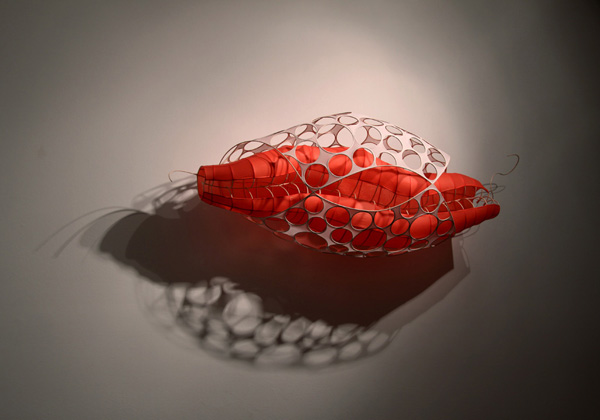
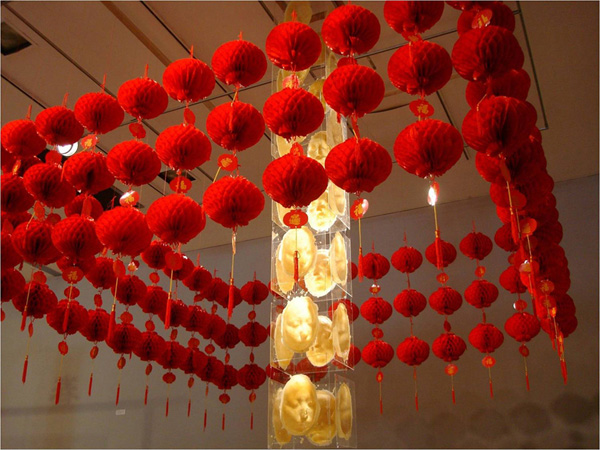
I have become increasingly interested in cultural and personal identity and in the need to discover a new mode of artistic and social intercourse that blends Chinese and Western ways of thinking. As an immigrant artist, both my identity and my work pass through the complex filters of different countries, languages, and cultural expectations. In my art, every idea travels through the intricate passageway of how I think in Chinese, but speak in English. In an effort to shape myself, I take traditional Chinese materials and techniques and reinvent them within a Western aesthetic and presentation.
Previous World of Threads Exhibitions
Xiaojing Yan exhibited in the 2009 Festival exhibition Common Thread International Part 1. For Festival 2012 she was in the Material Connections exhibition. Festival 2014 saw her work in the major exhibition The Red and The Black.
In my art, every idea travels through the intricate passageway of how I think in Chinese, but speak in English.
Where do you get your inspiration?
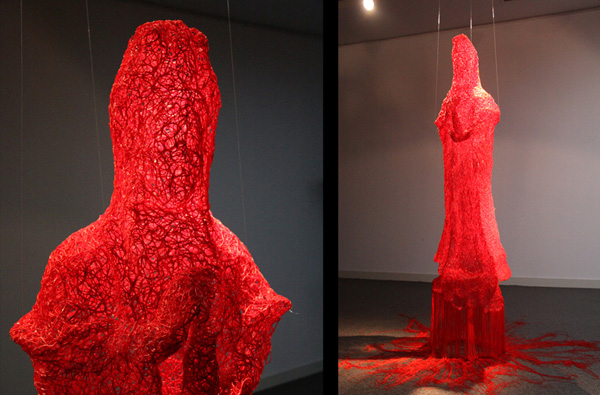
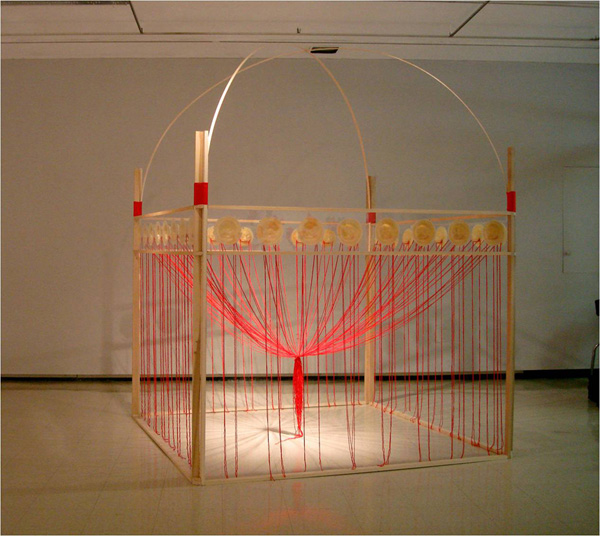
The experience of living and traveling between two cultures has been the greatest inspiration for me. I also like to experiment with materials and techniques. Sometimes, I just let the "accident" lead me. For example, Guanyin, a sculpture that I made using Chinese tassel threads, is the result of experimentation. I first made a styrofoam Guanyin statue. Then I cast the figure with fabric hardener and tassel threads. I wasn't sure what I would get at the beginning. I just play with the materials and techniques and see how far I can go.
Why did you choose to go into fibre art?
I work with a broad range of materials and techniques. Fibre is one of the materials I like to work with. It often relates to culture and tradition and the tactility and versatility help to produce unique artwork.
Though many artists never label themselves as fibre artist, they do work with fibre materials and fibre techniques.
Which is your favourite fibre medium?
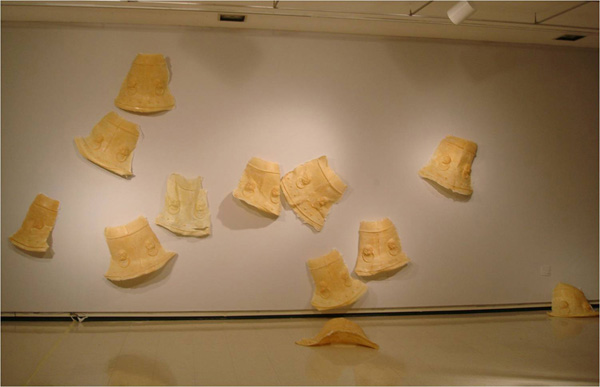
For me, choosing the right material is like choosing the right work to express my thoughts. I use silk in a lot in my works. Not only does silk speak about the tradition I came from, its transparency and delicacy also provides me the right effect for my idea.
What other mediums do you work in, and how does this inform your fibre work?
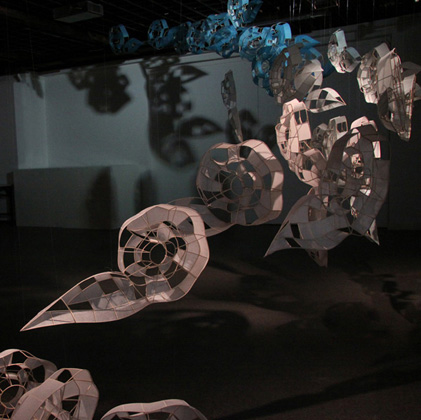
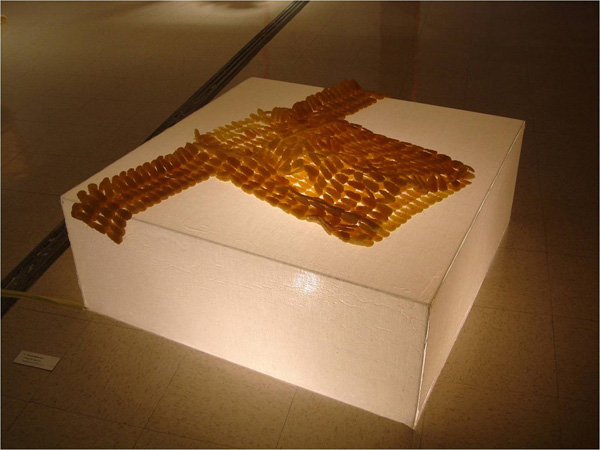
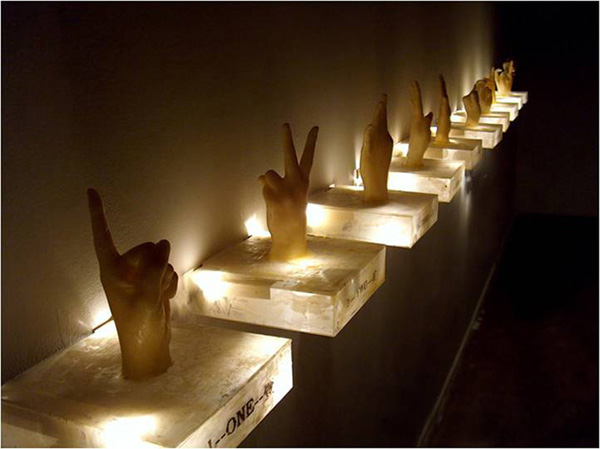
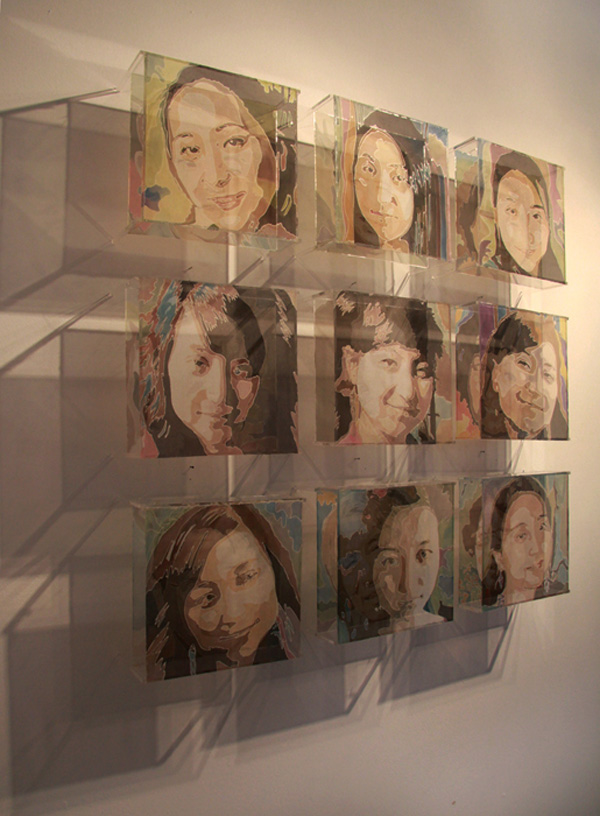
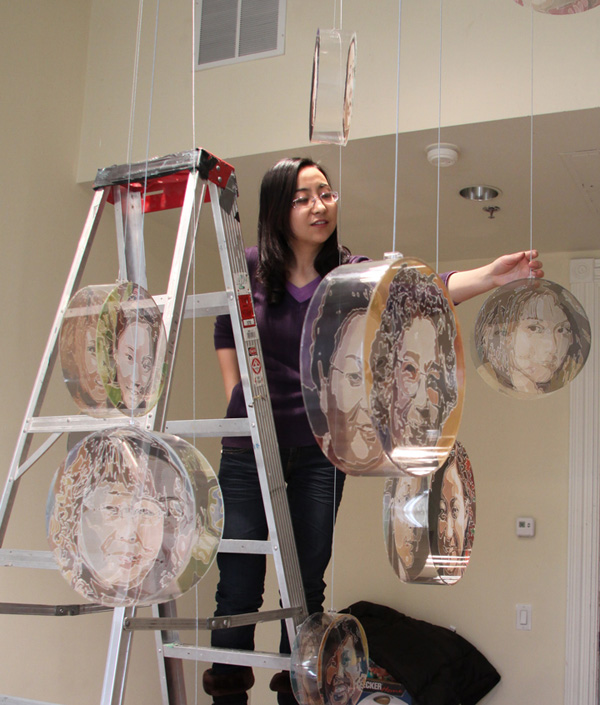
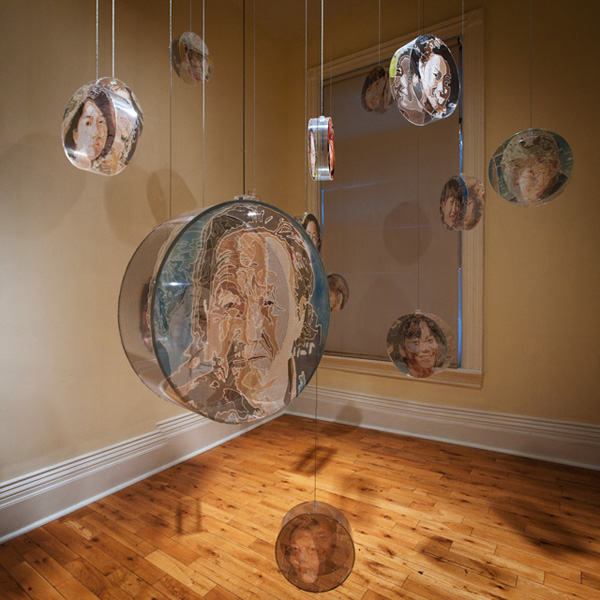
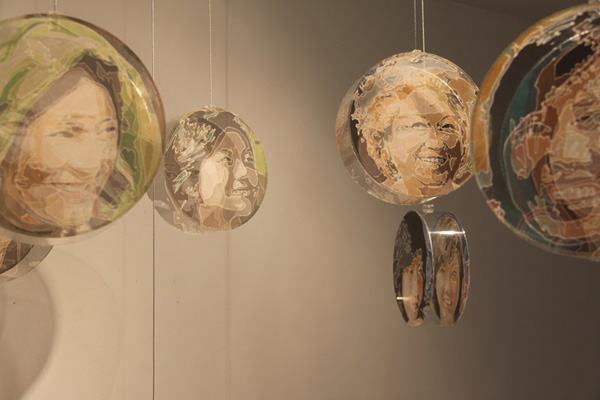
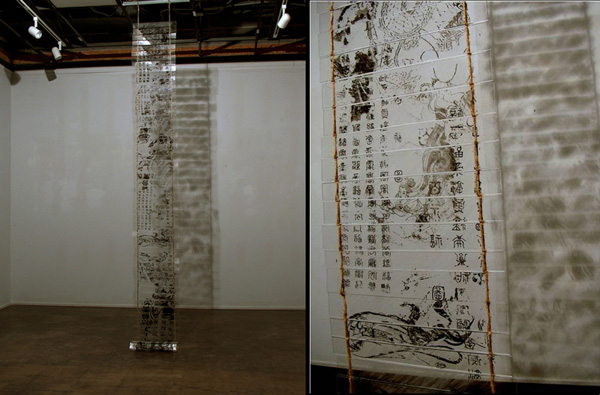
I work with wood, metal, plastic, paper, plaster, wax, found objects and all kinds of different materials. I often combine different materials together. And, I like to experiment with materials. For example, in my work "Face to Face", I mounted two layers of silk painting on plastic discs and these discs were hung by metal cables from the ceiling. People can see the layered portraits as it speaks about cultural and personal identities. I also applied fabric hardener to messy tangled red Chinese tassel threads to form a body of Guanyin - the Goddess of Mercy and Compassion. This work was hung from the ceiling, suggesting a constructive struggle.
What specific historic artists have influenced your work?
Since I was little, I started to practice Chinese ink painting. I used to copy from the Chinese painting masters' works, such as Su Shi, Qi bai Shi and Wu Cang Shuo. Even though I no longer practice Chinese painting, it is still the greatest inspiration for me. Later on, I had the chance to learn about Western art. I was very impressed by the very different techniques and broad range of approaches to ideas. I especially liked Marcel Duchamp. Though I did not understand very much about his idea then, it was awakening to know that art could be so playful and casual. It is nothing like the Chinese art I learned. I also like Henri Matisse, Michelangeleo, Pistoletto, Jasper Johns, Robert Smithson and many other great artists.
What specific contemporary artists have influenced your work?
I am interested in so many artists' work. Janine Antoni's work focuses mostly on process. She often uses her whole body or different parts of it, such as her mouth, hair and eyelashes, as tools and with them performs everyday activities to create her artwork. Her innovative uses of material and sculpting approaches have greatly inspired me. Do Ho Suh is a Korean sculptor and installation artist living in New York. Suh is best known for his intricate sculptures that defy conventional notions of "space". Whether addressing the dynamic of personal space versus public space, or exploring the fine line between strength in numbers and homogeneity, Do-Ho Suh's sculptures continually question the identity of the individual in today's increasingly transnational, global society.
Xu Bing, a Chinese-born artist, resident in the United States since 1990, is a leading figure of the Chinese avant-garde art movement. His work has made a strong impact on me not only visually but also theoretically. As many other Chinese artists, Xu Bing relies on his knowledge and understanding of Chinese culture, yet his location within the Western context provides an entirely unique denial of the fixed notions of East and West. With similar background, Xu Bing has greatly influenced me on the notion of the abstracted use of both language and traditional iconography, and his engagement with viewers to examine their own ideas of the other.
There are so many other artists who have influenced my work, such as Kiki Smith, Louise Bourgeois, Maya Lin, Lee Bontecou, Ursula von Rydingsvard, Richel, Whiteread, Cai Guoqiang, Eva Hesse and many others.
What other fibre artists are you interested in?
I like Toronto artist Kai Chan's work so much. I like how he transforms the most mundane materials into delicate and delightful works of art; how he uses traditional textile methods to create complex sculptural works that reflect his Chinese roots, as well as a respect for traditional craft techniques. I also like Orly Genger's work. She is known for transforming common nylon climbing rope into elaborate monumental sculptures. She knotted, stacked and painted miles of ropes to create gigantic site-specific installations. Her work evokes the normally intimate processes of knitting and crocheting, yet expands them to a newly epic scale.
Tell us about your studio and how you work:
I have been moving around for the past ten years since I first left China for Canada. I often work in large formats so it is not easy to find space. I work at my home studio now. It gets more crowded as I keep producing more art works. I will be moving to my new place and I am excited to have a bigger studio space soon. I remember an artist said that the whole world is his studio. I like this idea. I often work in gallery space or at the site to install my work. I like to consider these spaces as the extension of my studio space.
What role do you think fibre art plays in contemporary art?
Now that modern technology has become so popular, it is great to see that many artists are still working directly with their hands and continue in tradition ways. Fibre artists, like many traditional art forms, have the intimate connection between human body and materials. The skills and materials involved were practiced, expressed, and passed down through generations. The traditional craftsmanship relates to cultures and heritage. Though many artists never label themselves as fibre artist, they do work with fibre materials and fibre techniques. Fibre art appeals to many artists because the materials' tactility and versatility help produce unique and powerful artwork.
Where do you imagine your work in the future?
Moving from China to Canada has been the most significant change in my life. For me, this experience engendered a "new life", from which I draw strength and richness. Making art is not only meaningful to me but has sustained me. I know that the adaptation of these two cultures will be a life-long journey. With art, I will continue to solidify my experiential and complex reactions to this challenge.