Artist Interview 23: Hilary Rice
Corner Brook, Newfoundland, Canada
Self-taught fibre artist Hilary, has an experimental, even playful approach to her use of a multiplicity of techniques and unusual materials, combining these allows for experimental results to direct her actions. A friend used to say the reason she quilts is so she can embellish. She now thinks there is little left of the quilting part, it is all embellishment.
Tell us about your work?
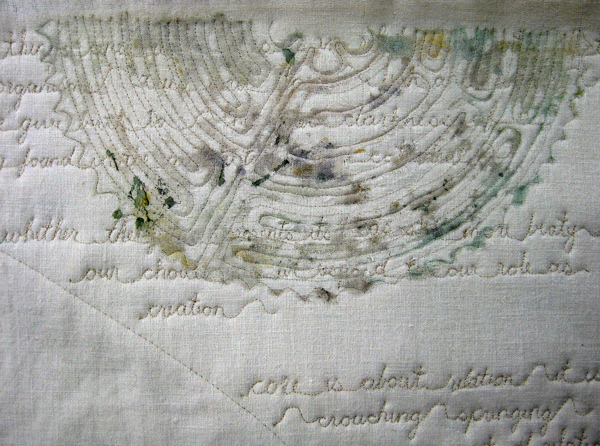
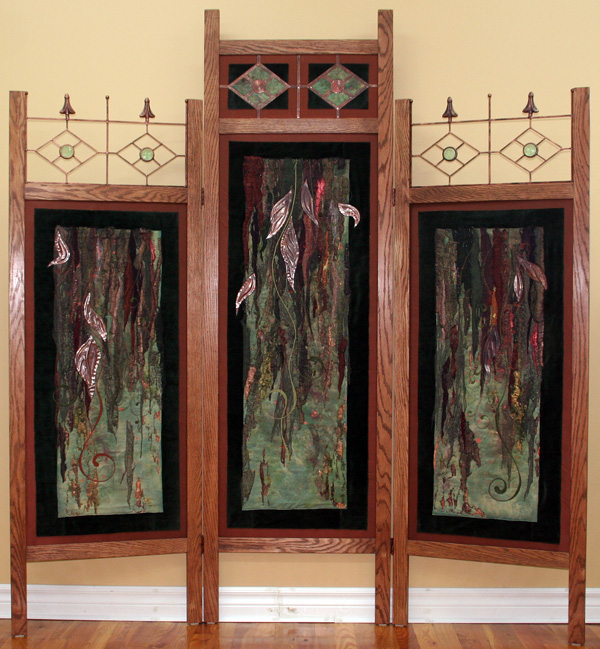
I often say that I came to quilting through the back door. I had no intention of learning to quilt. And some would say that I still don't quilt. In fact, I even say that I am not a quilter. I happen to use textiles (and other things) that combine in a similar way that quilts do - the official definition of a quilt is that it has three layers of materials, and mine have that (and often more layers than five). My work started off with dyeing and painting my own cotton. But I moved to using more unusual materials and techniques, after an extended trip to Britain in 2004. It was there that my eyes were opened to new possibilities offered using textiles. I just had fun trying new things - I would purchase a book and read it and try stuff! Before I realized it, I was creating work that had a look of its own. I have been very fortunate to be able to focus on building my skills this way. I have taken risks, and most of the time it has worked out.
As far as connecting to traditional quilting, my work incorporates many of the basic ingredients that a quilt from years ago did. I purchase used clothing and use that as a beginning source for my textiles. It is pretty neat to think that this connects to one of the key elements of why a person made a quilt over a hundred years ago! Another part of what my textile art is about for me is connected to my spiritual life. I like the idea that there is an association to the use of textiles in the ancient church. I enjoy using linen and gold threads for that reason. So, is there a link to tradition? Most definitely there is. But to be able to take the tools we have available now and combine them with modern imagery, is a wonderful and exciting journey. It is an honour to be connected to such a rich tradition.
Previous World of Threads Exhibitions
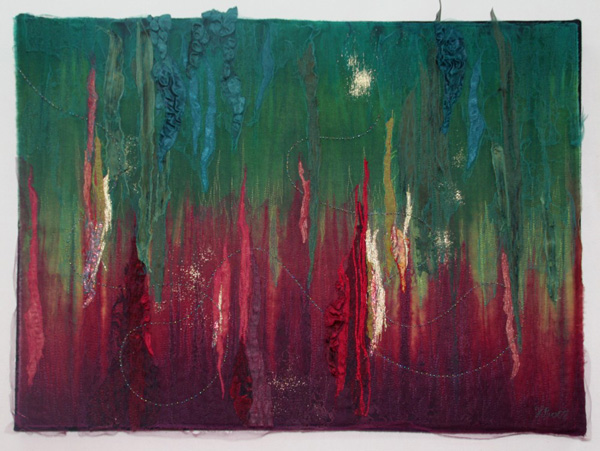
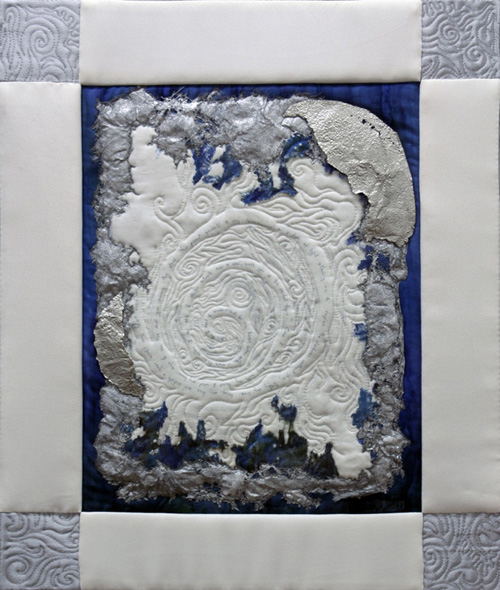
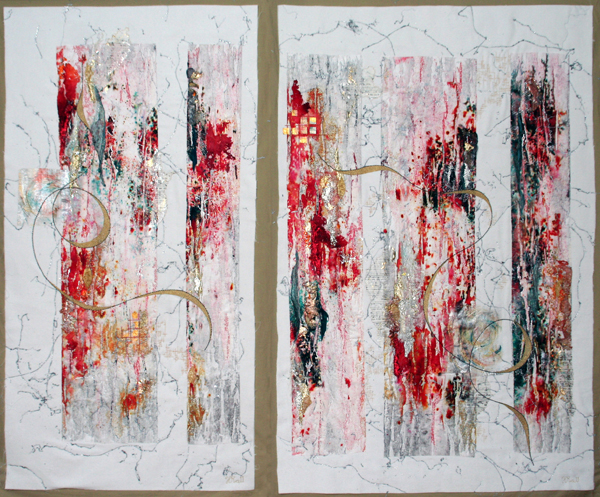
Hilary Rice exhibited Search for Light II in the 2009 Common Thread International Exhibition Part 1.
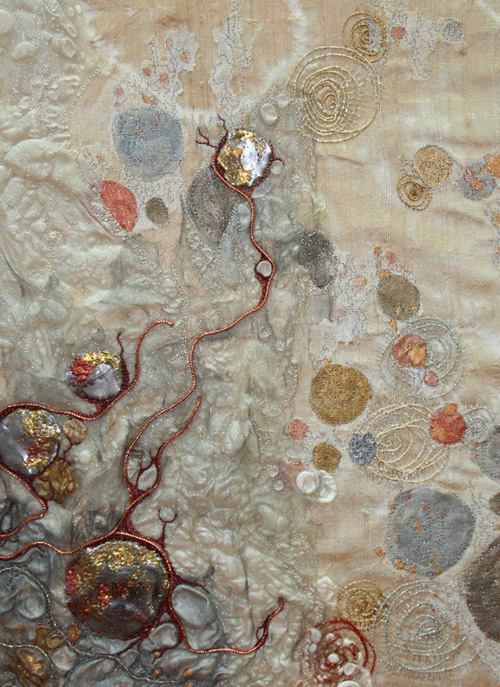
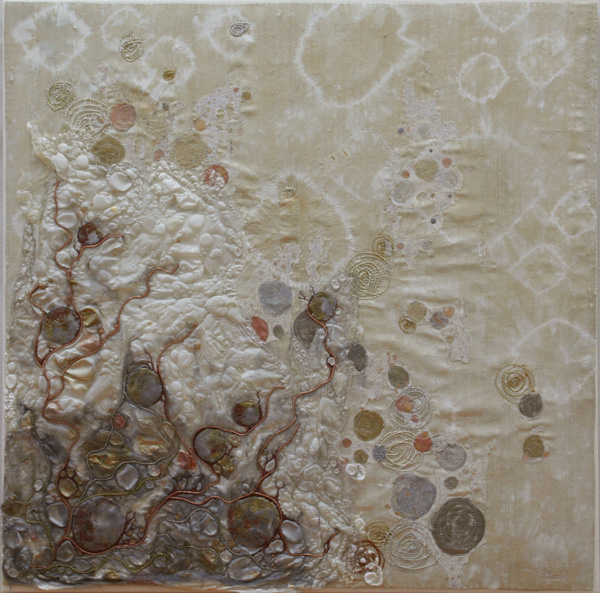
It is fascinating how much of my inner being is reflected through my art.
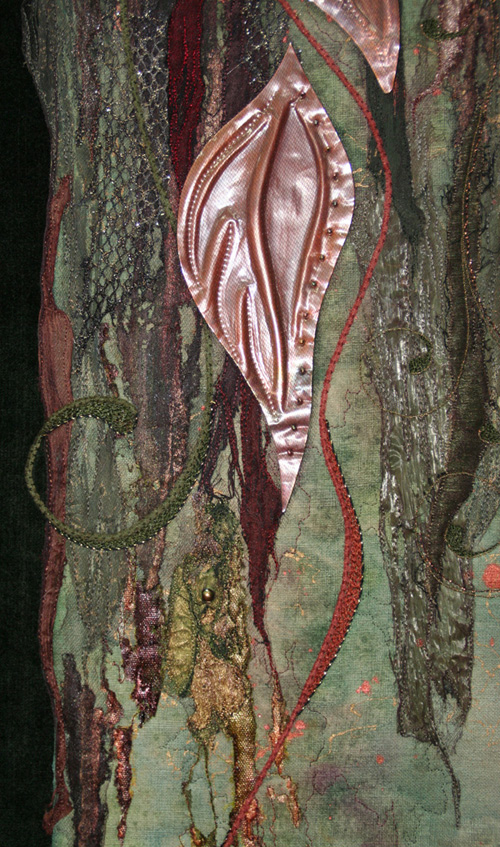
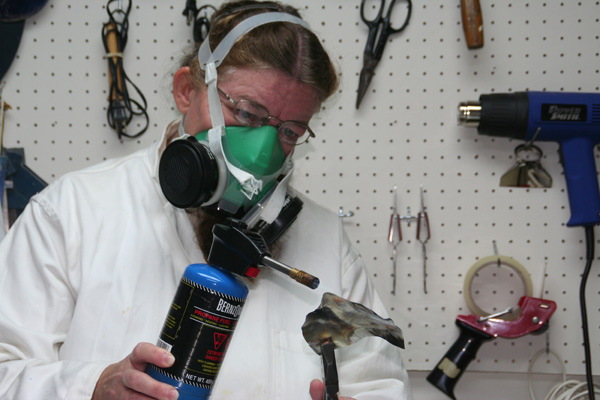
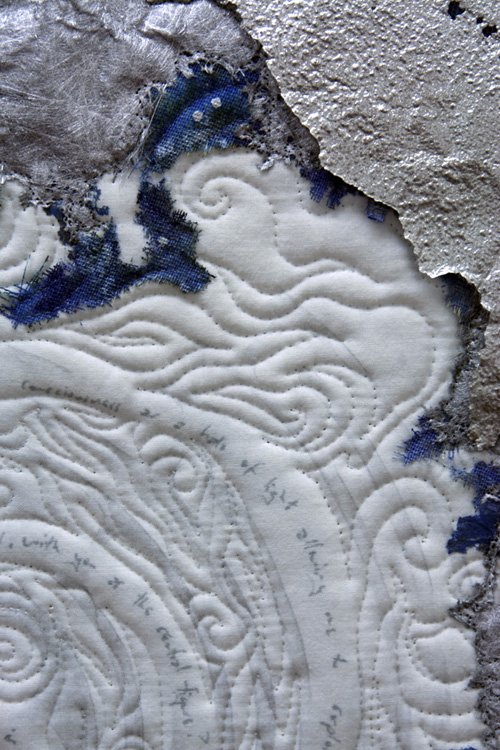
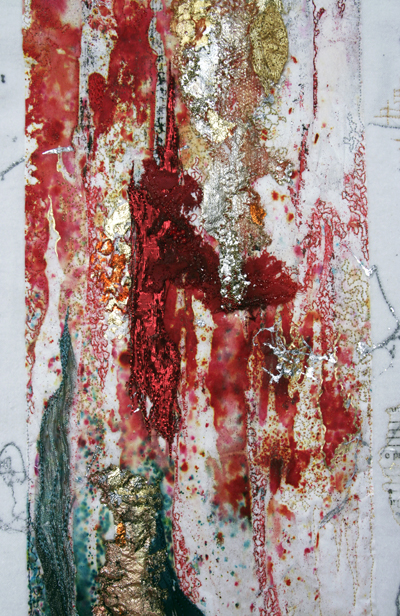
In my textile art pieces, I incorporate a variety of unusual materials - for instance, I paint a thin layer of glue (a product called "Wonder Under") and then bond that with synthetic sheer fabrics, and apply heat to that using a heat gun (normally used for paint stripping). This results in a most interesting material to then tear apart and collage into the art. I also use Tyvek this way (yup! The stuff that is used on the outside of houses as a vapour barrier)! Other materials I love to add are metals (copper, brass, aluminum and pewter) that I heat, emboss and colour. These are just a few of the most unusual things I use. Why do I do this? I love the texture it creates, when adding heat to things. And the addition of this, together with metals, makes my work unique. One of my friends used to say that the only reason I "quilt" is so that I can embellish! I think now, there is little left of the "quilting" part - it is all embellishment!
Where do you get your inspiration?
I struggle with this question every time I am asked it – mostly because it seems like my ideas come from within. Sure, I see things in my surroundings – often a shape, or a textured surface – that drive me to create something connected with that. However, I mostly am attempting to create a feeling or thought, using a variety of textiles and surface design techniques.
Ideas seem to flow ceaselessly - I gather thoughts, ideas and images like daisies from a summer field! It is fascinating how much of my inner being is reflected through my art. It has become a bearing of my soul.
My serious study has been in music – I have a Bach of Music degree, my major was vocal performance. I play the harp as well. In a mysterious and profound way, my music and my art are deeply connected. A beautifully orchestrated melody makes my soul soar, equal to the sensation which overwhelms me, as I seek to create its equivalent in fibre.
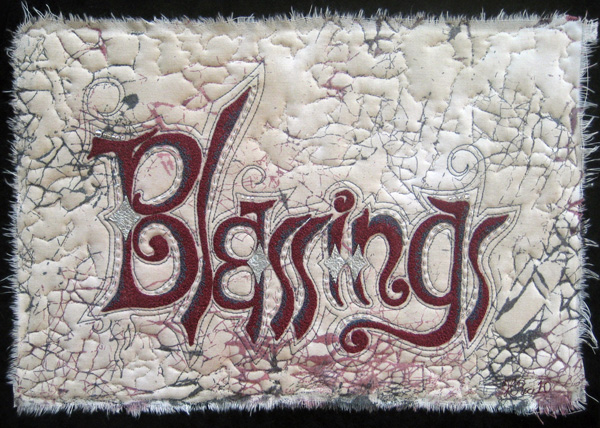
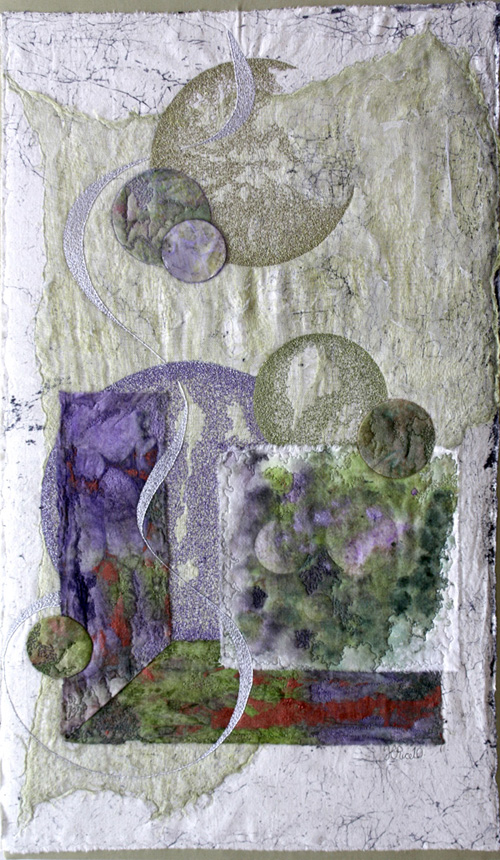
The terms ‘flowing’, ‘undulating’ and ‘rhythmic’ are often used to describe my artwork – these refer to my use of line. The way that I work ends up being a layering process and the final part often includes the addition of a line that weaves its way around/across/through things already in place. This produces the 'flow' referred to, and often results in waves (repeated lines) that can give a sense of undulating pulse. It seems natural that my art reflects my classical music training. There are also very many musical terms. I sometimes think the line is representing a melody, and a group of lines, a sustained chord or tone cluster. I also sometimes think of my textile creation in terms of composing an orchestrated piece, with repeated motifs, an underlying drone of bass, a trill. The other thing that works for my use of line, is its tendency to create a path, which can be ‘searching’ through things on the surface – it symbolizes the journey.
In a few words - my work seems to be about life energy in its many forms: nature, music, creativity and moods too.
What specific historic artists have influenced your work?
To be honest, I don’t feel I have been influenced by any historic artist. I have not studied art, not even at the secondary school level. All my education in this field has been through reading and experimenting – the only workshop I ever attended was on a weekend, to learn to spin. Otherwise, I am completely self-taught.
What specific contemporary artists have influenced your work?
I would say current work that I enjoy looking at would be by British textile artist Maggie Grey. I find her use of texture most appealing, and her techniques intriguing and unusual. Texture is a big part of what I like about working with textiles, and so I have enjoyed exploring some of Grey's techniques. But I find I can be inspired by many things that I encounter in day-to-day life. If that happens to be another artist’s work, then for a short time, I think about that person’s work. These past several months, I have been creating a new body of work for two exhibitions coming up within the year. These shows will be in conjunction with a metal smith, and friend. I have found that as we share ideas and design thoughts, my work easily reflects some of his silver work. It has been an intriguing project.
What role do you think fibre art plays in contemporary art?
I wish that it played a stronger role, actually. I find it most frustrating to have my work considered, at best, fine craft. In Canada, there seems little support in the commercial gallery scene, for textile art. I think we [textile artists] are still pioneering.
What other fibre artists are you interested in?
I find most of the textile artists I am most inspired by, are from Great Britain. They seem to be way ahead of Canada – both in making strides in being accepted in the art world, as well as exploring technique and materials. As I said earlier, seeing publications by Maggie Grey pushes me.
Also, I find there are a limited number of people in the art quilting and surface design ‘world’ that truly create work that has meaning, rather than making something pretty or simply interesting. In my work, I strive to make a connection for the viewer, to something with deeper meaning.
Which is your favourite fibre medium?
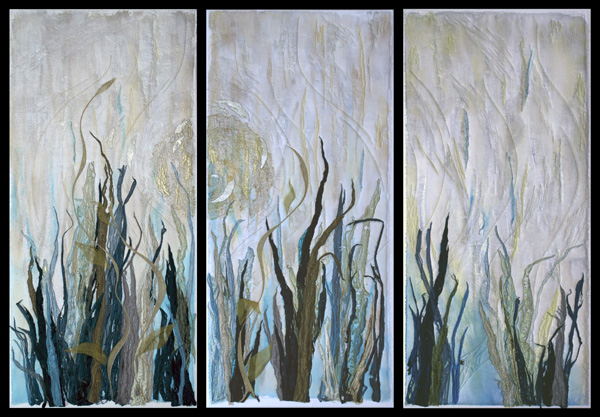
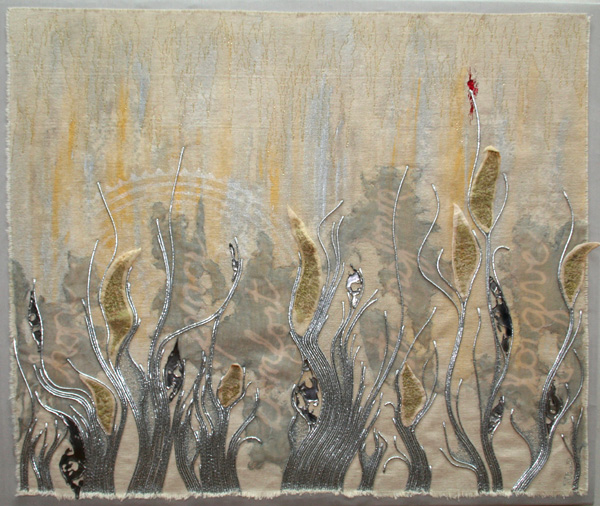
I am currently fascinated with the texture of melted synthetic textiles combined with natural textiles. I love the shine and richness of silk, satin and velvets, and the contrast between these when combined with the heat altered materials. The final addition of metal really works for me.
What other mediums do you work in, and how does this inform your fibre work?
As mentioned before, I also work with various metals – aluminum, copper, brass and pewter. I apply heat to bring out various colour changes, as well as applying colour other ways. The addition of texture and pattern by embossing the metals really enhances my textile art.
I have continued to spin my own yarn and knit, mostly for myself and friends/family. My loom is tucked away for now – I can’t do it all!!
Tell us about your studio and how you work:
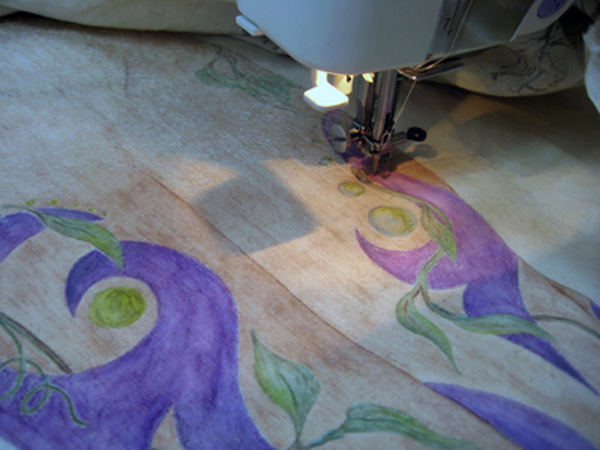
I am most fortunate to have extensive space available to work in my home. I have two studio spaces - one is on the main floor, with two large windows and the second is in the basement – both have had daylight lighting installed.
The larger main floor room is where the majority of my materials reside in cubbies, drawers, cupboards and on shelves. Because I work with such a variety of materials, I need lots of different storage, but it all needs to be easily visible and accessible. My sewing machine is set at a height that allows the work surface to extend to 2 larger tables, one in front and one beside the machine. In this way, larger work is supported during the sewing process.
The smaller room is equipped with a sink and washing machine – for my dyeing and painting of fabric. There is also a metal topped table that is my main work surface when applying heat to my fabrics. There is an industrial fan installed that exhausts to the outside. These are two very important safety features!
When I begin an art piece, I make a pile of fabrics, cords, threads and beads, and gradually work through each layer, putting away the rejected materials for each layer, until at the end I have a completed piece of art and a clean work space to begin again. I love being surrounded by all the possibilities, and it intrigues me that as each decision is made, the focus of the work narrows, and at the finishing step, it couldn’t have been anything different than what it is. Many people have asked how I know when it is done…and my answer is always the same. I try to add another element, and it just doesn’t belong. I know then that the piece is complete.
Where do you imagine your work in 5 years?
I will always continue to strive for excellence and attention to detail. I will not compromise this, in order to make my work fit into the ‘fine art’ category. I believe it is this fact that makes my work considered ‘fine craft’.
I would like to think that I will also continue to have successful exhibitions in an increasing number of commercial galleries, as I strive to educate the public about textile art. I have only been working with textiles as an art medium, in my mind ‘creating artwork’ for the past eight years. So many personal strides and successes have been accomplished in that time! It is difficult to imagine an additional five years from here… I am sure, however, that my art will continue to develop and mature in some manner.
Is there something else you would like us to know about you/your artwork?
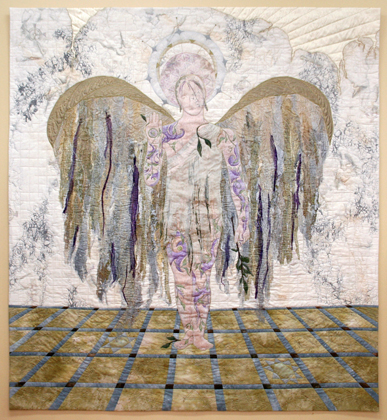
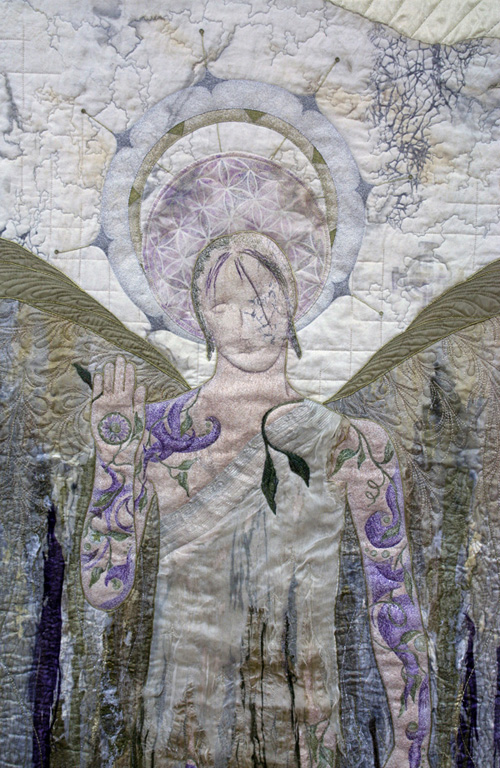
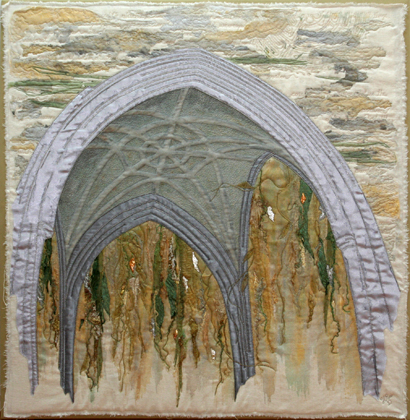
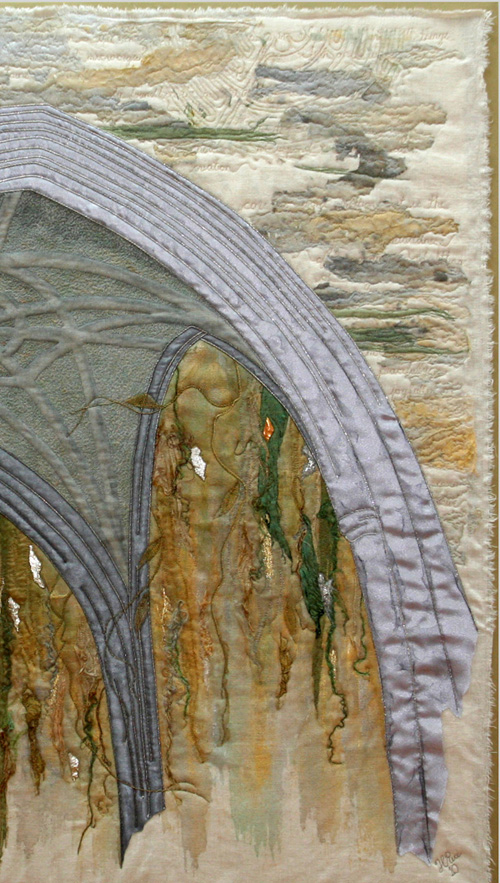
Somehow I think the sacred belongs in this conversation. Names I have given to my recent bodies of work include Landscapes of the Soul, Seeking the Holy.
I am not trying to proselytize with my art, but rather make a visual expression of my inner being, in respect to my spirituality and my understanding of the sacred. And again for me, this connects me to the holy. It is very much to do with connectedness and my strong desire to bring some beauty into this spiritually barren world of ours. It is very much personal expression. In some ways I am creating mandalas, that don’t happen to be round. So, much of my art depicts some elements of the search/journey, or leads into a space that might be called the “Other”, or sacred.
I think, too, for me, so much of my process is an act of meditation. I would like to include two quotes. One from Lenore Tawney (one of the original people to begin to work with textiles as a form of art making): "I become timeless when I work with fibre. Each line, each knot is a prayer... " And the other quote, also from her writing about her own work fits here as well: "I'm following the path of the heart. I don't know where the path is going." It is personal, the path of the heart, searching. And it is journey, too.
What was your motivation for submitting your work to the World of Threads Festival?
Up until my submission to the World of Threads, the only juried shows I had entered were connected to quilting. I was very keen to find another venue that might reflect a stronger connection to more serious art making. I was also very pleased to have found an international show connected to textiles that I was able to enter.
