Artist Interview 5: Cynthia Jackson
Stittsville, Ontario, Canada
Cynthia Jackson is an award-winning artist who creates intricate arrangements of fibre and stitch to achieve her artistic objectives. She continues to research the fascinating history of hand embroidery while maintaining her roles as teacher and contemporary visual artist.
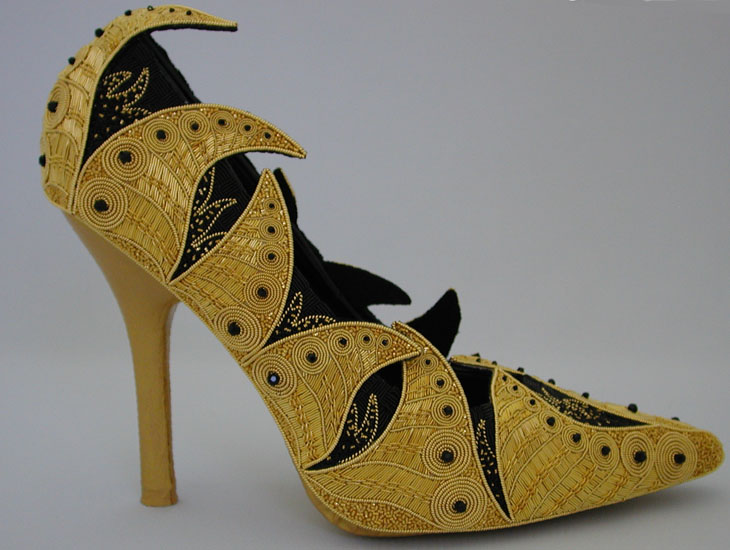
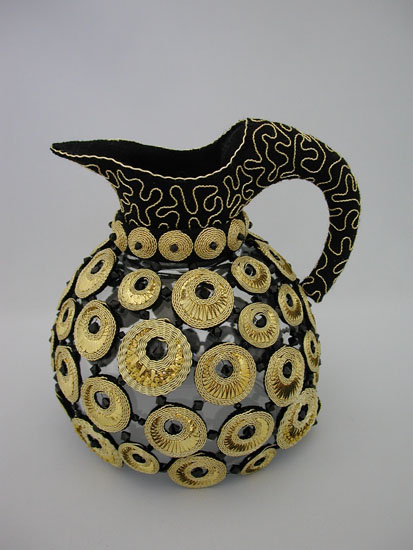
Tell us about your work?
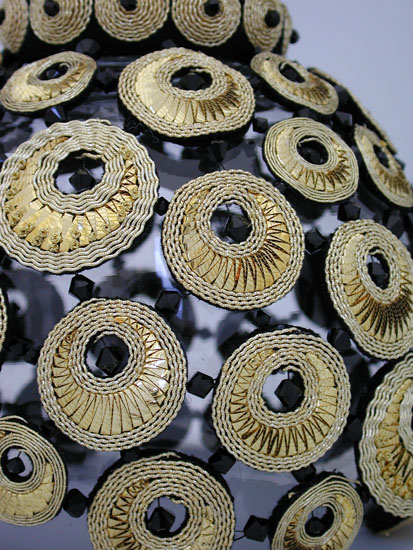
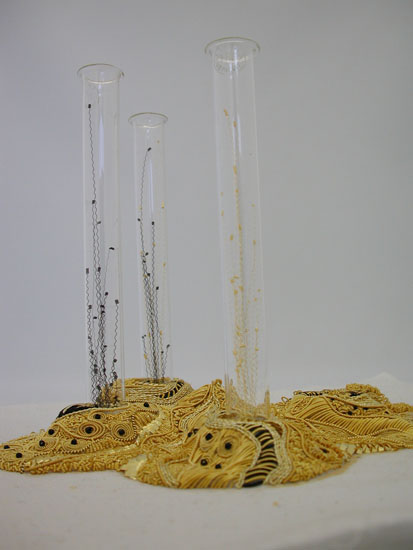
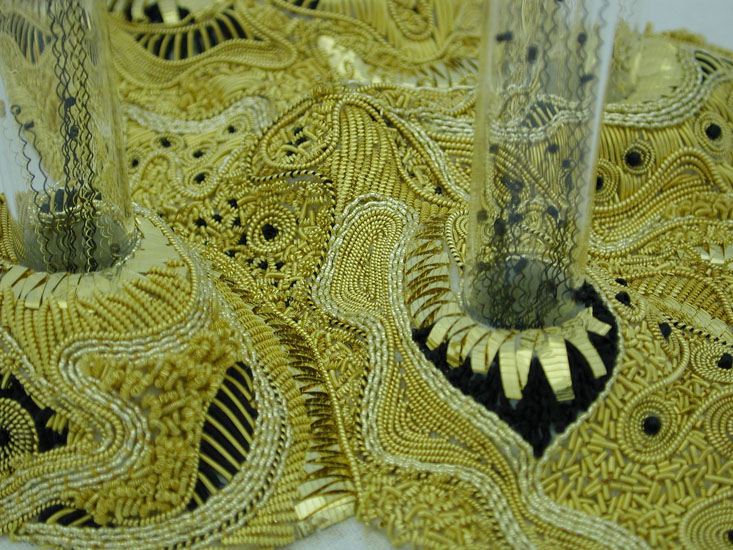
Technically, my work is a combination of hand and machine embroidery presented in a three dimensional format. I prefer to use a traditional, highly skilled form of English embroidery known as goldwork. However, I am constantly experimenting and combining a variety of old hand techniques and traditional materials with modern equipment and contemporary subject matter.
Previous World of Threads Exhibitions
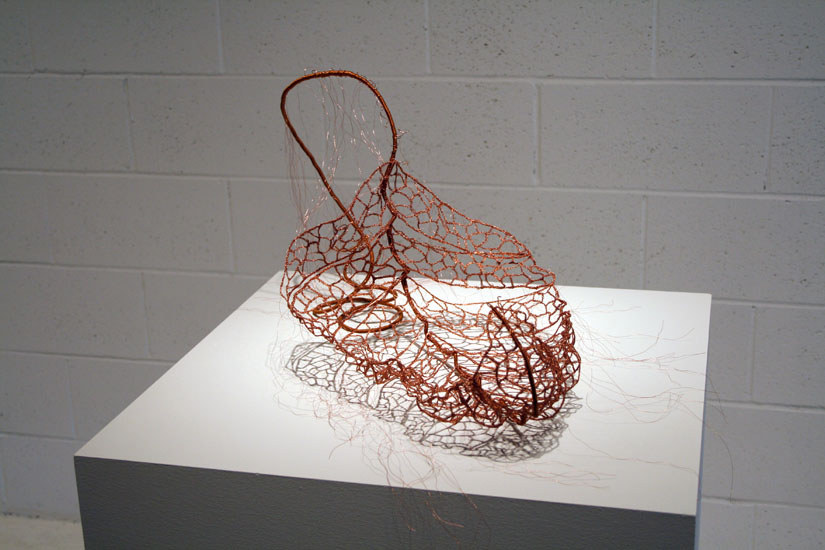
Cynthia Jackson exhibited her skeletal leaf Encore in Festival 2009 in the the Common Thread International Exhibition Part 3, at the B42 Gallery in Oakville.
Where do you get your inspiration?
Everywhere! I find it difficult to focus on a specific concept. I haven’t yet found my “raison d’être”, so I take my inspiration from the challenge of finding ways to make all my ideas come to life using embroidery.
Where did you first ‘discover’ goldwork?
Everywhere! I find it difficult to focus on a specific concept. I haven’t yet found my “raison d’être”, so I take my inspiration from the challenge of finding ways to make all my ideas come to life using embroidery.
Where did you first learn how to embroider?
I “discovered” goldwork towards the end of my apprenticeship at the Royal School of Needlework. Being one of the most difficult techniques it was kept until we had mastered most of the others. I believe it was included in the “church-work” sampler along with long and short silk shading on figures and flowers. Church-work was followed by Regimental Embroidery also known as “both sides alike”
Which is your favourite fibre medium?
My medium of choice isn’t technically fibre at all – it’s gold wire. My work is classified as fibre because I use a fibre technique – embroidery.
I presume that you started off with "flat cloth embroidery." When/how did you find yourself moving from ‘usual’ embroidery, into a more elaborate form?
Gold-work has always been a very dimensional form of embroidery – highly padded and textural.
What other media do you work in, and how does this inform your fibre work?
Really nothing is off limits – I’ve used old fabric softener sheets and guitar strings in my artwork. To develop ideas I use photography, computer graphics and occasionally water colour and pencil crayon, but mostly I like to work out my initial ideas in pencil or pen. My drafting skills don’t extend to the three dimensional perspective which is important to my work so I will also model using polymer clay, paper and muslin to create the pattern shapes I require.
Could you give me some idea of the kinds of objects, size, etc., that you have created?
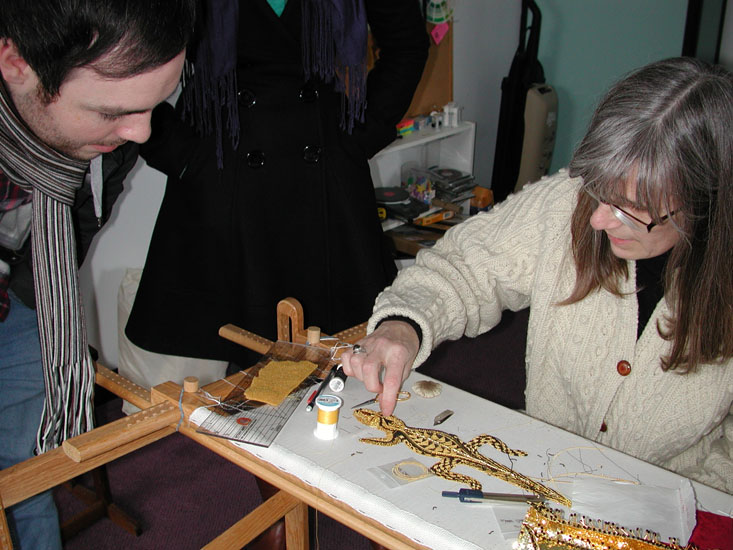
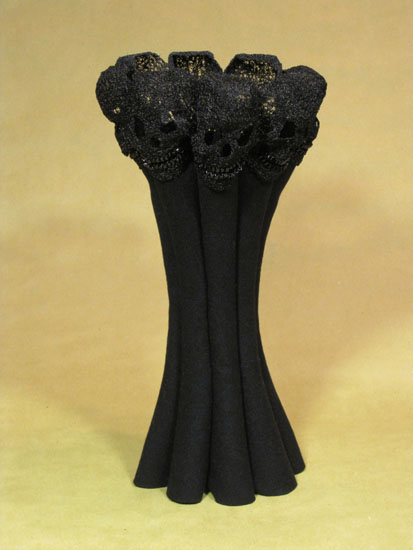
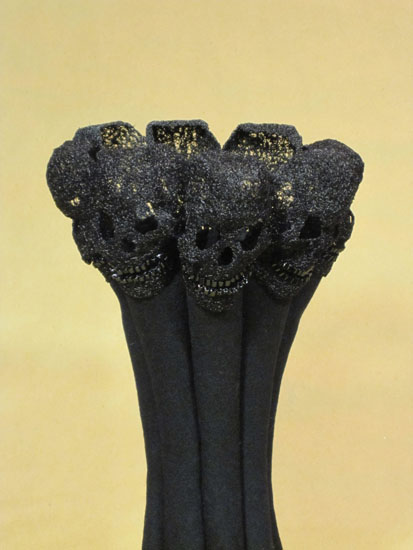
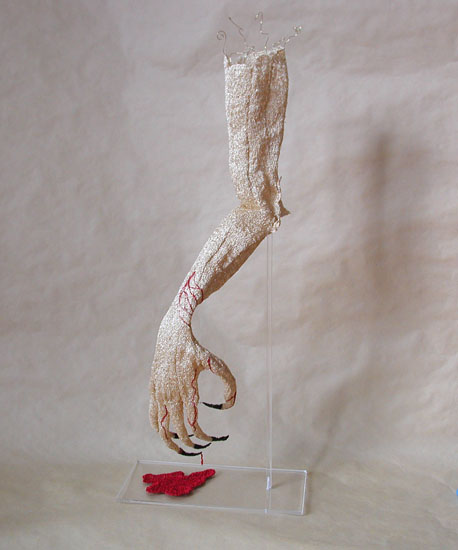
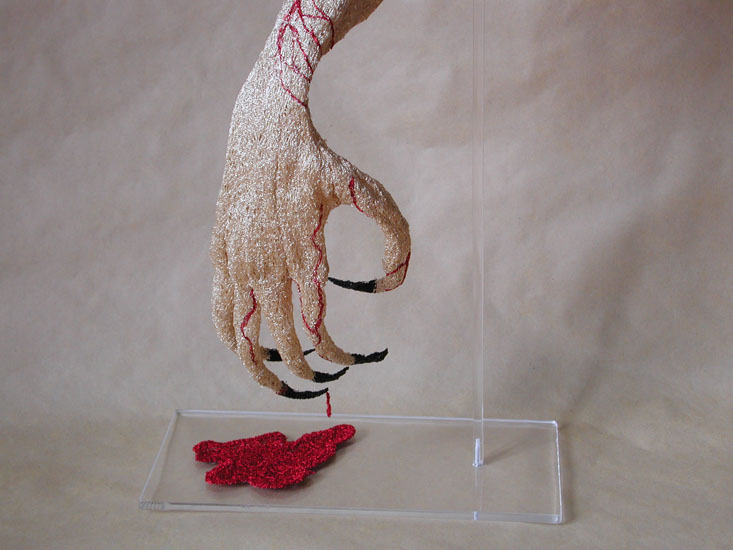
My three dimensional pieces are all in the 5” to 24” range. They include subject matter as diverse as shoes, skulls, seeds, sea creatures and a lizard. There is even a “bloody claw of doom – eh”. My largest and most satisfying (to me) work is “Listen” and it is 57”high, 9 feet wide and 6” deep. It was awarded the Society of Designer Craftsmen Award of Excellence at an exhibition in the UK.
How did you progress in the 3-D format?
It was probably about ten years ago when I was helping Merydie Fjarlie with the gold-work on the Bouquet of Celebration and Remembrance. It was a huge and technically challenging project.
Could you explain a little how you use these different types of media to create the pattern shapes you use?
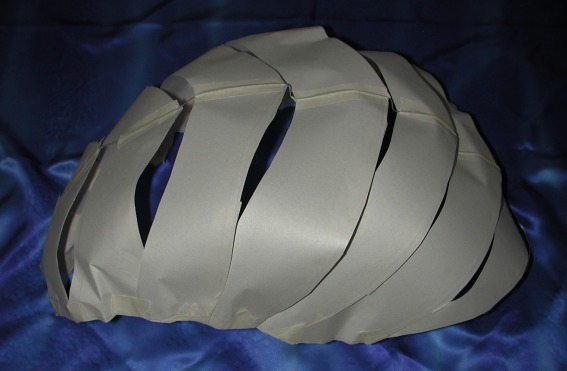
I usually have a good idea of which technique and material I’d like to use for the piece but sometimes I need to “see” it from all angles so I make a mock-up in whichever material will work for the project. For example here is a photo of the paper leaf which became the skeletal leaf Encore.
What specific historic artists have influenced your work?
Master embroiderers John Parr and Edmund Harrison and a host of anonymous embroiderers of the 16th and 17th century! I am in awe of the detailed work that was accomplished without benefit of artificial light and corrective lenses. The goldwork of the era was highly dimensional and technically complex. There are few extant examples of their work (in comparison to oil painters) but what has survived is amazing. Much of what hasn’t survived can be seen in the portraits of that era.
What specific contemporary artists have influenced your work?
As an artist I was first influenced by Mark Rothko. I greatly admire his ability to evoke a sense of deep emotional reflection. I have learned to be vulnerable to the experience and to appreciate that there is more than what is immediately apparent visually.
What other fibre artists are you interested in?
Canadian artist Kai Chan uses unusual and found materials to create delicate three dimensional work. Yinka Shonibare (UK and Nigeria) explores concepts of social convention and colonialism, through the use of colourful contemporary African textile in sculptural form
What role do you think fibre art plays in contemporary art?
I’m really not quite sure what “fibre art” is. Fibre is ubiquitous throughout contemporary art: think of artists such as Rebecca Belmore, Tracey Emin, Joyce Wieland and Louise Bourgeois. I think labeling our work limits the ability to appreciate it for its own sake.
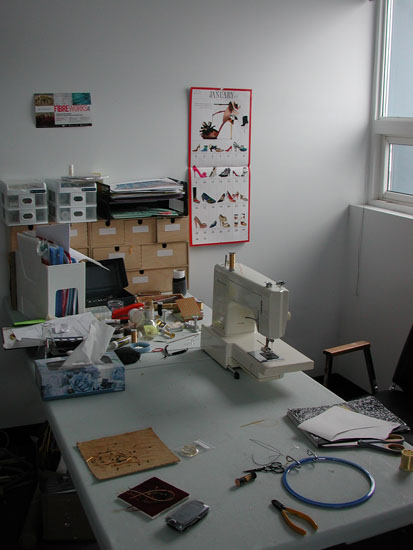
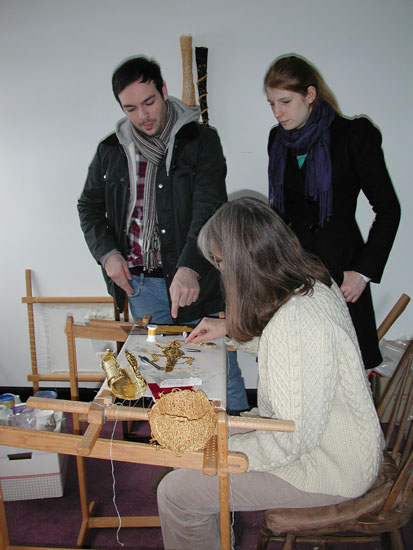
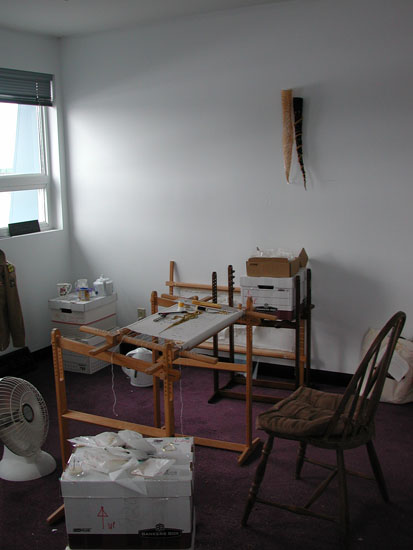
Tell us about your studio and how you work:
I love my studio. It’s quiet; sun-filled on sunny days but still brightly lit when it’s cloudy. There is no phone, no fax, no computer: just me, CBC radio and books on CD. I use stations for various activities: each has its own physical, emotional and creative space. Some days I’ll be constantly moving from one to the next and other days I’ll settle in at one and stay there for hours. It’s rarely neat, but always organized.
