Artist Interview 98: Merill Comeau
Concord, Massachusetts, USA.
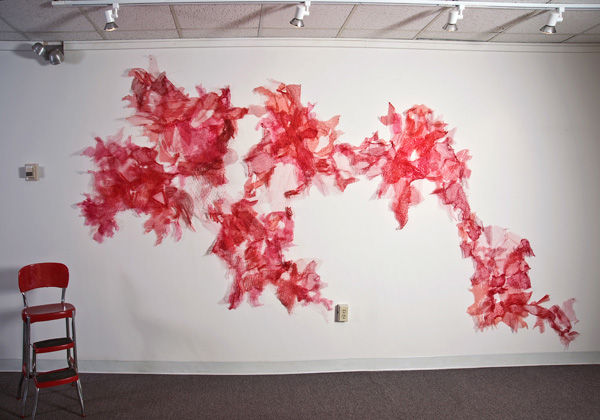
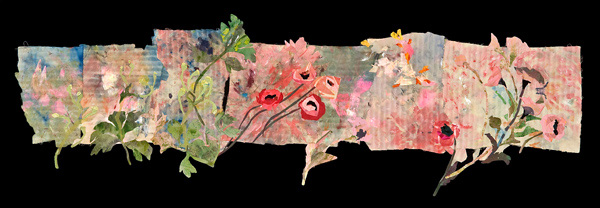
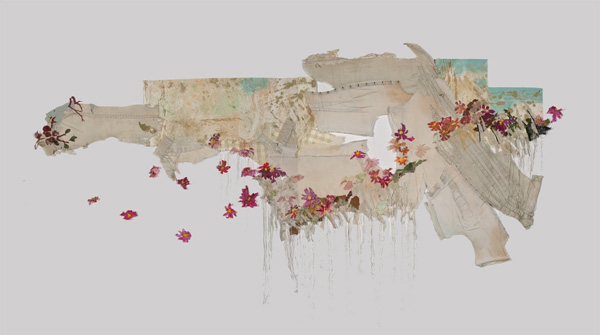
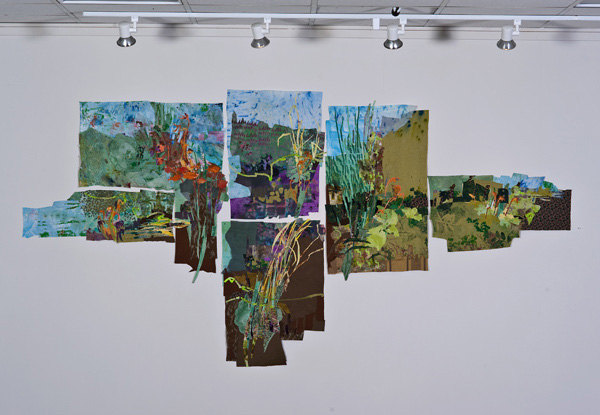
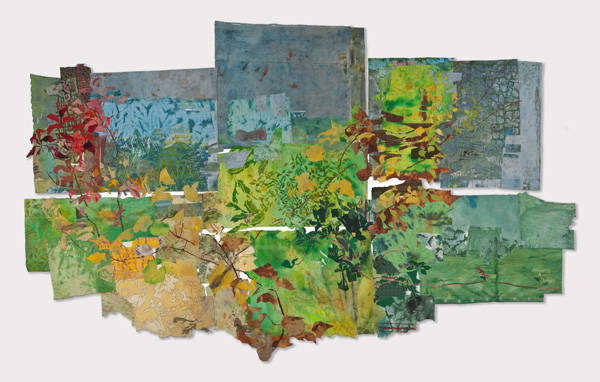
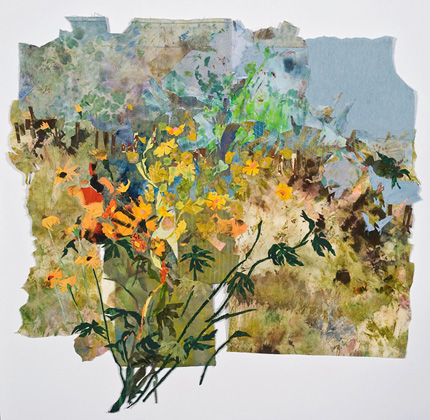
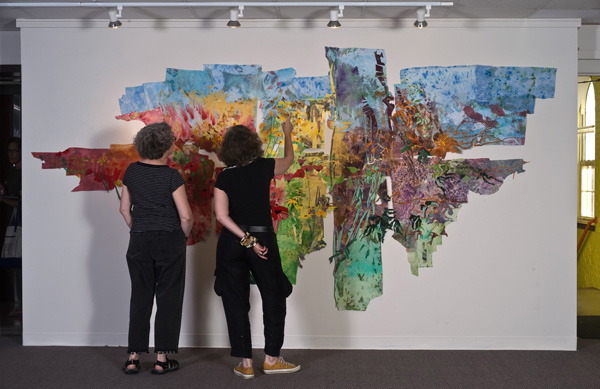
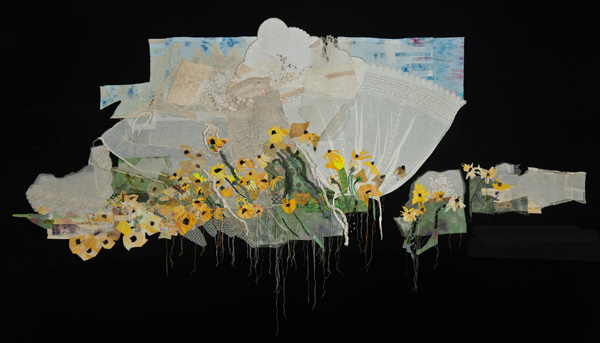
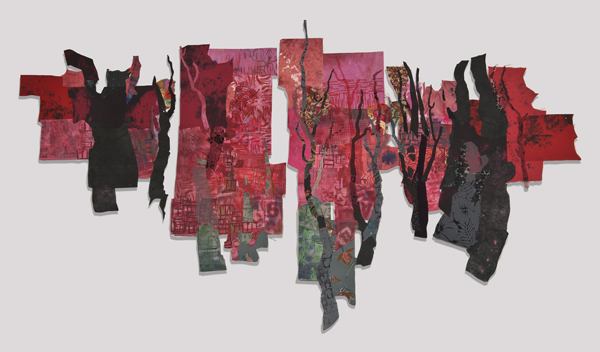
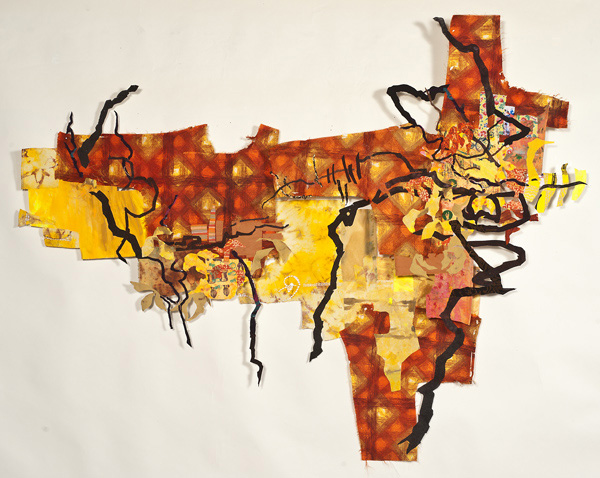
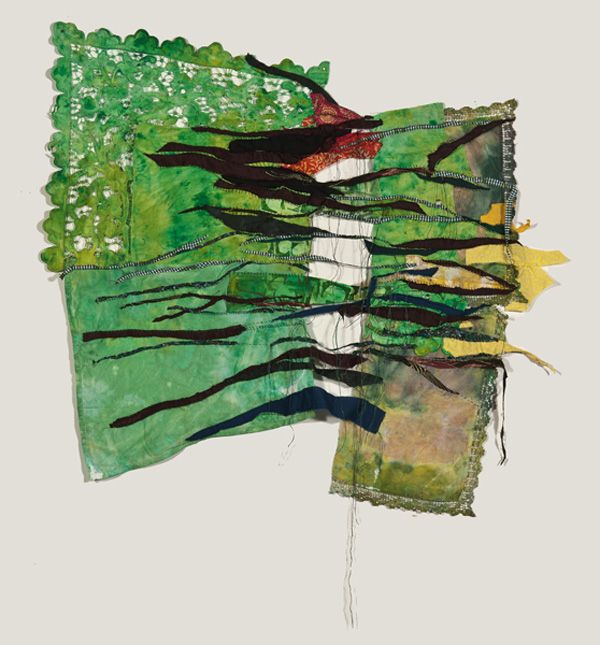
An enthusiastic recycler, Merill produces her work primarily from discarded materials, creating large-scale, wall-hung murals with discarded clothing, salvaged fabrics, plastic net vegetable bags and thread. Attempting to make sense of a life bombarded with information and beset with challenges she uses detritus and repurposed fabrics to reflect her concern for the environment.
Tell us about your work?
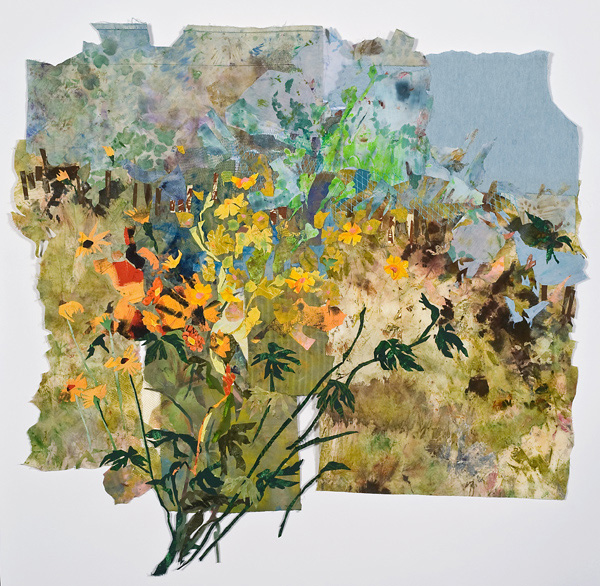
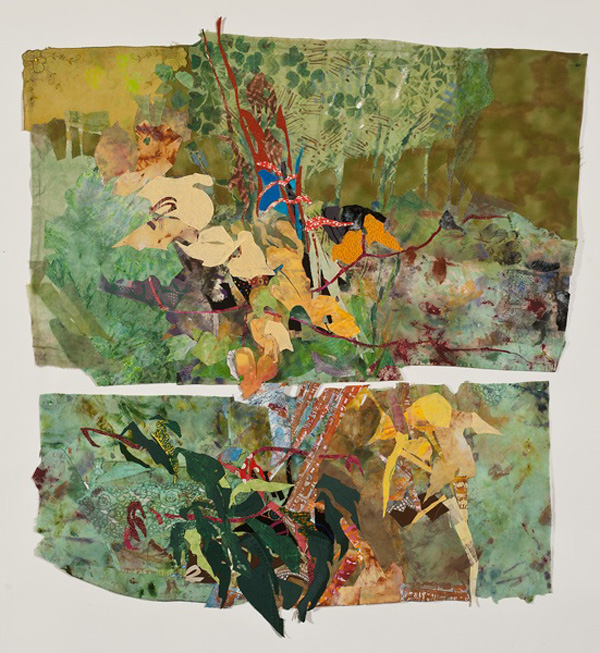
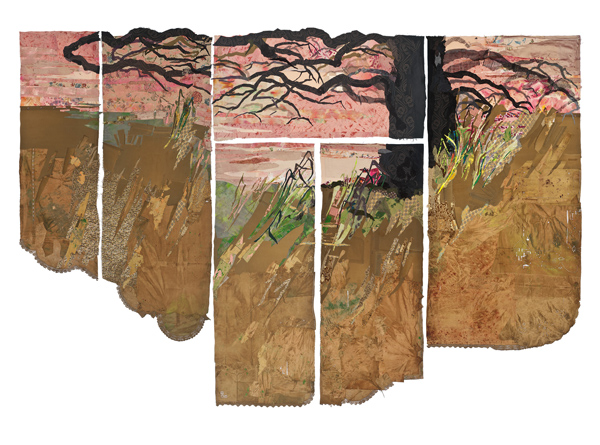
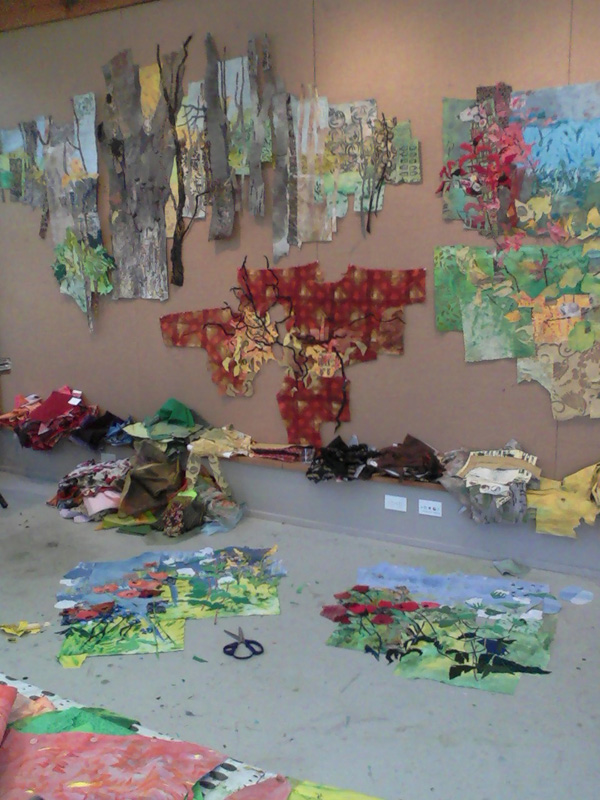
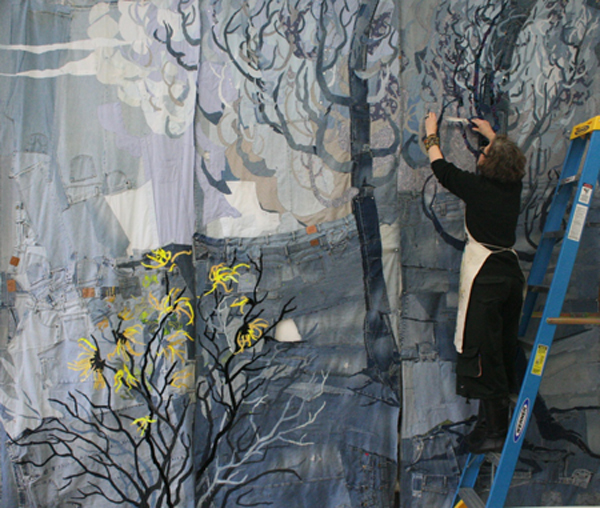
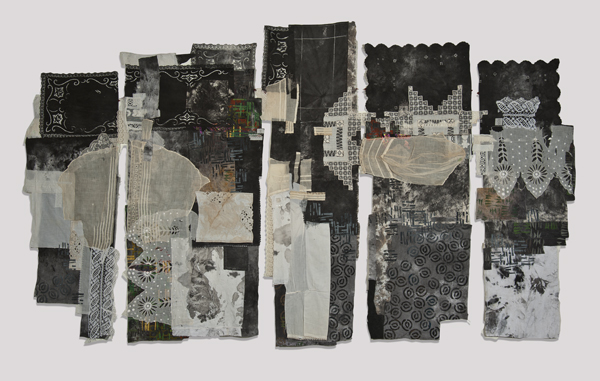
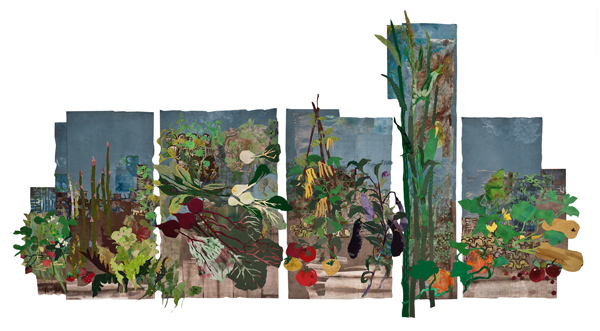
I am a fibre artist working with discarded, repurposed materials. I collage large, multi-sectioned, wall-hung murals. For the past three years I worked on a project titled Fragments of Eden, optimistically imagining a new garden arising from our debris. Currently I am working on an abstract series titled Edge of Darkness, which explores issues of loss, grief, memory and repair.
Textiles are part of our everyday experience: we sleep in sheets, dress our bodies, use ritual linens to mark celebrations, employ fibres to bind and construct. My choice of medium reflects my interest in our shared experience of cloth. My use of detritus and practice of repurposing reflects my concern for the environment. I collage seemingly disparate elements into a unified whole, attempting to make sense of a life bombarded with information and beset with challenges.
Previous World of Threads Exhibitions
Merrill Comeau exhibited in Festival 2014 Solo Shows.
I find human society and how we inhabit the world fascinating and concerning.
Where do you get your inspiration?
1. Autobiography – my narrative, my story, what I am trying to make sense of.
I think about life events and frustrations as I work. Also, because I often know the people who give me their discarded materials, as I work I am surrounded by my community and I think of my friends and family.
2. My materials – the poignancy of a worn piece of clothing: soft, tattered and laced with stains carrying the memory of lives lived, meals shared, parties attended. The expressiveness of a stitch of thread; I love a thimble, a needle, and thread! I always say I could take a bath in fabric – I like the sensual pleasure of working with fibres.
3. Engagement with the world – my concern about global manufacturing, my awe of the beauty and power of nature. I was a social theory major in college and studied design in my thirties. I find human society and how we inhabit the world fascinating and concerning. I am inspired by nature's chaos and order and its infinite array of form, colour, structure and texture.
4. Books –The Fabric of Cultures: Fashion, Identity, and Globalization edited by Eugenia Paulicelli and Hazel Clark. This book explores the United States and global clothing manufacturing and how fashion and markets reflect culture, identity and economics. The artist Jodi Colella introduced me to the book The Age of Homespun by Laurel Thatcher Ulrich that examines women-owned objects from early days in this country and how they illustrate relationships, gender roles and values of the time. I heard Elissa Auther speak at Fiber Philadelphia 2012 and have read her book String Felt Thread: the Hierarchy of Art and Craft in American Art. Beverly Gordon's Textiles: the Whole Story reads like a college level course given by an articulate, enthusiastic professor.
What specific historic artists have influenced your work?
My first real engagement with art was in high school when I avoided my mother by hiding in the local library (where I knew she would never look for me) and I stumbled upon the word juxtaposed in a book about Impressionism. I was captivated with the idea that you could daub blobs of different colours next to each other, and that the eye would enjoy the work of making sense of them. In high school I built my first memory box, à la Joseph Cornell. I loved telling my story through my sentimental objects arranged as I saw fit – elevated in status by setting them carefully in a box. In college I was introduced to Roberto Matta and his abstract forms. I just saw a show of his in New York City at the Pace Gallery last year … enormous paintings he did in his eighties … if only I could be so lucky to be working with such vigour at that age. Another "historical" figure would have to be Robert Rauchenberg. What permission his work gives: appropriation, abstraction, paint, silkscreen, found objects – everything is a source for expression.
I think it was incredibly important for me to see the work of women artists – and I wish I had known about more of them in my youth. In the seventies I was greatly moved and inspired by Judy Chicago – her brazen, female-centric imagery and her employment in new ways of traditional women's work techniques. In the 70s I stood in line to see The Dinner Party and was high on the experience of seeing this work in the heady days of the women's movement. Her biography is also worth reading: Becoming Judy Chicago by Gail Levin. There are so many women who paved the way for the work I do today: Miriam Schapiro, Sheila Hicks, Eva Hesse and Louise Bourgeois. These artists pioneered the use of fibrous materials to create art.
What specific contemporary artists have influenced your work?
So many contemporary artists inspire me and influence how I think about art and my work. It is hard for me to list just a few! Some of the folks I have been looking at lately include:
Xenobia Bailey, (New York City) uses the traditional method of crochet in vibrant new ways. She inspires me to be bold in colour and form and illustrates that artists can create environments out of their work.
Mark Bradford, (Los Angeles) combines materials and paint into large abstract wall works. He reminds me of how much I love a good mixed media painting. He inspires me to create large work and to let my environment and the materials at hand be present in the work.
Nick Cave, (Chicago) sculptor, dancer, and performance artist uses various fibre sources to create "sound suits" used in performance works. He inspires me to blur boundaries between fashion and art, to combine multiples of like materials and makes me dream of where I may explore in my future.
Adrian Ghenie, (Romanian born, works in London) creates large paintings with abstraction and figural references. His recent exhibition at the Pace Gallery in New York City blew me away because of his mastery with paint. He inspires me to be brave with my use of colour and to love the sensual surface of wall work.
Cornelia Parker, British sculptor creates installations exploring material that inspire me to think about what is left behind and how elements inhabit space and/or create negative space.
Jean Shin, (New York City) creates installations exploring material, including some fabulous work using deconstructed clothing. She inspires me to see things anew through the arrangement of elements.
Shinique Smith, (Brooklyn, New York) binds clothing, including her own, into 3-D sculpture and combines her sculpture with wall murals. She inspires me to draw from and honour references to the self and to engage walls, floors and ceiling.
Yinka Shonibare, (London, England) uses traditional wax resist techniques to create fabrics that he uses in figurative sculpture and installations referring to history and commenting on society. His exquisite craft inspires me, and his reference to history and re-claiming of traditional techniques employed in a new way.
Sarah Sze, (New York City) uses ordinary things to create extraordinary sculptures. She inspires me to see the beauty in line and form.
Amy Yoes, (New York City) uses an incredible array of mediums to explore spaces, forms, and ornament. Yoes was a visiting critic when I was at Vermont Studio Center and she gave me feedback that I still value and use. She inspires me to not limit myself, to give myself time to fully explore a given material and/or motif.
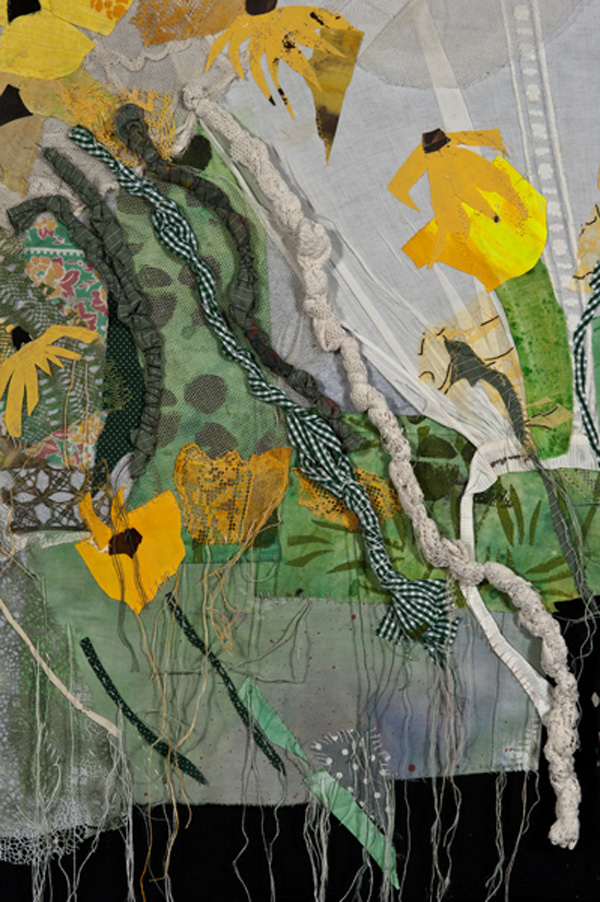
I can see the evidence of someone's hand stitching when I deconstruct an antique garment.
Why did you choose to go into fibre art?
My first foray was the result of what I had on hand. During the years I had school-aged children, I ran an interior design business out of my home. At the same time, I worked with community groups leading them through a series of workshops in which they explored who they were as individuals, what they had in common, and how they wanted to express themselves to the wider world. They created self-portraits, mandalas and wall hangings from fabric. So I used discontinued fabric samples and community art-making supplies to create my first works.
I am sure my choice of fibre also harkens back to my family history of seamstresses and the greater history of "women's work". I feel part of a long continuum of women salvaging bits of still useful cloth to create something beautiful for themselves, their home and their family. I can see the evidence of someone's hand stitching when I deconstruct an antique garment. I think about the fact that I am undoing another woman's work, yet continuing to see the usefulness of the fibre. A piece I am working on now is titled Women's Work is Never Done and will be a large collection of small samples made from painted black rags illustrating the different techniques used to manipulate fabric for the creation of clothing: darts, ruffles, pleats, seams, etc.
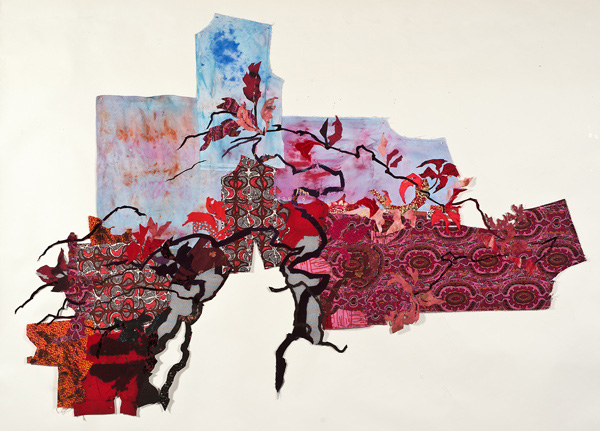
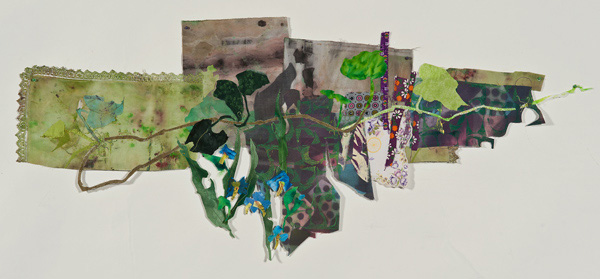
Looking at what others create opens up new possibilities, ideas spring to my mind, and concepts develop.
Is there something that/someone who in your life, has influenced your art?
My husband, Rick. He has influenced my art in that I wouldn't be able to create it without his support. He is very confident of my creativity and talent, and encourages time in the studio and my taking month-long residences. He also encourages me to stay engaged with the wider world and is very proud of my work with youth at risk.
Another influence is what I see. I am always looking, looking, looking at art, design, fashion and craft. I go to see as much as I can, and when I cannot get out … I surf and pin on Pinterest. My favourite museum is the Museum of Art and Design in New York because of the materiality of their exhibitions – such as the 2010 exhibition Slash of artists working in paper and the 2012 exhibition Swept Away: Dust, Ashes and Dirt.
I was inspired by the ideas in The New Museum 2012 Triennial: The Ungovernables.
I learned so much from the 2011 exhibition Fibers Futures: Japanese Textile Pioneers at the Japan Society in New York City and from attending Fiber Philadelphia 2012 – both offered a wealth of materials, methods and mastery for study. I always stop in at the Fashion Institute of Technology exhibitions when I am in New York City – this last time to see the sculptural pieces in Shoe Obsession, and I was so moved by the exhibition of fashion designer Alexander McQueen's work at the Metropolitan Museum in 2011. I will look at any kind of art from any period. Looking at what others create opens up new possibilities, ideas spring to my mind, and concepts develop.
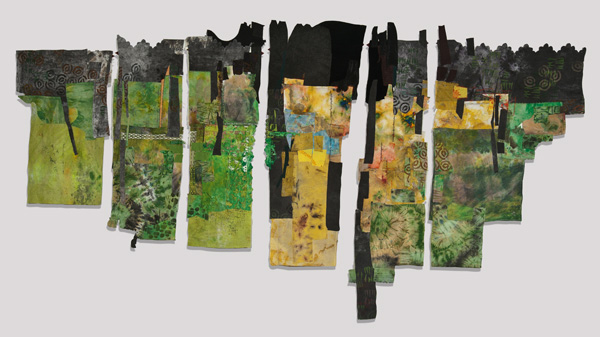
Working in fibre leads to opportunities to create installations.
How did you initially start showing your work in galleries and do you find it more difficult to show and sell your work than non-fibre artists?
A neighbour of mine stopped by and saw my first piece as I was making it on my dining room table and told me to take it down to the local art association (she was on the curatorial committee). I thought of myself as a designer, not an artist, but I took it down. The director asked me how long it would take for me to finish it; she wanted to put it on the wall. So I started applying to and getting into juried group exhibitions, then solo shows, which led to invitations to exhibit. I shifted into the identity of being an artist as things took off.
Showing and selling, making a living, is difficult for all artists. I'm not sure it is more difficult for fibre artists. It is true that there are many people who want a stretched, square, painted canvas wired to hang – something easy to take home and put on a wall of their house. But painters have many other painters to compete with. If you work with fibre, it is easy to distinguish yourself from the crowd of artists. I also think I may have unique opportunities for commission work, as I can create a piece from the materials of peoples' loved ones – in celebration or memorial. Another bonus of working with fibre is the ability to use found materials and to create work that reflects context. Working in fibre leads to opportunities to create installations. I have sold work to a corporation, as some of my work fits well on a large wall. I hope to have more opportunities like that. I also juggle design projects and teaching to support my art practice. I like having alternative sources of income, which allows me to create work that I want to see and not be required to respond solely to what the public would buy. And one of the real benefits of being a fibre artist is that I can roll up my inventory! This makes it easier to store and to cart around to exhibitions!
It is possible that in the art world there are increased challenges to being identified as a fibre artist, but I'm not someone who is easily discouraged or who lets categories limit my sense of what I can accomplish.
Do you think the interest in fibre art is increasing and why?
Yes. The rules about what materials can be used and who uses them are loosening up. And, there is a new acceptance for one artist to use wildly divergent media and create a diverse array of work. The boundaries between sculpture and 2-D work are disintegrating and the demarcation between craft and fine art is being re-evaluated. All this leads to a greater acceptance of fibre and the integration of fibrous media into the mainstream art world and market.
Through your art, are you attempting to evoke particular feelings in your audience?
Oh no! Although I am compelled by the ideas and concepts behind my work and express my feelings through my art, my hope is that the viewer finds their own entry into the work. I don't like the idea of forcing my agenda, or controlling the viewer.
I do hope some people are attracted to, appreciate and feel compelled by the work! I think the purpose of art is to help people see something in a new way. Personally, I love discussing art that I love and art that I dislike. I'm happy to have my work fall on either side of someone else's discussion.
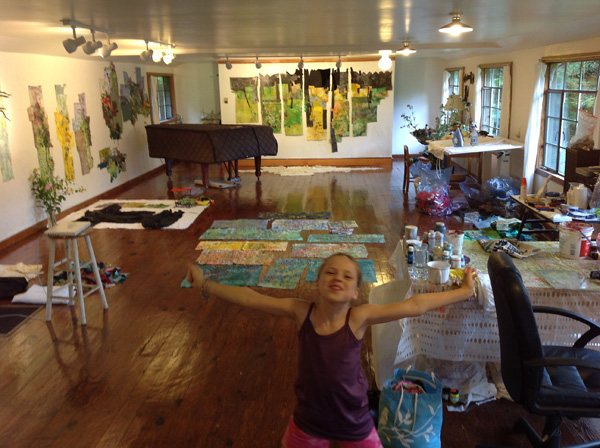
I am always impressed by their observations and moved by their efforts to create work that represents them.
You have been an Artist in Residency on a number of occasions. Tell us about the experience.
I'm glad you asked about this – experiences dear to my heart! There are not always significant monetary rewards for being an artist. But one unique benefit is that we can participate in the extensive network of residencies specifically designed to provide time and support for creative work. In a residency setting, with long hours of uninterrupted time to focus, I explore a backlog of ideas, techniques and materials that I dream about but that I am not able to get to during my normal life. On residency I tackle challenges, create anew and never focus on completion. Being in the company of like-minded residents is empowering, stimulating and fun. I have made friends, seen new places, been inspired by and exposed to creative expressions I would never have found on my own.
In 2009 I went on my first residency at the Vermont Studio Center in Johnson, Vermont – a residency distinguished by its size (60 writers and artists are in residence each month) and its visiting artist program. Each week two visiting artists give presentations about their work and meet with residents in their studios to discuss work. I challenged myself to create a small work each day using new colours and forms, to create some larger works in black and white, to incorporate clothing elements, and to begin my first wall sized work. I found it hard to live in such a large community of unfamiliar people, but I left having made friends I still see regularly today. A bonus for me was attending the weekly readings by visiting and resident writers and poets.
For my second residency in 2011, I stayed in a quaint cottage and had sole use of a new studio at the Weir Farm Art Center in Wilton, Connecticut. This farm, now a national park, is the only residence continuously inhabited by artists since the time of American Impressionism. I loved being part of this continuum and having oodles of alone time. I challenged myself to draw every day, create work from sections of clothing without altering their forms, and to create a large work made only from red patterns. The bonus was catching the local commuter train to New York City to see exhibitions.
This past fall I spent a month at the Hambidge Center for Art and Science in Raban Gap, Georgia. Established in 1934, this program is situated on 600 acres of temperate rain forest. Writers, musicians and artists each have their own secluded residence with attached studio space. A southern chef cooks dinner and residents eat together on a candlelit, screened porch. Living on this rural sanctuary felt like living in the Garden of Eden. Again I challenged myself to draw every day. I also explored putting whole clothing into my work, techniques of creating wall relief in fabric, working abstractly, and hand stitching. As I have family in the area, the bonus was seeing siblings and being an aunt.
In addition to my attending residencies to create my own work I am a teaching artist. For the past two years I have been an artist-in-residence at a residential treatment program for teen women who are in the court system. I absolutely love working with these students to explore and to visually express their identities, what they value, and their hopes for their futures. Students make both take home projects and create collaborative group works, which are installed on-site. I teach collage, painting and printing on fabric, and sewing techniques. They learn basic 2-D principles as we work. We look at and discuss relevant examples of art, craft and design from all different periods and styles. I am always impressed by their observations and moved by their efforts to create work that represents them.
What project has given you the most satisfaction and why?
I am never satisfied with work I have produced -- I always think my next project will be the most satisfying! I mine my dissatisfaction – it always spurs me on to create. I am so excited by and want to delve into all the possibilities.
Tell us about your studio and how you work:
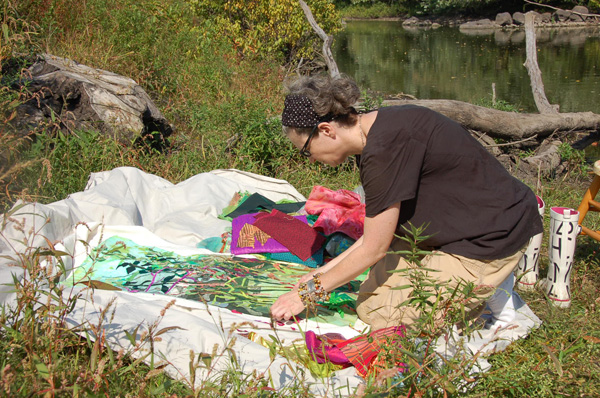
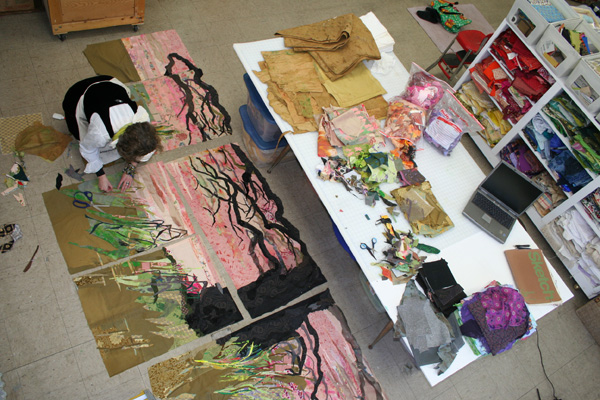
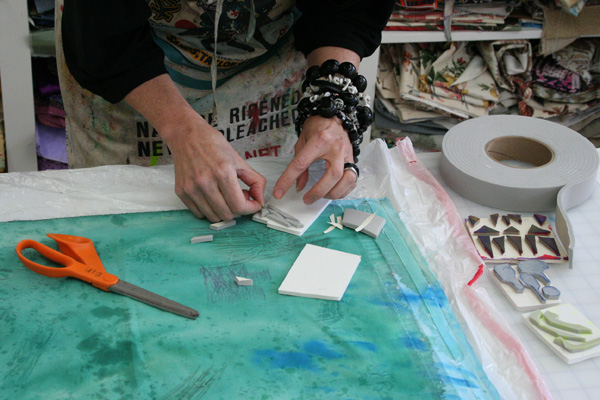
My studio is a big, sunny classroom in an old brick school building. I have a 4x8 foot worktable, a large pin up wall, and a sitting area with a chaise for napping. My supplies and tools are organized and stored at hand. It is very quiet in my building and people respect each other's privacy and need for concentration.
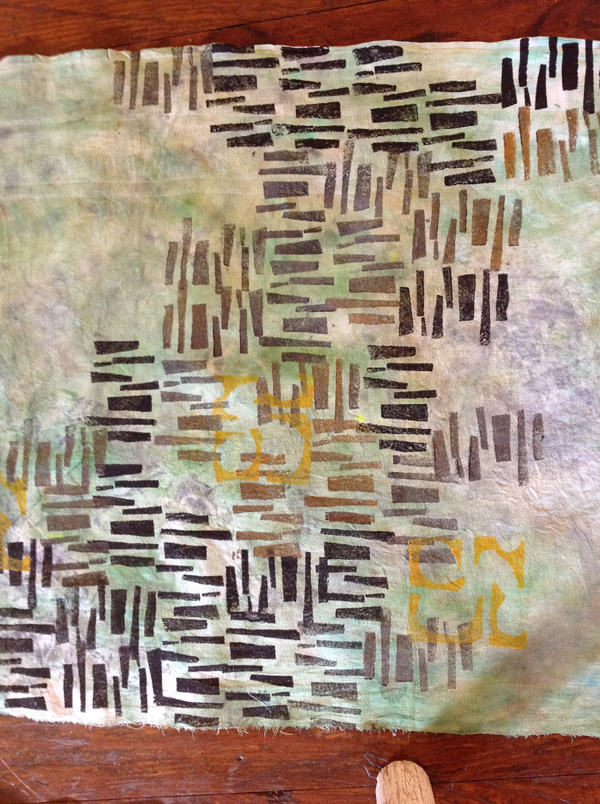
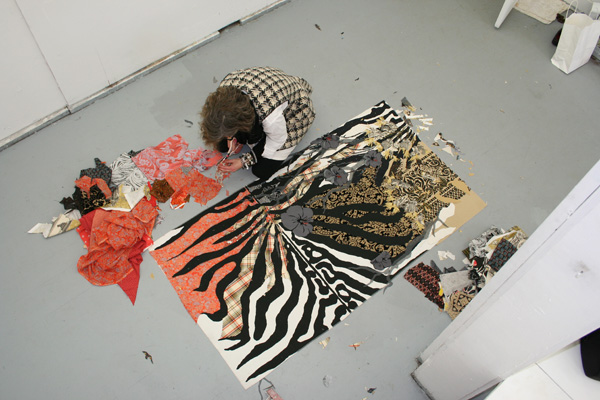
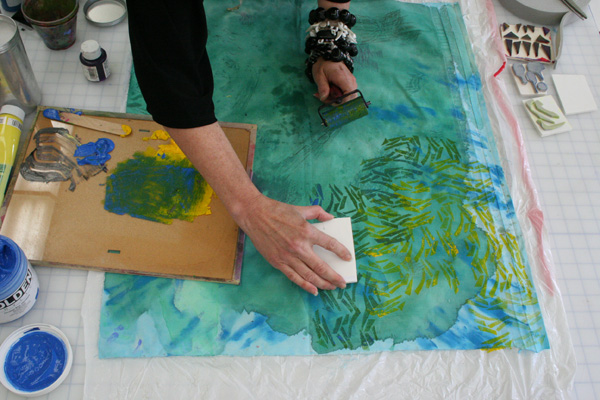
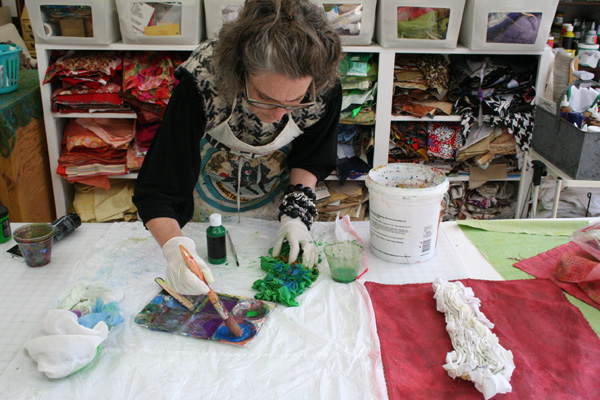
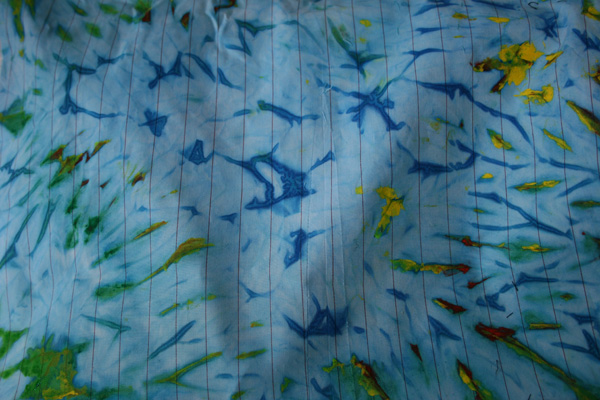
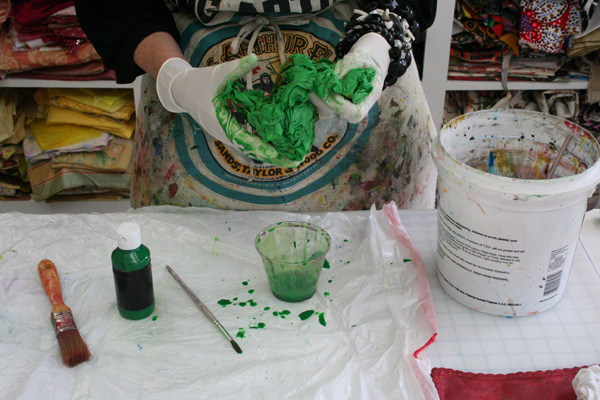
I spend a lot of time preparing the materials I use in my work. I draw, deconstruct clothing, stitch old linens to be resist-painted, and paint and print on fabric and fibres. I collage small works to warm up and to explore ideas. I start large work by laying out materials on the linoleum floor because the grid helps me keep the sections organized. As I am arranging pieces, I climb up my 12' stepladder to "stand back" and look, and then climb down and arrange some more. Once I have a section well in hand, I lightly adhere the snippets together, pin it up on the wall, and begin editing. Sewing and embroidery are the final stages of my work. I use free motion and zigzag stitch to hold everything together and then embellish with hand stitching.
Where do you imagine your work in five years?
I would like to expand the materials I work with as well as the techniques I use for mark making. I started my practice with fabric and thread and am now adding things like paper and tape. I have always loved drawing and I am trying new methods and including them in my work. I would like to explore creating pubic art outdoors and include public participation. I would like to work with my own clothing – altering, printing and painting on it. I imagine I will still enjoy my teaching artist practice and will be working with youth at risk. And I hope I will attend a residency in a different country!
What interests you about the World of Threads festival?
The World of Threads festival provides an opportunity for the general public and other artists to see and learn about fibre art. Your documentation of the exhibitions allows people to access the art online if they cannot attend in person. Your artist interview series offers a rare, in-depth look into artists' ideas, motivations, and processes. Fibre arts festivals, exhibitions, magazines and newsletters are essential for the promotion of and education about fibre art. Keep up the good work!
Is there anything else that you would like us to know about you or your work that we have not asked?
One other important thing in my life is my Women Artists Coaching Group. In 2009 I formed a self-coaching group that meets monthly to share skills, develop marketing plans and set goals. We hold each other accountable, celebrate successes, and support each other when discouraged. We meet over a bag supper, share laughter and tears. In many ways my journey as an artist is solo, yet the business of being an artist requires me to acquire many skills and to effectively engage with others. I love being part of this group of women who are crafting their careers as carefully as they create their art.