Boston, Massachusetts, USA
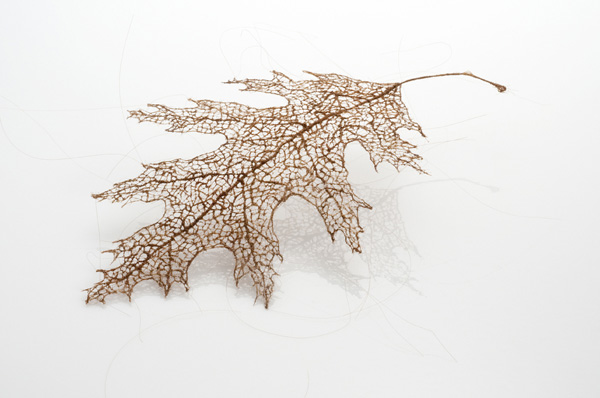
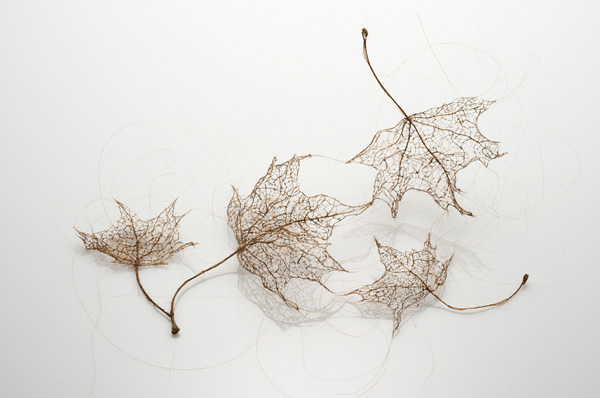
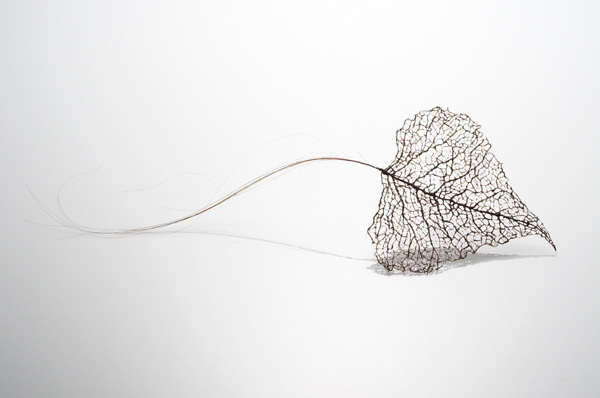
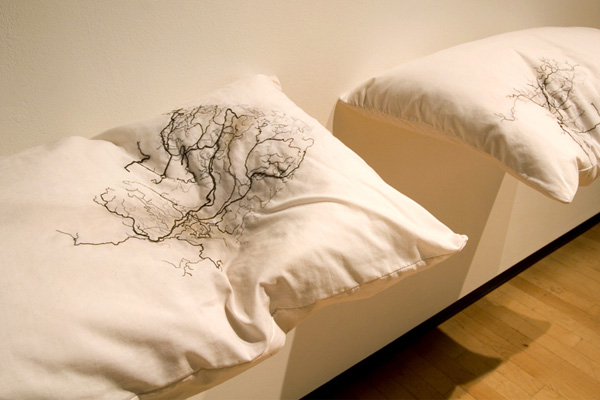
Sculptor and installation artist, Jenine uses fibre and textile in her artwork. From her collection of found skeleton leaves, and working with humble materials such as hair or thread, referencing the traditional lace-making techniques, she creates the intricate line-work of leaves. She says there is a parallel between the vascular tissue of plants to the vascular system of the human body.
Tell us about your work?
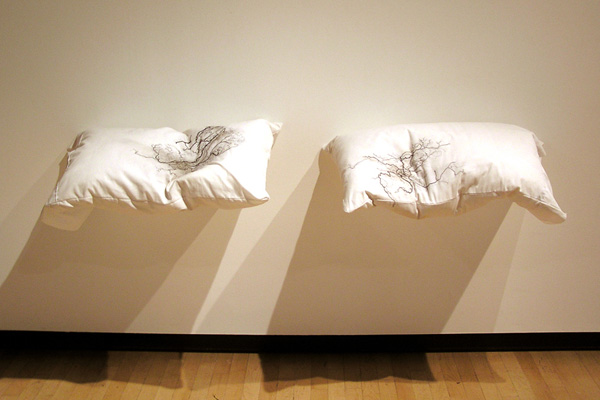
Using the language of textiles, my work explores themes of personal and collective memory. I am interested in the way our experiences of the world are absorbed through the body on both a psychological level and a biological level as well. I often work with humble materials such as hair or thread and even more ephemeral qualities such as light, shadow, and breath. Concepts of memory, trace and human presence are subtly alluded to within my work.
Where do you get your inspiration?
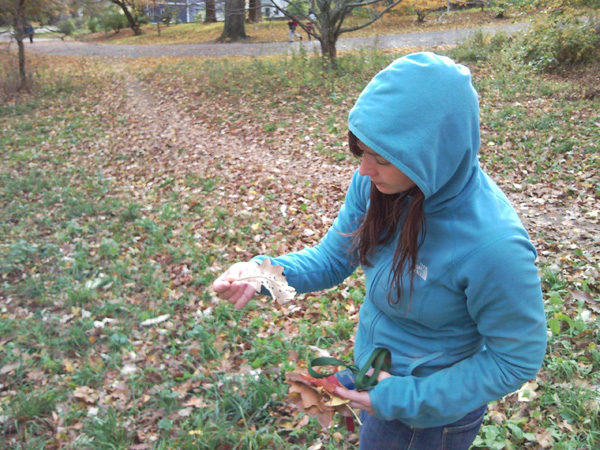
I find much of my inspiration from long walks and observations in nature. For example my idea for the Leaf series began several years ago while hiking in Northern California. I came across a number of leaf skeletons, which I collected and kept in my studio. I had been interested in branching and organic forms for a long time and I was particularly drawn to the detailed and delicate nature of the leaves. The intricate line-work in the venation of the leaves reminded me so much of hair! I had worked with hair in the past, and wanted to explore it further, both as material and metaphor. It was this collection of found skeleton leaves that sparked my process of experimentation
What specific historic artists have influenced your work?
Historically I have been most influenced by looking at world textiles. While traveling in Hungary a few years ago I had the opportunity to visit the Ethnographical Museum in Budapest. The museum houses artifacts from the rural folk culture of Hungary, dating from the prehistoric era to the 20th century. I was entranced by the intricate embroidery work on all of the garments and textiles, the time and care that had gone into their creation and the resourcefulness of the materials that were used. I am also fascinated by the history of weaving, and the fact that it has been such an integral part of human history for thousands of years!
Where do you get your inspiration?
I recently saw an inspiring exhibition at the Boston Institute of Contemporary Art entitled Dance/ Draw which explored notions of trace, movement, mark-making and human presence. One piece that I was particularly taken with was Bahamian artist, Janine Antoni's work Butterfly Kisses, in which she repeatedly batted her mascara-coated eyelashes against a large piece of paper, covering it with a dizzying and surprisingly arresting array of delicate black lines.
I have long been inspired by Antoni's innovative use of materials. I love her 1994 performance, Slumber, in which she recorded her rapid eye movement while dreaming and then wove that pattern into cloth that she used as her blanket while she slept at night in the gallery.
Other contemporary artists I admire include Palestinian artist Mona Hatoum'svisceral and disquieting works; Columbian artist Doris Salcedo's haunting use of personal objects; British artist Cornelia Parker's poetic transformation of materials; and American artist Tim Hawkinson's bizarre and whimsical inventions. In particular, I like Hawkinson's 1997 piece entitled Bird, in which he painstakingly re-created a bird skeleton out of fingernail clippings.
I also find great inspiration from the arte povera movement of the 1960's and 70's, in which artists were working with humble materials and exploring themes of the body and connectedness to nature. I especially admire the poetic works of Giuseppe Penone. In 1968, Penone inserted a steel cast of his hand in a tree trunk to create the piece Continuerà a crescere tranne che in quel punto ("It Will Continue to Grow Except at that Point"), and in 1969 for Il suo essere nel ventiduesimo anno di età in un'ora fantastica ("His Being in the Twenty-Second Year of his Age in a Fantastic Hour"), he partially carved into the beam of a tree, revealing the tree as it was when it was his own age.
What other fibre artists are you interested in?
I have long admired the poetic and sensorial works of American installation artist Ann Hamilton, who uses textile materials and processes to explore language, text, memory, and time. I am also drawn to the work of American artist Anne Wilson, particularly her Damask series and Topologies; American artist Lenore Tawney's delicate woven works; Polish artist Magdalena Abakanowicz'smassive woven installations and sculptures, just to name a few.
What role do you think fibre art plays in contemporary art?
I think fibre techniques and materials play an integral role in contemporary art. The medium lends itself so naturally to contemporary issues such as a renewed interest in craft, materiality and technology, personal identity, gender and labour
What project has given you the most satisfaction and why?
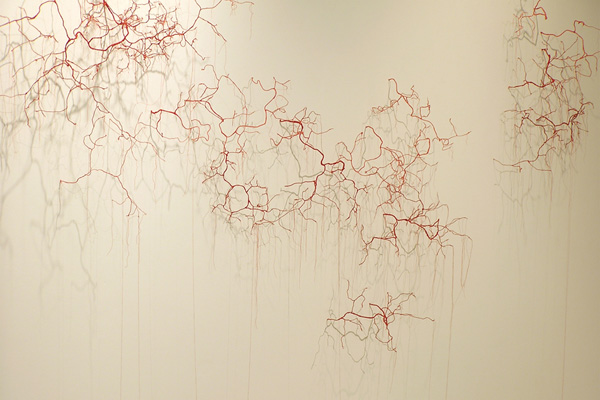
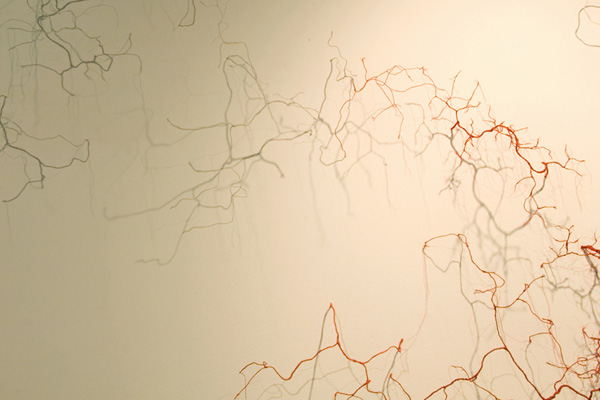
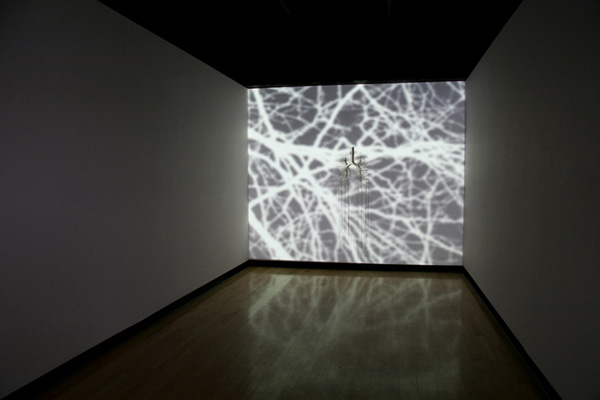
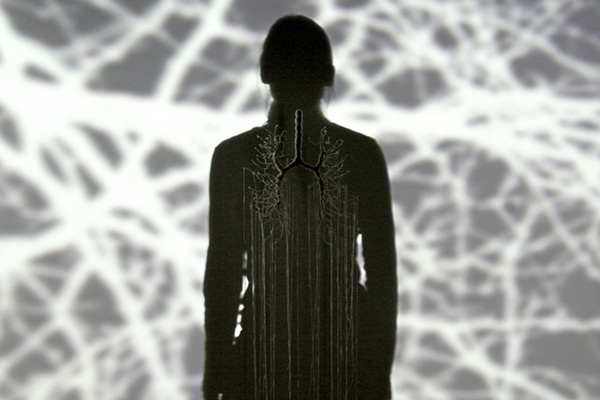
Over the years, there have been a few "breakthrough" pieces that have been especially important in my development as an artist. An installation that I did in 2005, Breathe, was a pivotal work for me, both thematically and materially, as I incorporated video, sound and textile techniques. In a description of the piece, I wrote: "Branch-like forms move subtly, fading in and out almost imperceptibly, as sounds of wind and breathing undulate in the background. A mysterious object is suspended in the center of the wall, and is revealed as the video fades to white. The viewer has the opportunity to align their shadow with this object, a pair of lungs constructed using fibrous materials, thus positioning themselves simultaneously within the body and within the landscape. Notions of the body, time and memory are alluded to within the work."
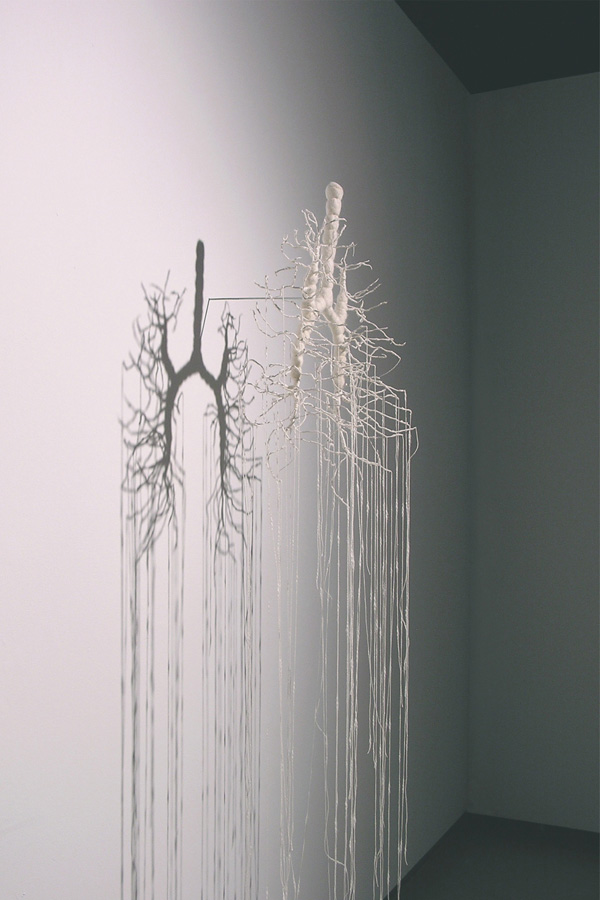
There is the parallel between the vascular tissue of plants as well as the vascular system of the human body.
What is your philosophy about the Art that you create?
A former professor once described my work as "fragile yet tenacious". This description has stayed with me over the years, and I think it applies to more or less every piece I have ever created. For me, this concept speaks to the fundamental experience of the human condition, both on a psychological level and on a biological level as well.
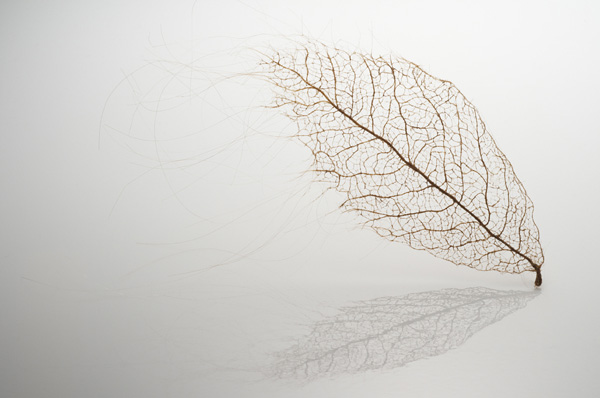
I am also very attracted to the idea of transformation and the way that humble materials can be used to make something strangely beautiful and unexpected. In the Leaf series, for example, the hair becomes the leaf, and the leaf becomes the hair; it is a sort of transubstantiation in a way. There is the parallel between the vascular tissue of plants as well as the vascular system of the human body. I am also alluding to natural systems of growth and decay. The work is very ephemeral. But this is just the beginning of course; and hopefully meaning continues to extend out from there.
What other mediums do you work in, and how does this inform your work?
In addition to fibre materials and techniques, I have also worked with video, installation, mold making and ceramics. I love experimenting with different materials and the conversation that happens between seeing what a material is capable of doing naturally, and how it can be manipulated. I also consider ephemeral qualities such as light, shadow and breath, to be just as important as the more tangible materials that I work with.
What bridges the works that you have created in differing media?
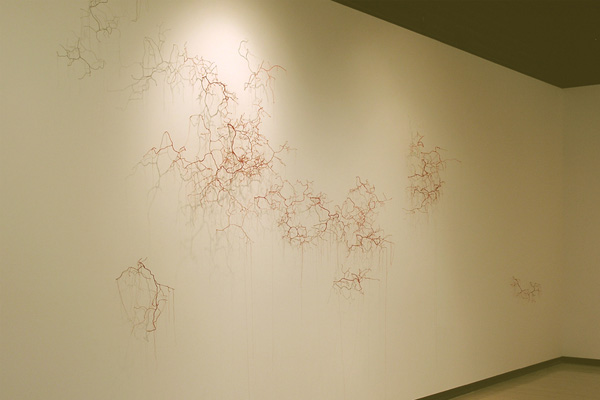
Conceptually, my work tends to address themes of memory and the body. Aesthetically, delicate line-work and branching forms often characterize my work. There is a sort of fragile and sometimes dark expression of beauty. I also tend to allude to things without specificity. The branching forms in Emergence, for example, seem to exist simultaneously as branches, roots, coral, vascular system, and ancestral roots.
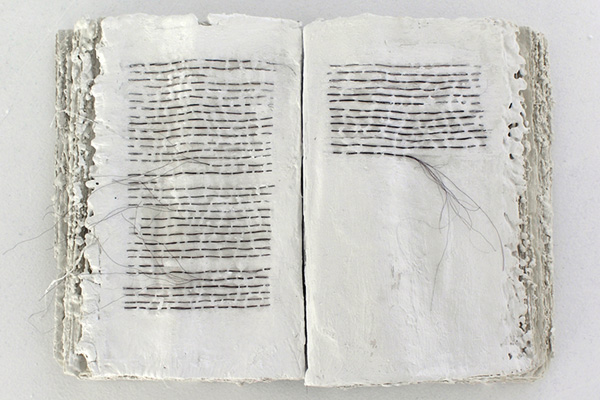
I love the idea of working with detritus that is part of our everyday lives but goes unnoticed, and what it means to transform such a material and attribute meaning to it.
Which is your favourite fibre medium?
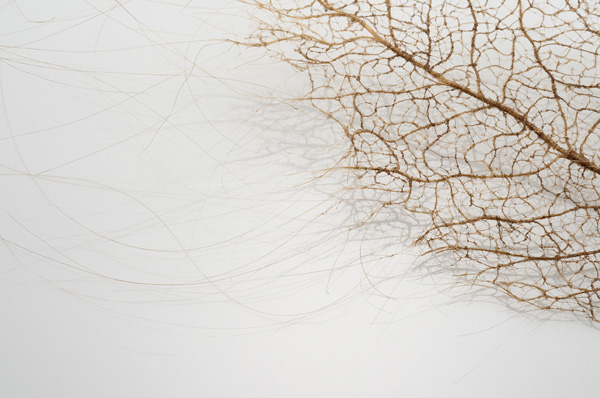
For the past few years, I have been attracted to working with hair. I often think of my work as dimensional drawing, and as a material, hair has the potential to produce such a fine, delicate line. I love the idea of working with detritus that is part of our everyday lives but goes unnoticed, and what it means to transform such a material and attribute meaning to it. I am also fascinated with the personal quality of hair. I love that it is an extension of the self that goes out into the world and is encoded with our unique DNA. It functions as a sort of memory or a trace. There is the reference to Victorian mourning jewellery as well. And then there is of course the attraction/ repulsion juxtaposition. Hair is seen as attractive and even luxurious when it is on one's head, and at the same time repulsive or disgusting when found as a single strand apart from the head.
Growing up I had a creative bent that manifested itself early on in creative writing and poetry. Gradually words became too elusive, and I felt myself grasping for some other way to comprehend and express my thoughts about the world around me. In high school I took a number of art classes and slowly over the years, my words became sculptures.
Where did you train and how did your training influence your art?
As an undergraduate, I studied painting at a small private liberal arts college. Although this experience provided me with a strong artistic base and fueled my passion for making art, I found myself quickly moving away from painting. My work started to become much more sculptural and I was layering materials and paint on canvas, stitching into the canvas, and embedding objects within it. During this time I was very influenced by the work of the German expressionist painter and sculptor Anselm Kiefer. I was searching for a more tactile expression and eventually I abandoned working on canvas all together. When I started to think about graduate school, I was primarily looking at Sculpture programs. Although I wanted to continue developing my work conceptually, I felt that grad school would be an important time for me to learn technical skills and explore materials and process. Coming from a small art department, I had not been aware of fibre/ textiles as an area of study. I was living in Southern California at the time, and when I discovered the Fiber Department at California State University, Long Beach, it opened up the rich language of fibre and history of textiles. I also had the opportunity to study with Carol Shaw-Sutton, who has been an important artistic mentor for me.
How does your early work differ from what you are doing now?
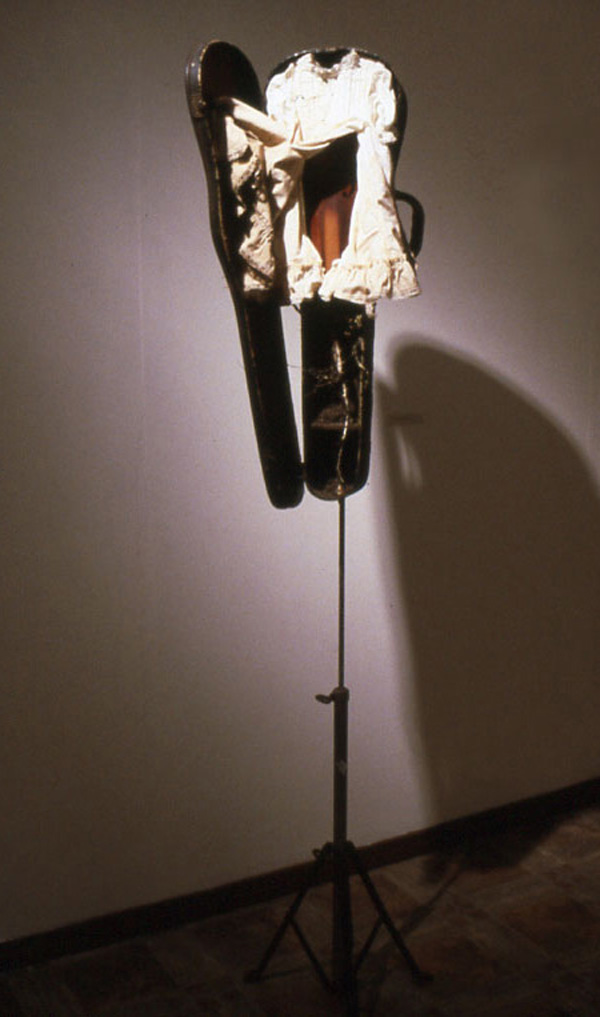
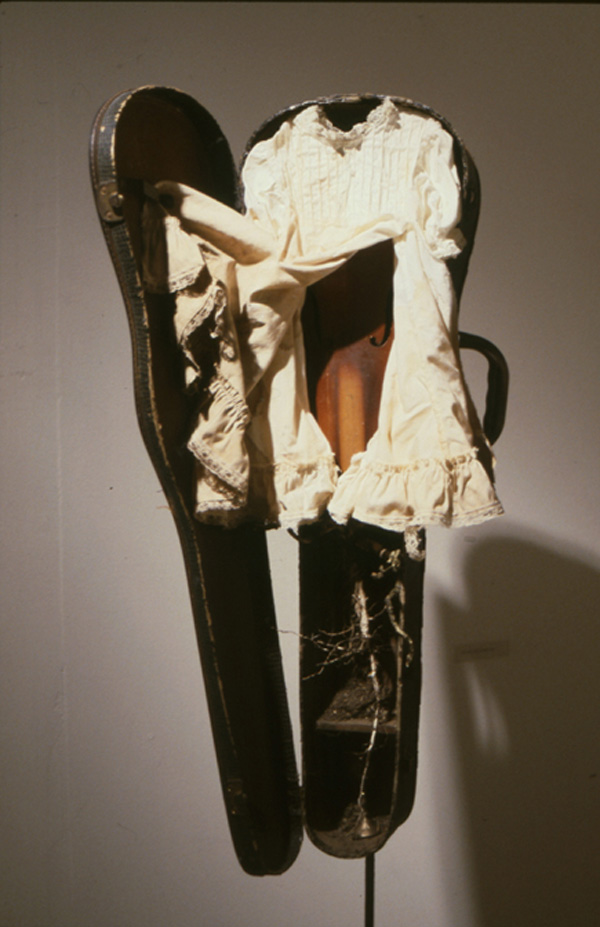
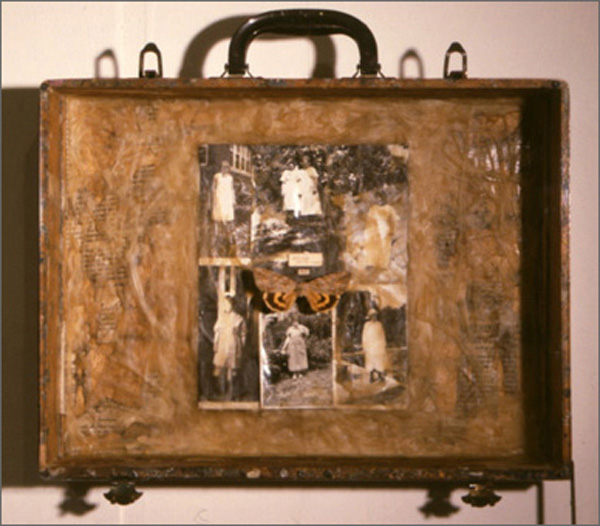
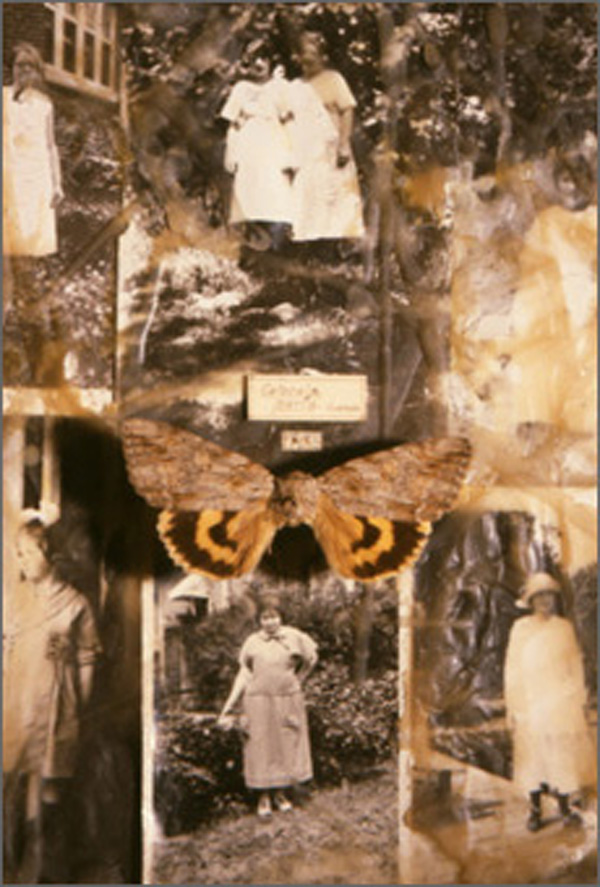
My early work was very assemblage based. I was attracted to objects that had a history, or a story, even if I would never know what that story was. My studio was filled with antique photographs, butterfly and insect collections, and broken instrument parts that I found in thrift stores and at flea markets. I found many of these treasures on trips to visit my family in Chicago, the city of my birth and early childhood. In the neighbourhood where my parents lived, a family friend by the name of George Stotis owned a shop consisting of two floors absolutely filled with old discarded objects. George was a small, unassuming man with a twinkle in his eye. He spent day in and day out in this store, and so I was surprised to learn that he was also a millionaire as a result of real estate investments he had made years ago. George was from the tiny mountain village in Greece where my papou (grandfather)'s family was from. As a child, he knew my great-grandfather. I loved going to his shop and hearing stories about my ancestors from the village. Several items that I found in his store I later used in assemblage works. (examples: Threshold and Violin)
During graduate school, my work became much more minimal. I was still working with ideas of memory, trace, and human presence, but I was no longer using found objects as my starting point. I was learning and experimenting with new fibre and sculpture techniques. When I did work with domestic objects, I transformed them in new ways giving them my own sense of meaning and history instead of relying on what was already there. (examples: Anatomy of Dreaming and Untitled 2006.
Can you talk a bit about the commercial viability of fibre art and do you find it more difficult to show and sell your work than non-fibre artists?
Even though I do tend to work primarily in fibres, I try to show in exhibitions with both fibre artists and artists working in other mediums. I think it is important to keep an open dialog. Finding venues to exhibit my artwork doesn't seem to be an issue and a lot of my work tends to be ephemeral or installation based so I haven't really focused on sales. I do hope to create more saleable works in the future though.
Please explain how you developed your own style.
This is a difficult answer to pinpoint. I tend to think of my artistic style as an extension of my personality. Ultimately, I have found that the more you keep making art, the more your own style continues to emerge and solidify as you accumulate thoughts and experiences in life.
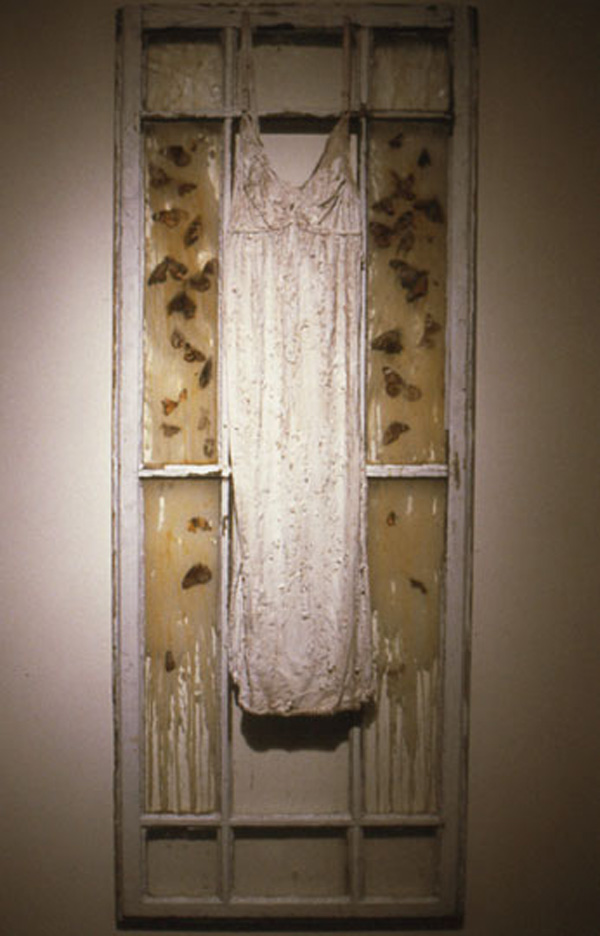
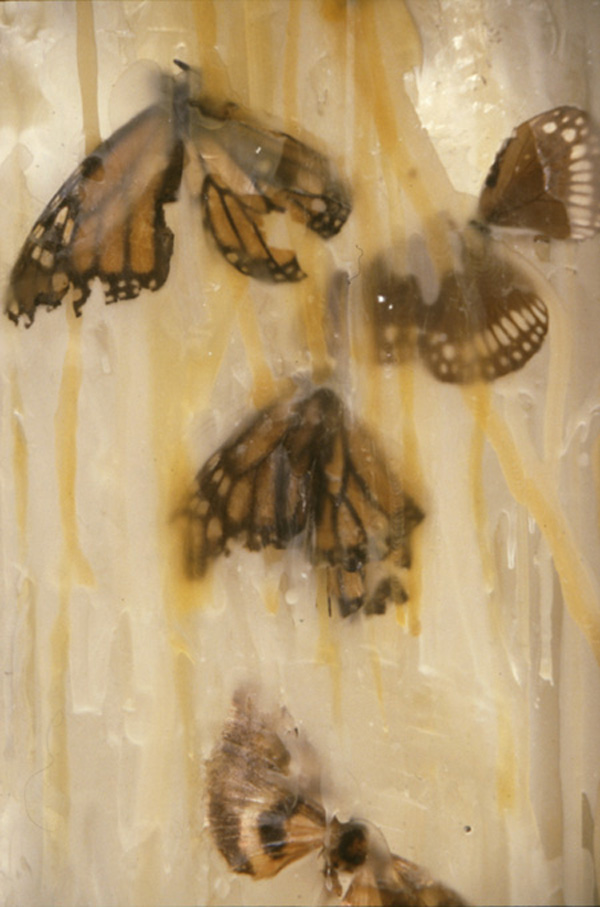
Have you experienced fluctuations in your productivity and how have your expectations changed through the years?.
Just after finishing graduate school in 2006, I moved from the Los Angeles area to Boston. After such a productive and prolific period of working on my thesis exhibition, I suddenly felt unable to make anything. I didn't create much work in my first few years here but I often went on long walks and took many photographs in Boston's Arnold Arboretum. After living in Southern California, I was struck by the way that every visit to the Arboretum differed so drastically based on the changing seasons, fluctuations in weather, and ever-changing flora and fauna. This experience reminded me that even when I feel unable to physically manifest anything in the studio, I am still moving through the world breathing, absorbing, looking, thinking, and collecting.
I have also found that limitations can oftentimes lead to inspiration. For example, I developed the Leaf series around the time that I began working full-time at my current job. I didn't have a lot of space or energy at the end of the day, and so I adapted by finding a way of working that was relaxing and could fit practically into my daily life.
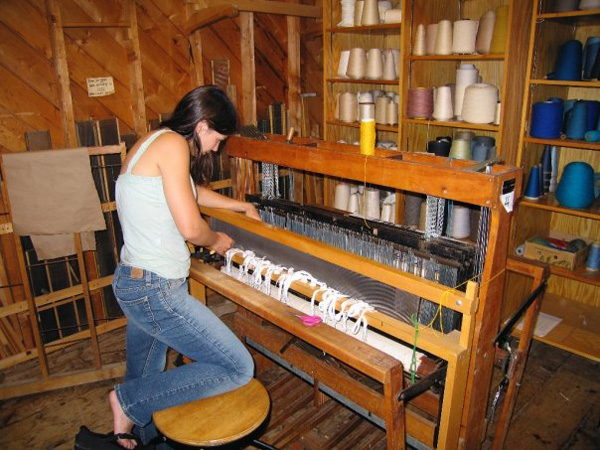
Tell us about your studio and how you work:
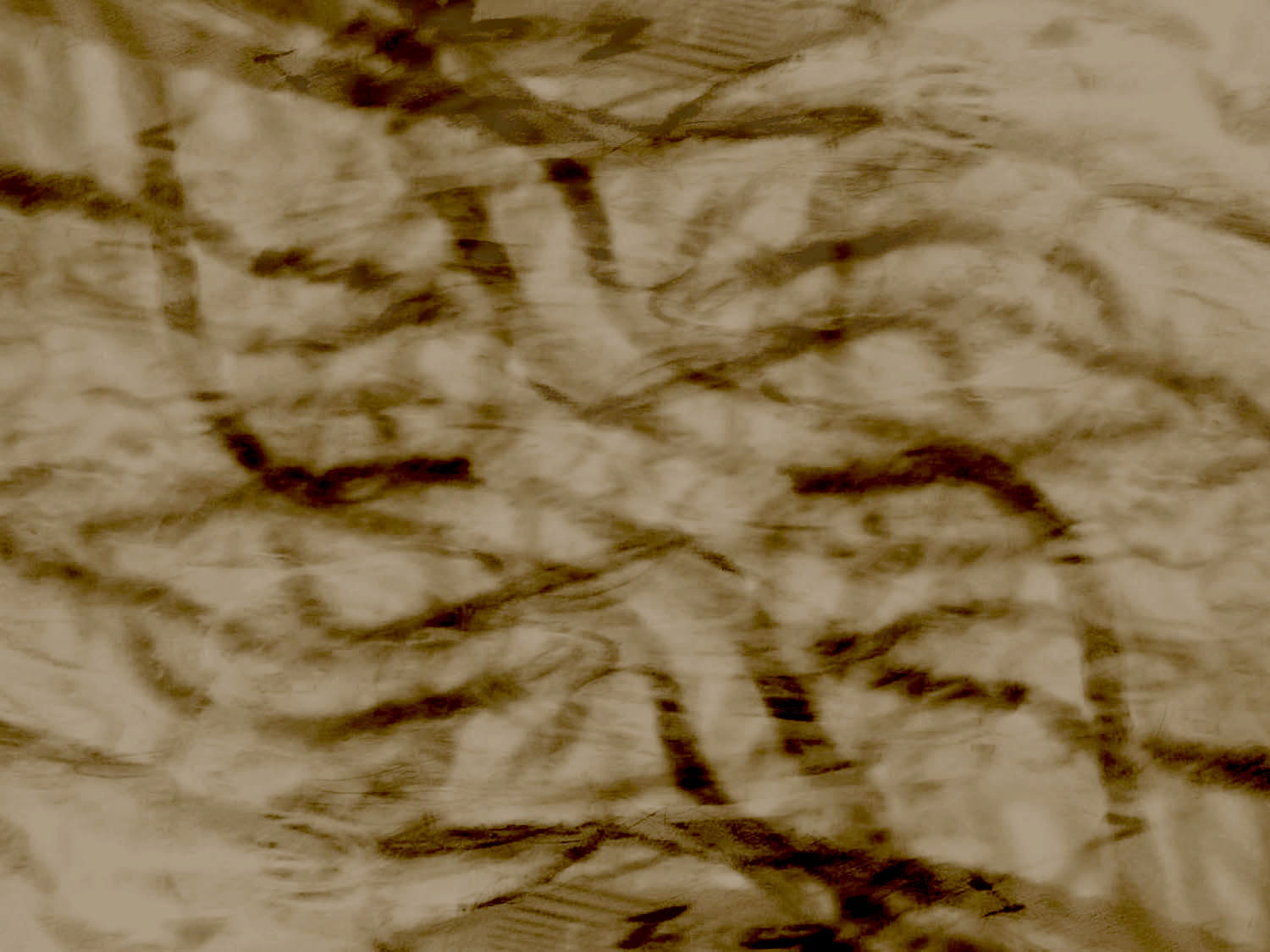
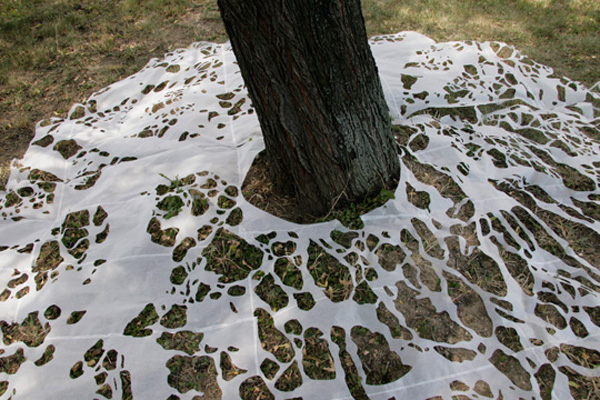
For me, the studio is a very fluid space that is both physical and mental. I am always walking, moving, thinking, looking and absorbing. I have a space in my apartment dedicated to making art, but it is quite small. Sometimes I work outside on location as with the Lacework series. With smaller scale pieces such as the Leaf series, I am able to be nomadic and carry it with me.
In terms of my process, I often come up with an idea, and then both love and hate the challenge of figuring out how to make it work! Ultimately, I often end up coming to a process that is very slow and meditative. For the Leaf series, it took quite a bit of experimentation and a number of unsuccessful iterations before I came up with a technique that I was satisfied with. To create each leaf, I start by forming the primary vein structures by grouping strands of hair together and wrapping them together with another strand of hair against a water-soluble backing. I then sew in the details, threading each individual strand of hair into a needle and securing it to the needle with a knot. At each point where one strand of hair intersects with another, I stitch a tiny knot, so that when the backing is dissolved, the entire piece is able to hold its form. Even though hair is such a fragile material, it holds together quite well using this technique and the leaves are surprisingly strong.
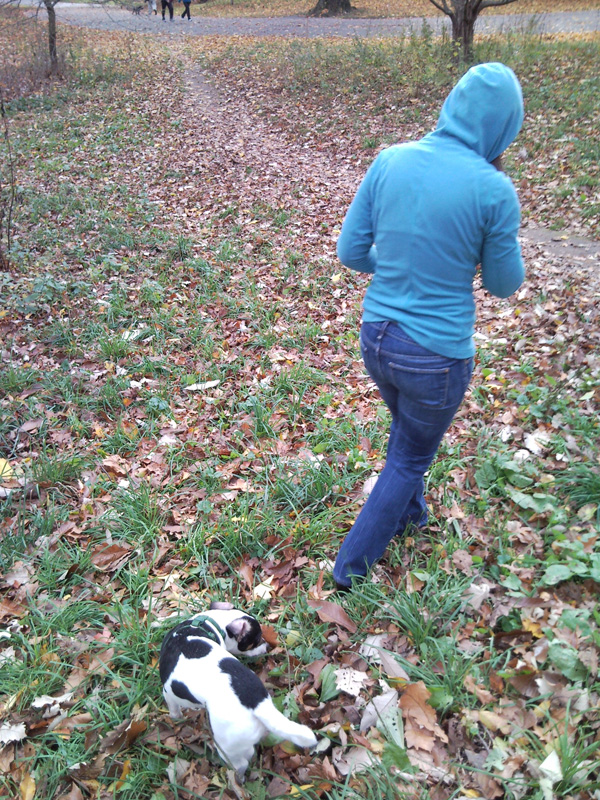
When working on location, how much do you improvise when you are on site?
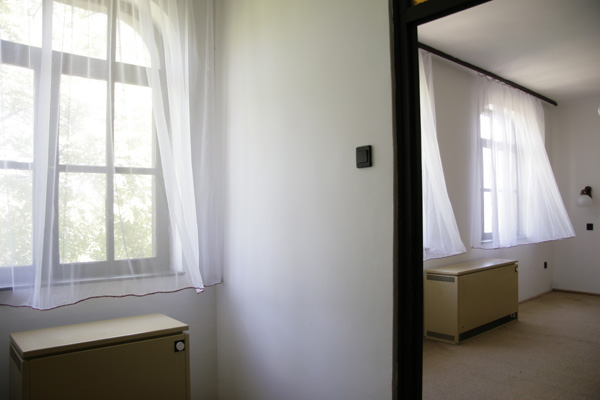
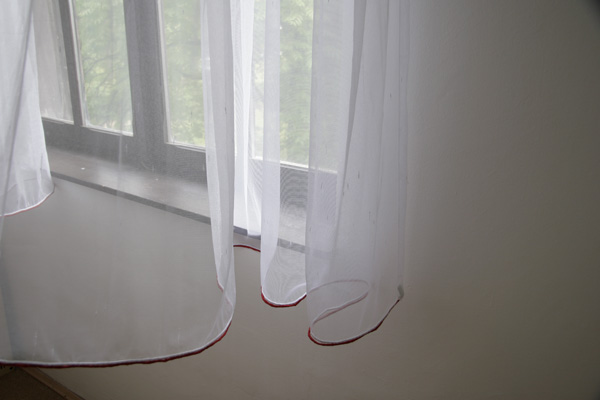
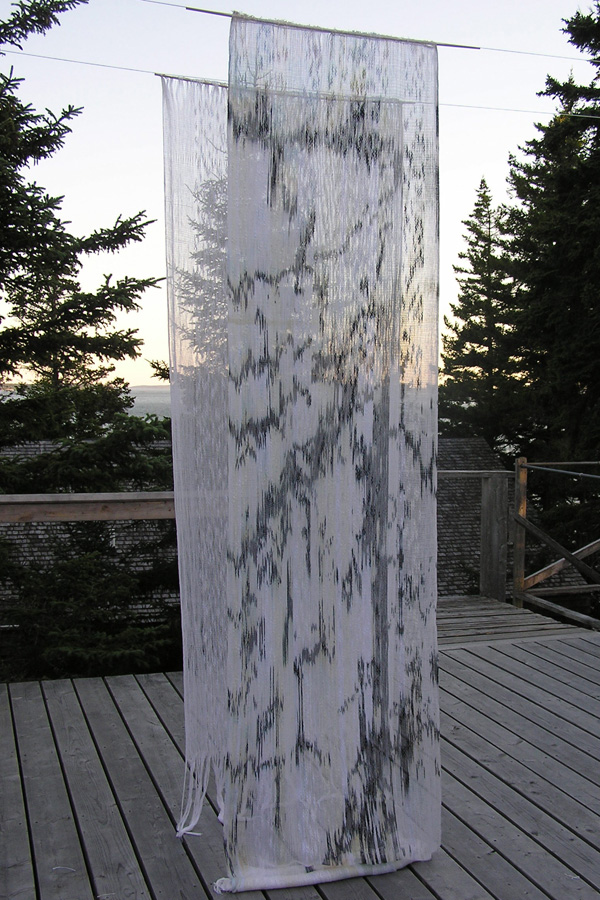
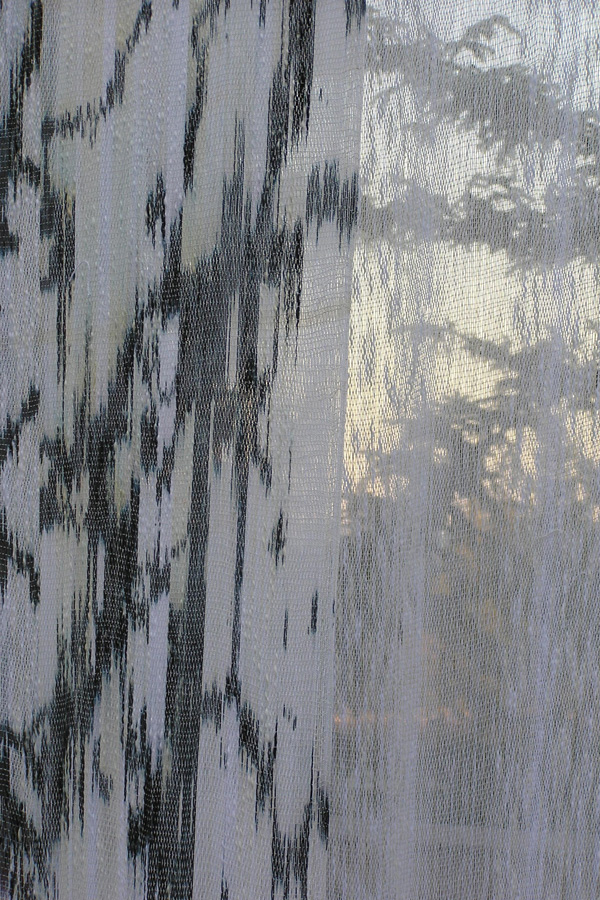
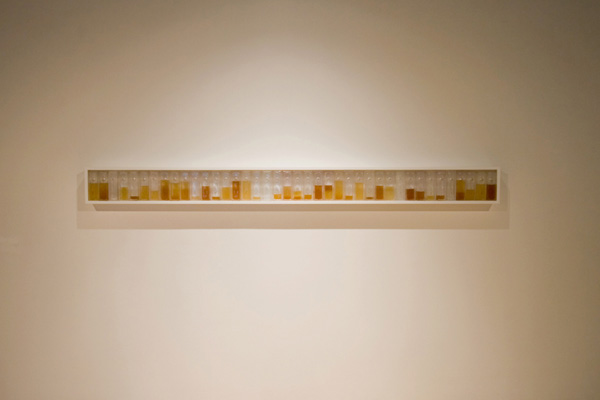
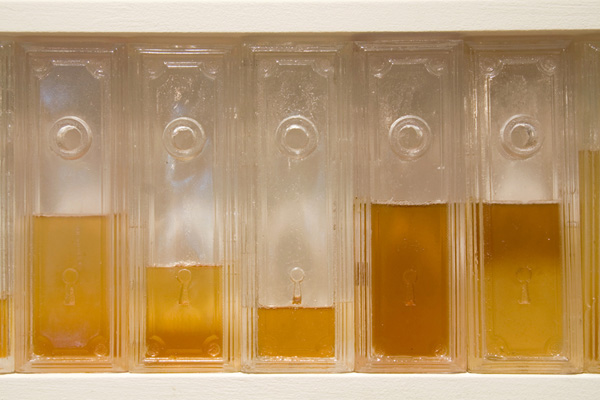
In 2006 I took a weaving workshop at Haystack Mountain School of Crafts in Maine, and in 2007, I had the opportunity to do a month-long artist residency in Hungary. I didn't go into either of these experiences expecting to do site-specific work, but on both occasions, I was inspired to work on location. I am hoping to experiment more with site-specific work, and I would love to do more artist residencies in the next few years. (Examples: Forest Veil, Lacework, and Curtain Installation).
Where do you imagine your work in five years?
I really enjoy the process of making the Leaves, and imagine that I will continue to develop that work in some capacity throughout my life. I also have a number of larger scale projects in mind that I would like to develop.
Is there anything else you would like us to know about you or your work that we have not covered?
For the past three years, I have been the weaving instructor at Gateway Arts, an arts-based day program for adults with disabilities located in Brookline, Massachusetts. At Gateway, I assist adults with autism, down syndrome, vision and/or hearing impairment, and various developmental disabilities as they work to achieve their goals in weaving and other fibre techniques such as embroidery, knitting, and fibre sculpture. I have been enriched beyond words by my experiences at Gateway Arts, as I have had the opportunity to see weaving and fibre arts being used as a medium to empower and bring confidence to the individuals that I work with.
What interests you about the World of Threads Festival?
I love discovering new artists, especially artists working in fibre mediums. I also find it fascinating and inspiring to learn about other artists and their creative processes.