Artist Interview 46: Anastasia Azure
Providence, Rhode Island, USA.
Anastasia Azure is a weaver, working mainly in metals. She is also an installation artist and jewelry maker. Anastasia says she weaves and integrates structural form into fabric and shapes the fabric afterwards.
Tell us about your work?
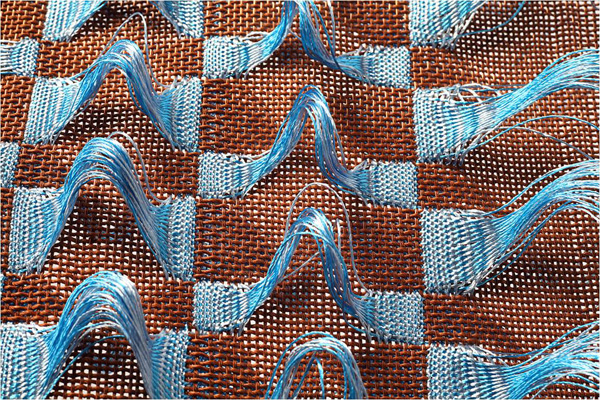
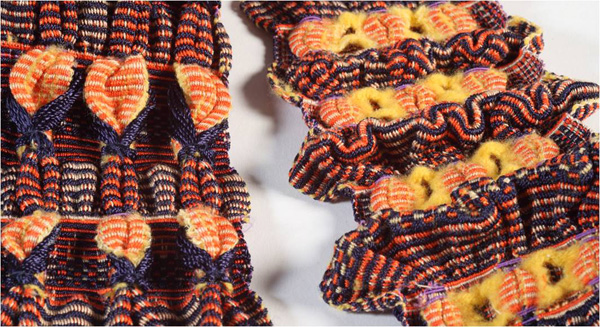
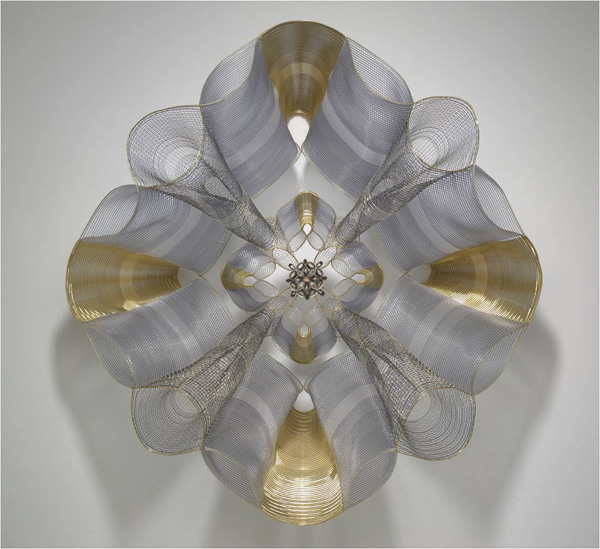
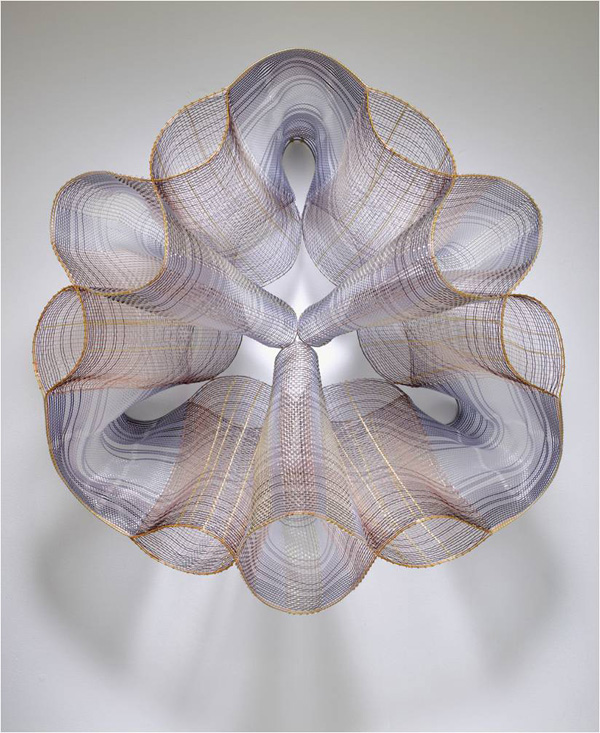
Essentially, my work is woven dimensional fabric. I weave and integrate structural form into fabric and I also shape the fabric afterwards. I feel that my weavings truly breathe life when they exist in the third-dimension. I am inspired by adornment, ritual and the elegance of geometry. To evoke emotional response, I use lyrical movement, vibrant colour, complex constructions and compositional beauty. I weave contemporary materials to create sculptural effects with playful interaction, formal resolve and conceptual content. My artistic evolution and development reflect my travels and the available specific textile technology. My fibre artwork has had three distinct phases: sculptural adornment, installation art and pure exploration.
Where do you get your inspiration?
For shapes and colour, I am inspired by various genres of objects: the vibrancy of tropical aquatic life, the structural intersection of bridges, the symmetry of mandalas, the boldness of Maasai tribal jewelry, the flowing curves of Art Nouveau, and the boisterous decorations of Balinese festivals. For materials, I am drawn to new technology and by the actual process of investigating unique characteristics of materials. I push, stretch, fold, shrink and heat a material to fully understand its limits and thereby capabilities. For conceptual content, I am inspired by personal experiences, emotions and a reverence for beauty.
Which is your favourite fibre medium?
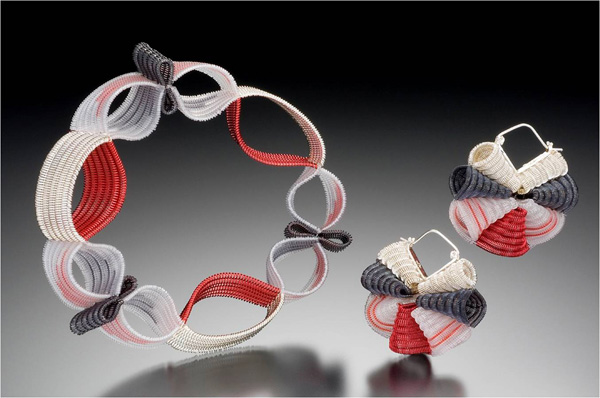
During my BFA at California College of the Arts (CCA) I majored in Jewelry Metal Arts. During the spring of my junior year I took a weaving class with Lia Cook. The first project she assigned was double-cloth. I instinctively chose to weave with metal. I jumped right in with an experimental sculpture, woven with indigo dyed silk and 16-gauge steel wire warp. With Lia's encouragement and support, I focused exclusively on this technique to make jewelry with ikat dyed yarns, nylon monofilament and metals. My senior thesis, a collection of woven sculptural adornments, reflected my longing for the four distinct seasons (spring, summer, autumn and winter) of my childhood in New England.
After graduation from CCA, I went to the Appalachian Center for Craft and was an Artist-In-Residence for the Fibers Department for three years. I dedicated this time to the research and development of the body of work I now call dimensional-weave.
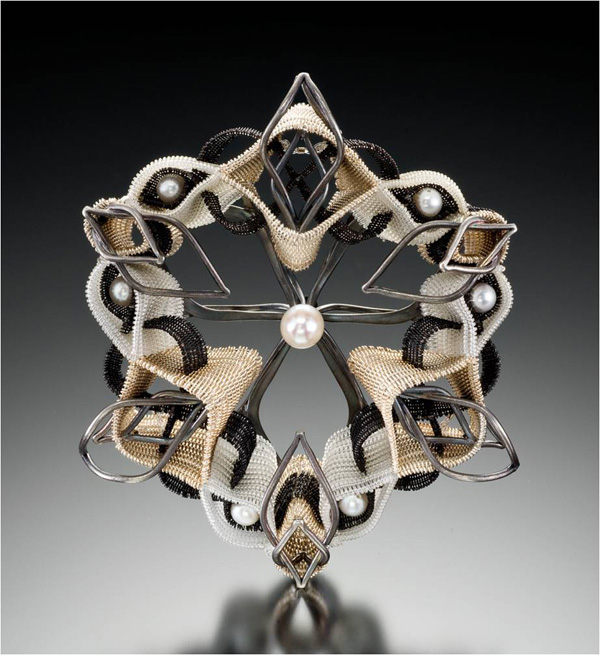
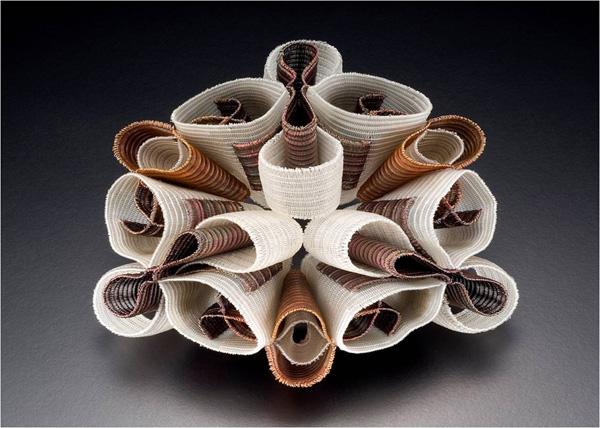
I push, stretch, fold, shrink and heat a material to fully understand its limits and thereby capabilities.
What other mediums do you work in, and how does this inform your fibre work?
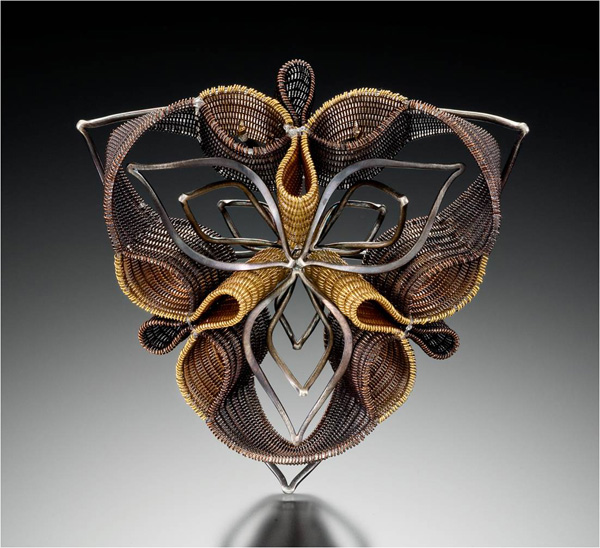
My weaving has been married to my jewelry for some time. For me, jewelry satisfies a primitive desire, a need for self-expression. Making jewelry provides a unique opportunity for me to touch people's lives, by reminding them of their individual uniqueness with wearable adornment that inspires confidence and radiance.
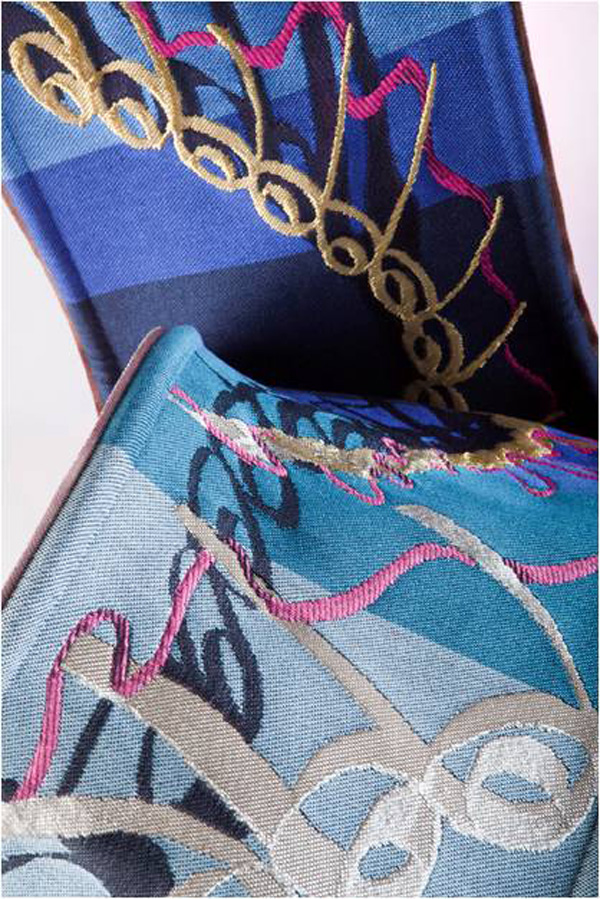
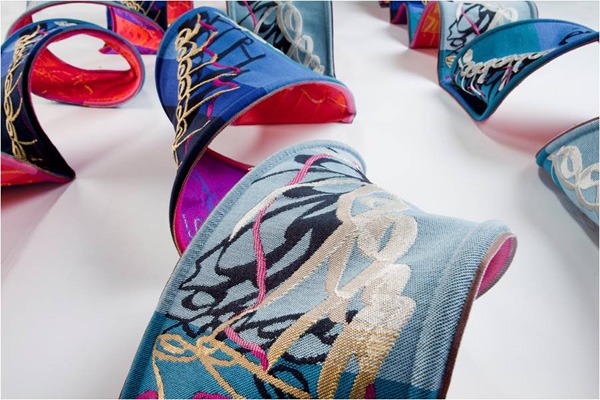
What specific historic artists have influenced your work?
My favourite painting is The Joy of Life (1905) by Henri Matisse because of the colours, the curvaceous dancers and the celebration. The sensual brush strokes and luscious colours of Georgia O'Keefe's magnified floral compositions are stunning. The surreal paintings of Remedios Varo and Salvador Dali awe my imagination. Marcel Duchamp's Nude Descending a Staircase (1912) is genius with the geometric shapes in motion. I love Constantin Brancusi's simplified, abstracted sculptural forms in his series Birds in Space (1920s). 16th century Safavid textiles are mind boggling with their intricate geometries. I dream of the Ardabil Carpet (1550s). From the same time period, Iznik Pottery is also amazing. My favourite textiles are double Ikats from India, Japan and Indonesia, especially the Balinese geringsing. My favourite historical jewelry is from the Art Nouveau period, with the ultimate master being Rene Lalique.
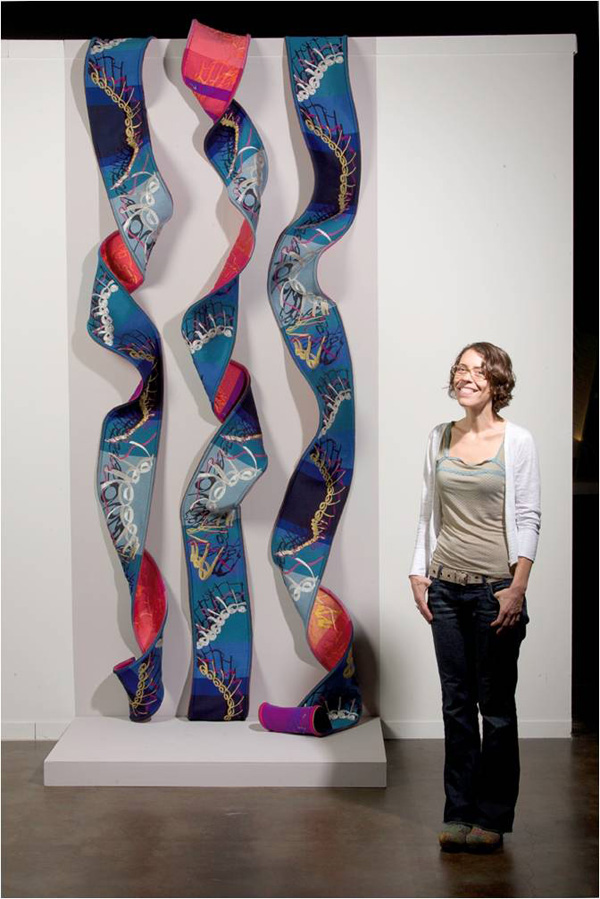
What specific contemporary artists have influenced your work?
For me, the most influential and life-changing weaver was Paul O'Connor because of his book Loom Controlled Double-Weave. My creativity of dimensional-weave construction was directly a result of his visual diagrams and instructions on double-weave.
Recently I went to the Museum of Arts and Design in New York to see the exhibition Crafting Modernism. It was amazing to experience the works of Kay Sekimachi, Ruth Asawa, Lenore Tawney and Sheila Hicks, all favourites of mine. Witnessing their large-scale sculptures in person was profound. Kay Sekimachi's early work (1968-1972) has always resonated with me because she pioneered multi-layered weaving with nylon monofilament. The bold, abstract shapes of Ruth Asawa's hanging wire sculptures capture strength and fragility. Shelia Hicks and Lenore Tawney's innovative constructions and colours are breathtaking. This past December, I was completely blown away by the milestone exhibition, Fiber Futures: Japan's Textile Pioneers. I am thrilled to discover how it will inspire my work.
Contemporary jewelers, who use textile techniques in metal, especially those using wire, have also influenced me. I had the good fortune to take a workshop from Arline Fisch, who wrote the book Textile Techniques in Metal. She broadened my ideas about adapting techniques to fit alternative mediums. Mary Lee Hu and Maria Scarpa both create exquisite fine jewelry using gold and platinum wire with textile techniques. Their meticulous attention to detail sets a standard of craftsmanship for my work.
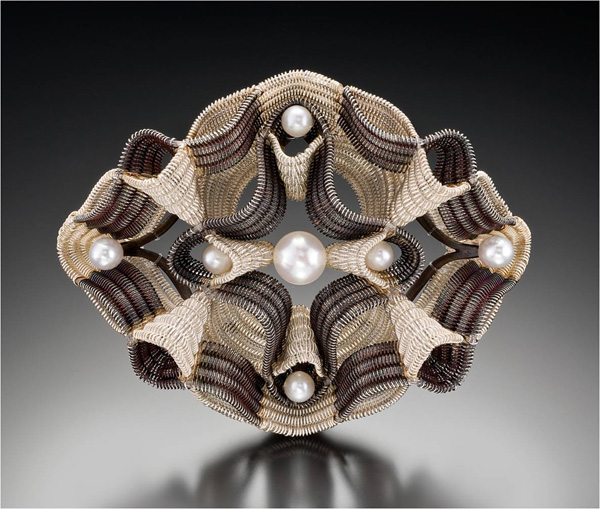
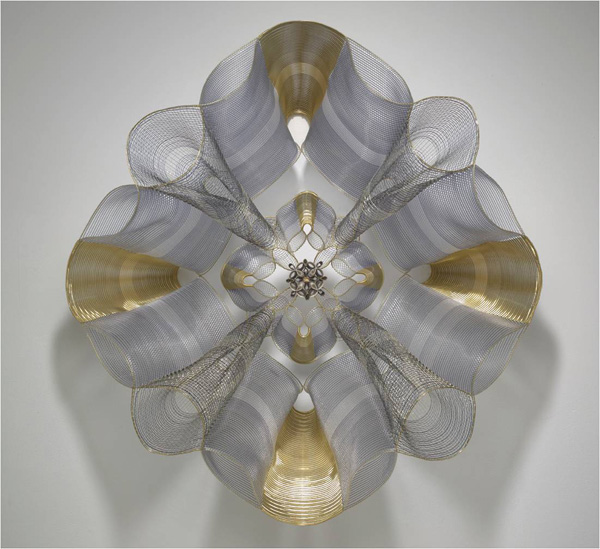
I merge the ancient, present and future through my integration of techniques: weaving and goldsmithing, and by my combination of materials: fibres, metals and plastics.
What role do you think fibre art plays in contemporary art?
I think that fibre art is a broadly inclusive field that is very accepting. For me the category can be defined by the use of materials and/or techniques that relate to fibres. Unfortunately, I think that fibre art is still vying for legitimacy in the contemporary art world. The book, String, Felt, Thread: the Hierarchy of Art and Craft in American Art by Elissa Auther is very insightful and discusses this subject in depth.
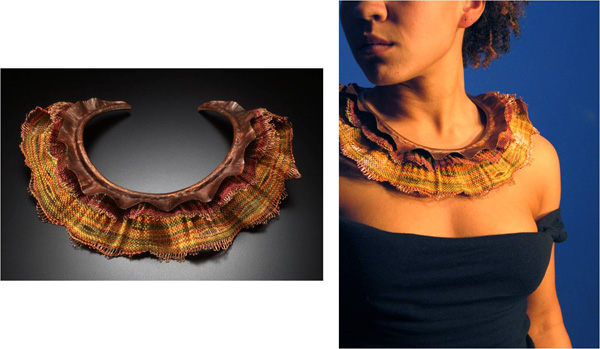
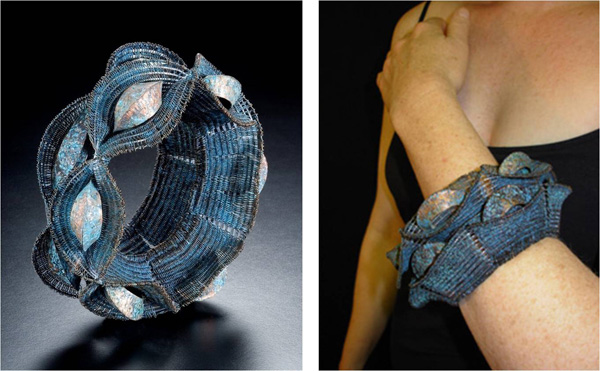
Since a main technique of my artwork is weaving, it makes sense to place my work in the context of fibre art.
What do you think of us placing your work within the context of fibre art?
Since a main technique of my artwork is weaving, it makes sense to place my work in the context of fibre art. Interestingly, when it functions as jewelry, it is included in the context of jewelry art. And when it has no function beyond aesthetic value, it can cross over to contemporary art.
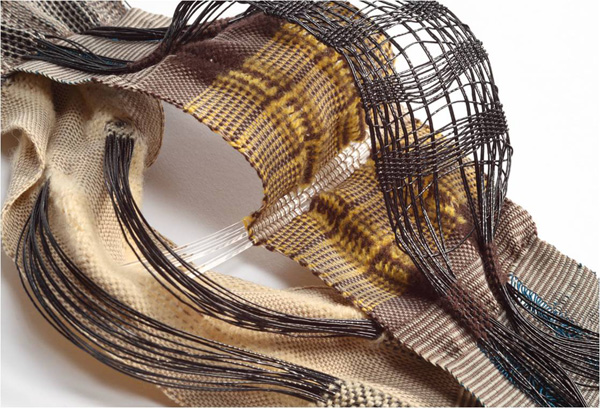
Weaving embodies rhythm, balance and order.
How do fibre techniques and materials relate to your practice?
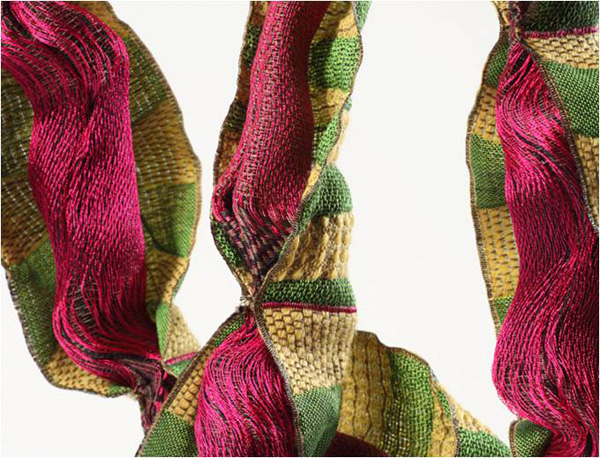
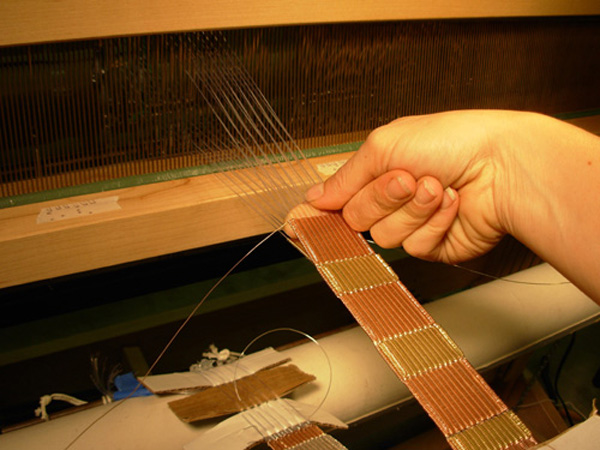
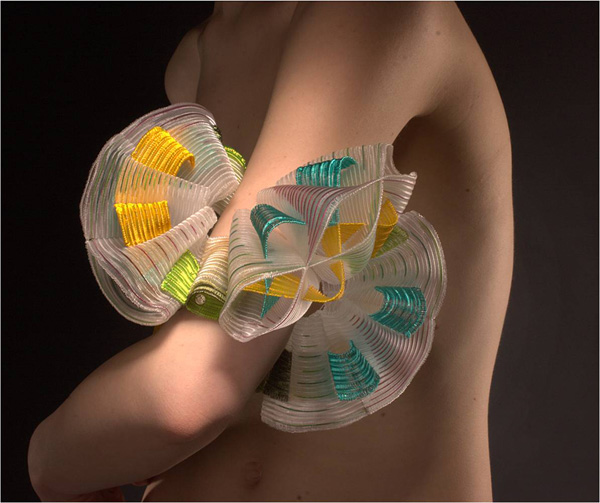
For me, weaving embodies rhythm, balance and order. For my first six years of weaving, I focused on the double-cloth technique with nontraditional materials on a conventional floor-loom. The double-cloth technique is a complex weave structure in which two sets of warps interlace with two sets of wefts, simultaneously producing two distinct layers. I merge the ancient, present and future through my integration of techniques: weaving and goldsmithing, and by my combination of materials: fibres, metals and plastics. I have taken a traditional technique and assigned a new application, turning double-weave cloth into dimensional-weave jewelry and sculpture.
The durability and strength of metal, paired with the luminosity and flexibility of plastic, allows for the inherent structure of double-cloth to be explored in the third-dimension. Plastic is a central material, used to capture translucency, spectacular colour phenomena and flexibility. I use wire ranging from 12 to 30 gauge. For the larger wall sculptures, the selvedge needs to be strong to maintain the structure, therefore I use 12 gauge brass. For the weft of my jewelry I use 30 gauge wire.
When did you first discover your creative talents?
From an early age, my parents encouraged creativity. My love for making jewelry began when I was seven years old with summer camp projects. Working with plastic lacing, I learned techniques such as the zipper, the butterfly, the box and the spiral stitch. I loved having my hands active and my mind pulled into the organizing principles of structure. Also, I was enamored with making key chains and bracelets; they were objects of portable adornment.
During high school, I took jewelry making classes. When I first witnessed sterling silver melting in a crucible, silversmithing captured my heart's passion. An inherent essence in me connected with the precious materials of shiny metal, luminous stones and the transformative power of fire.
Tell us about your studio and how you work:
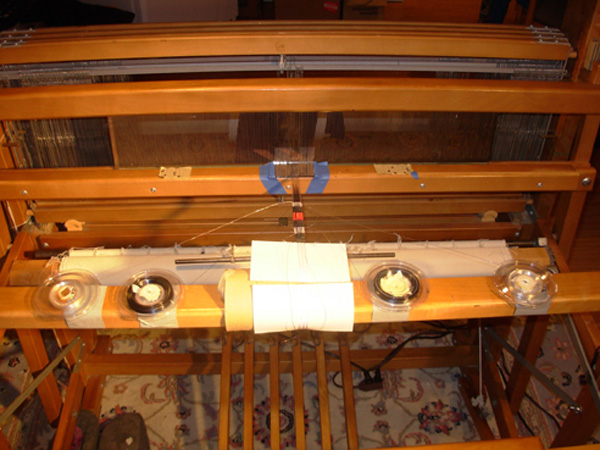
My cycle of invention begins with simpler forms. I strive for a superb sense of design balance and effective use of negative space. I am able to perfect proportion, balance and artisanship in less complicated pieces. These investigations generate the building blocks to execute grander projects. The myriad points of interlocking strands drive my exploration of form, structure and volume. The dimensional-weave technique does not allow for great spontaneity and the designs must be planned. My process reflects hours of detailed repetitious precision work. A project may begin with days of paper model making and weeks of on-loom sampling. Extensive preparation is essential to ensure success. It can take months to weave an elaborate one-of-a-kind piece, such as Accentuating Focus and Egg Hunt, both of which are quadruple cloth.
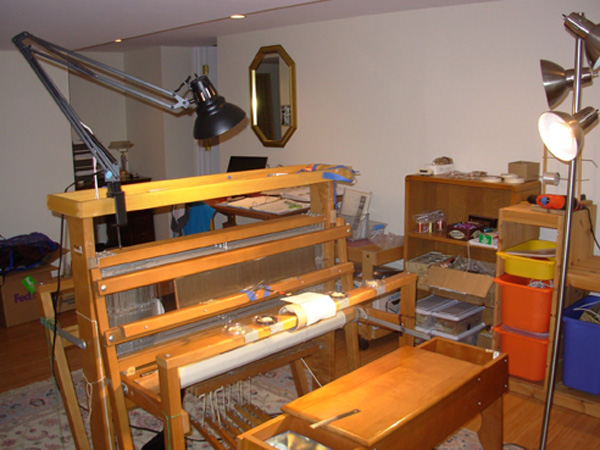
Studio space has been a challenging, fluctuating variable in my artistic career. My work requires two studios: a fully equipped jewelry studio as well as a furnished weaving studio. Only during my residency at ACC were my two studios located together. Other than that, I have had to commute between two studios, everything from crossing the street, to a two-mile bicycle ride, to a three-hour drive. At the moment my jewelry studio is in my living room and my weaving studio is in my parent's home. Fortunately, this spring semester I will be an Artist-In-Residence at the University of Massachusetts Dartmouth, where the Metals and Textiles departments are located on the same floor.
When you were starting out, did you have a mentor?
I have had the great fortune of learning from extraordinary art teachers who have supported and encouraged my artistic development through patience, devotion and confidence. Individuals such as Lia Cook, Alan Revere, Marilyn DaSilva and Susan Wood have been instrumental in teaching me technical skills and integrity, while nurturing imagination and fostering experimentation.
Thea Izzi, a professional art jeweler, showed me the dedication necessary to make a production line and exposed me to the world of the American Craft Council shows when I worked for her from 2002 to 2004. She taught me how to balance business success with creativity.
Jeanne Brady, the head of the Fibers Department at the Appalachian Center for Craft, has taught me how to be a teacher. By setting an impeccable standard of excellence, she has shown through example, how to encourage and educate the next generation of artists.
How does your early work differ from what you are doing now?
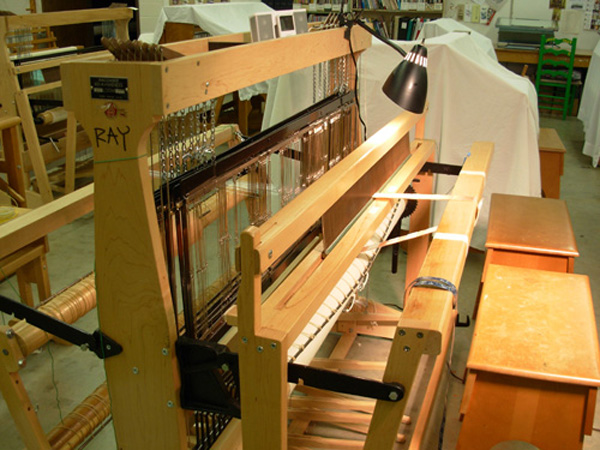
During my two years of graduate school at the Rhode Island School of Design (RISD), I learned to work with computerized and mechanical looms with complex patterning. I had time to expand my material exploration. In addition, I learned how to develop concept, context and colour into my weavings to make them more expressive.
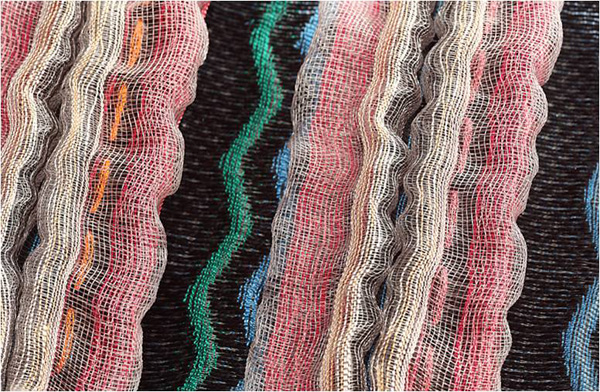
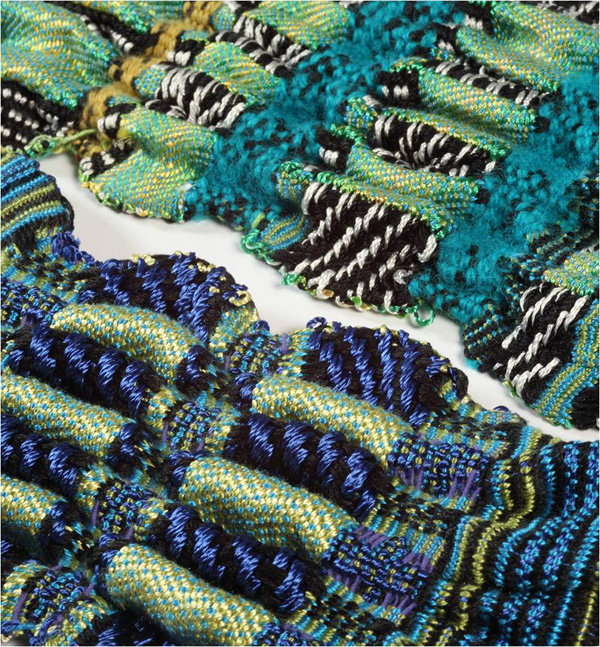
I worked a lot with a 24 harness Compu-Dobby loom to make dimensional fabric with multi-layered, block weave structures. I used yarns, such as rayon and cotton as the warp, instead of the plastics I was so accustomed to using. Materials provided unlimited play; I used the differential shrinkage of wools and pull of elastics to create volume, movement and undulations.
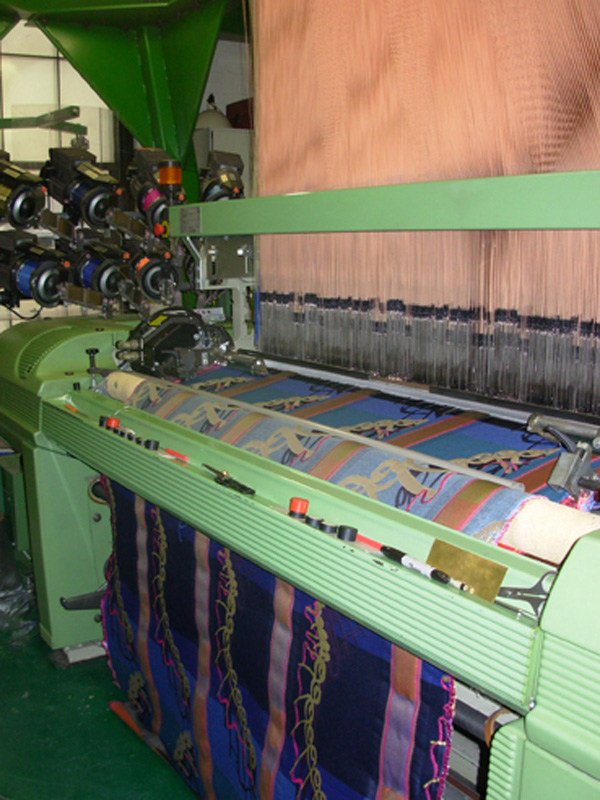
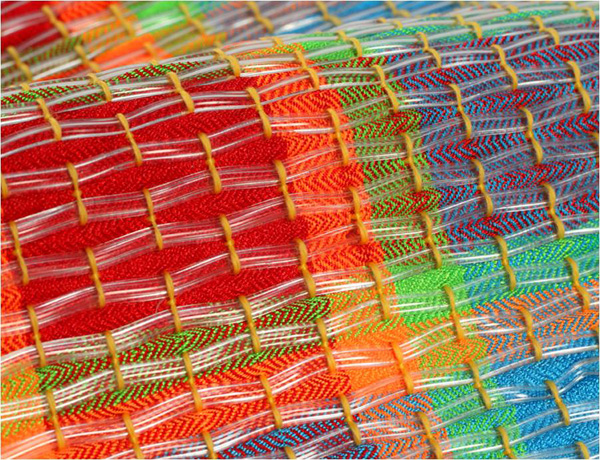
Also I had the rewarding opportunity to work with an industrial Jacquard loom. Again, my main focus was figuring out how to make the cloth dimensional. My resolution was to weave pockets into the vertical length of the cloth, so that I could insert vinyl tubing when the fabric was off-loom, to provide flexibility and structure. Then the yardage became a material with which to sculpt.
Where do you imagine your work in five years?
Right now I am at a crossroad in my career. I am seriously evaluating both where and what my artwork will be in five years. I want to use my creativity to educate others, foster social change and improve the environment by generating art projects that are community and service oriented. I am very concerned about the resource consumption involved in art making and the environmental impact of materials and the waste stream generated. What can I do to make a positive impact in our world? How can artists re-imagine, restore and rebuild a better world?
What interests you about the World of Threads festival?
The World of Threads really connects fibre artists and is a valuable international resource. I have thoroughly enjoyed reading the artists' interviews, specially the "behind the scenes" information about inspirations and historical/contemporary artist influences. The interview format truly allows for a glimpse into the real person, as well as insight into the fullness of their artwork and development. I am honoured to be part of this.