Artist Interview 40: Sandra Gregson
Toronto, Ontario, Canada
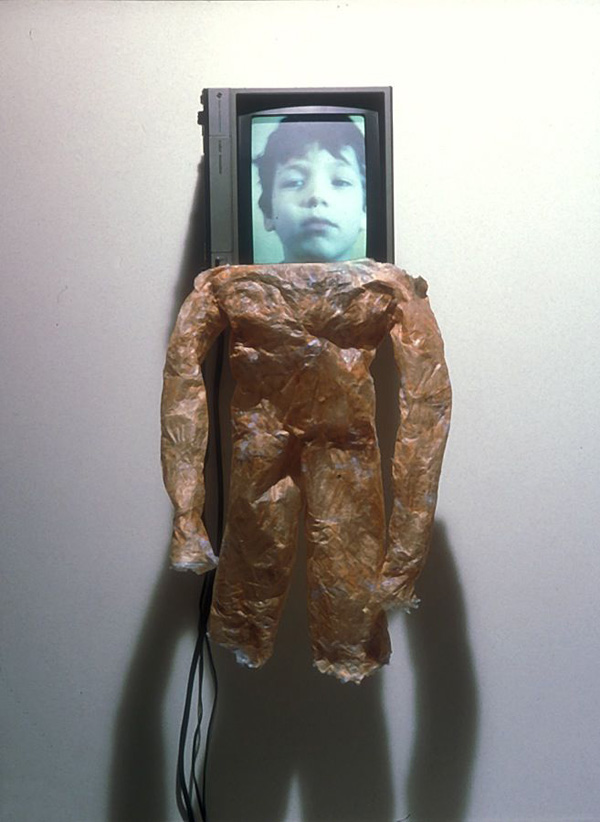
Sandra Gregson is a Toronto-based artist who works with drawing, sculpture, installation, and video; at times, she combines these mediums. Her work often references fibre objects in its form or with the use of materials.
Tell us about your work?
My work evolves from a visual art background: drawing, sculpture, printmaking, painting; and from a Western visual art history. I like working with materials and using specific materials to correspond with and explore ideas. My work includes drawing, sculpture, installation, and video. Art is a way of engaging the world and the use of different mediums provides a variety of ways to do this. What medium I use may depend on how much time I have to work on art making over a specific time period, or the overall intention of the work.
Where do you get your inspiration??
My inspiration often comes from everyday things or objects which I take notice of. I am also a reader, and reading novels or non-fiction books often shapes or expands my ideas.
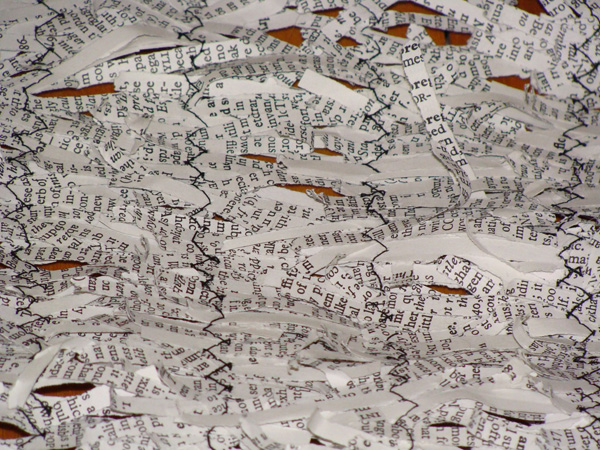
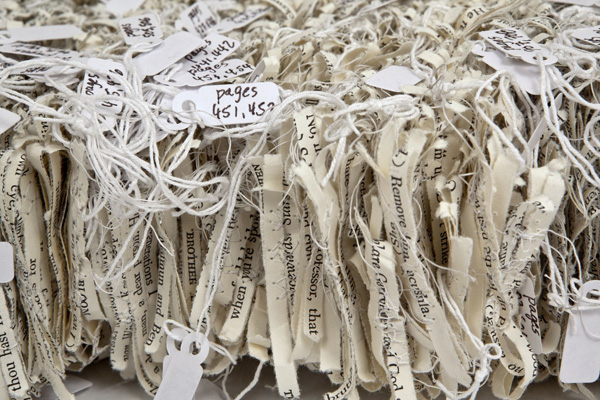
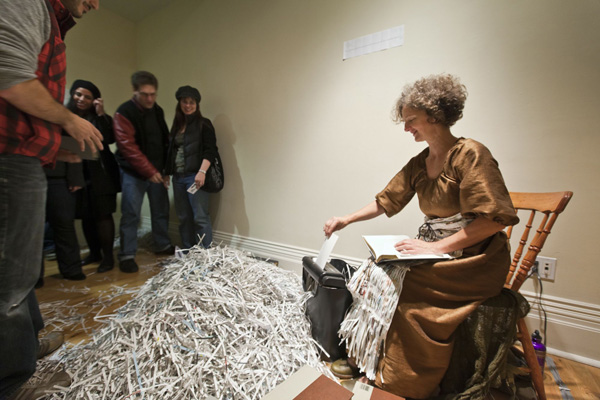
I make a lot of notes, from reading and from thinking. I am often drawn to things which are taken for granted in our culture but offer more complex meanings. I'm interested in how the meaning of things can change over time. For example, I recently shredded and sewed, page by page, the novel Ulysses by James Joyce. I choose the novel because, although it is considered the "masterpiece of the 20th Century" and frequently referred to, most people haven't read it. As a novel it has become a cultural object and so I re-made the novel as an object. It's become an object of bookmark-like forms held together in a plexiglas holder. Although it is no longer readable as it was written, words and fragments are readable. And of course, we wouldn't read it today as it was read when it was first published in the early 1900's.
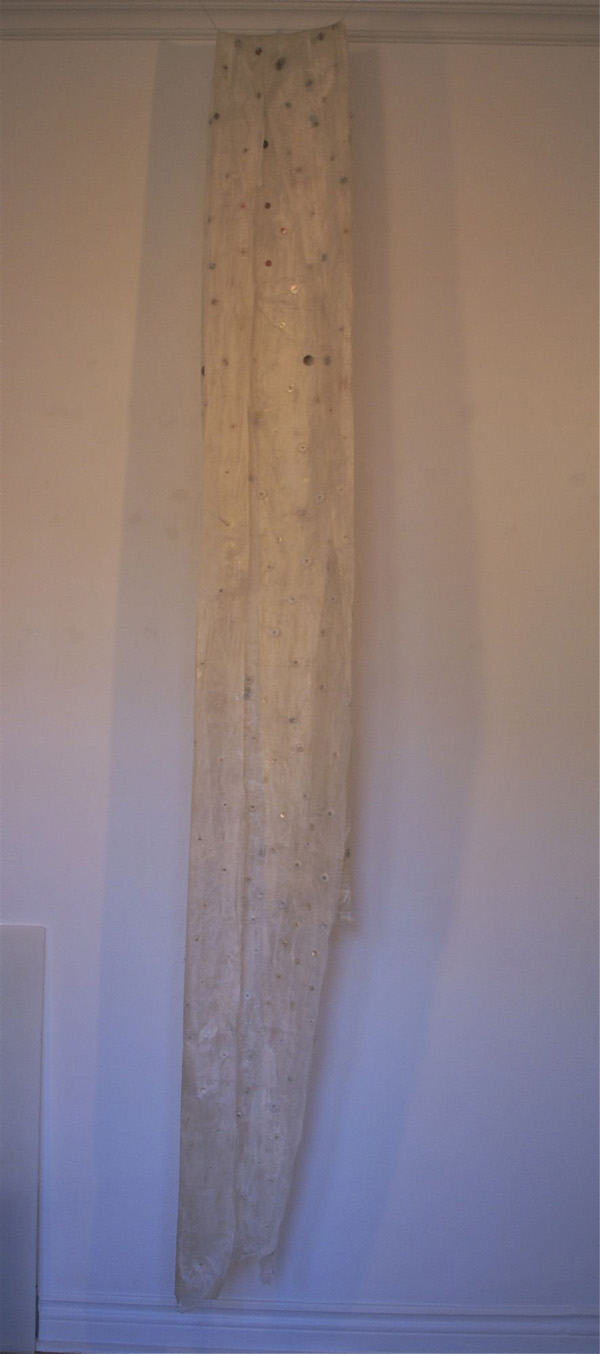
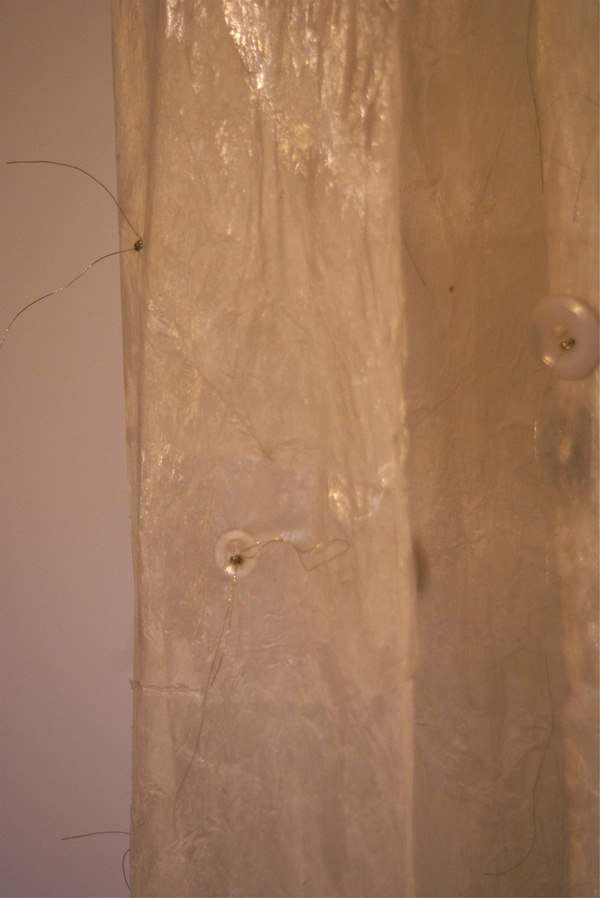
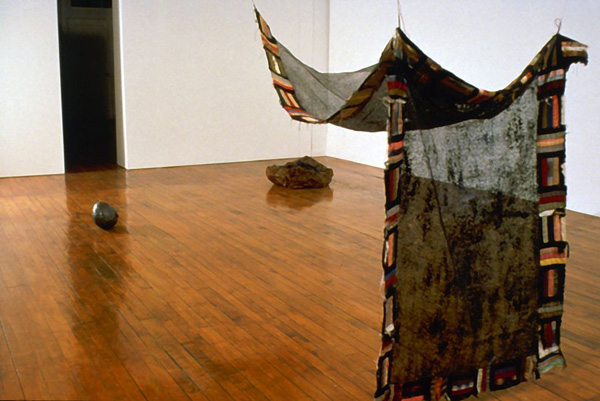
We often take materials for granted too. In my grandparents' time you would save everything. If an article of clothing became worn, the buttons would be cut off and saved to be reused. When my grandmother died I got her sewing box and button collection. I sorted the buttons into colour variations and made a long hanging sculpture form of ripped silk tissue glued into layers very reminiscent of skin, and sewed the buttons from her collection on to it. The buttons act as a kind of marker of time, event, and memory, on the skin-like form.
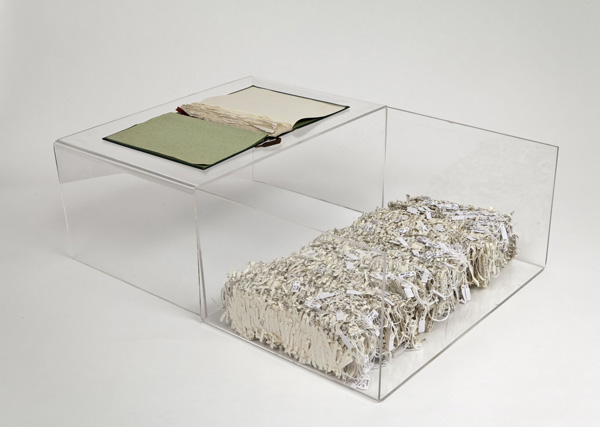
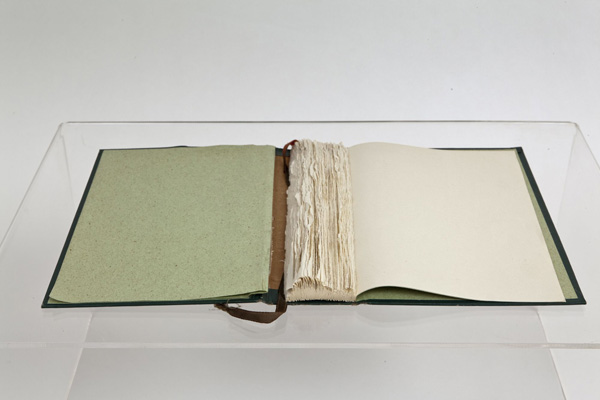
I shredded and sewed, page by page, the novel Ulysses by James Joyce. I choose the novel because, although it is considered the "masterpiece of the 20th Century" and frequently referred to, most people haven't read it.
Why did you choose to go into fibre art?
I use fibre-based materials, such as paper, clothing, and found cloth. My interest in fibre art evolves from my family history of making things. The women made things, often functional, such as knitted clothing, quilts, rag rugs. Conceptually it interests me that cloth is often the first thing that we are wrapped with when we are born, and often, the last thing when we die. So for me, there is the relationship between cloth and the body. Cloth offers a memory of the body.
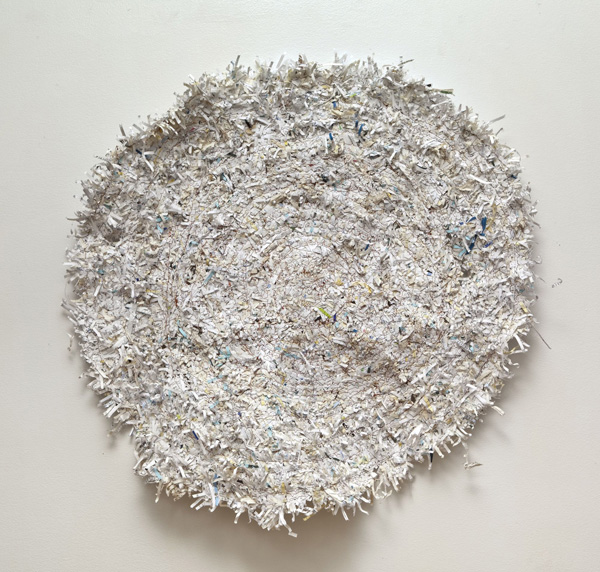
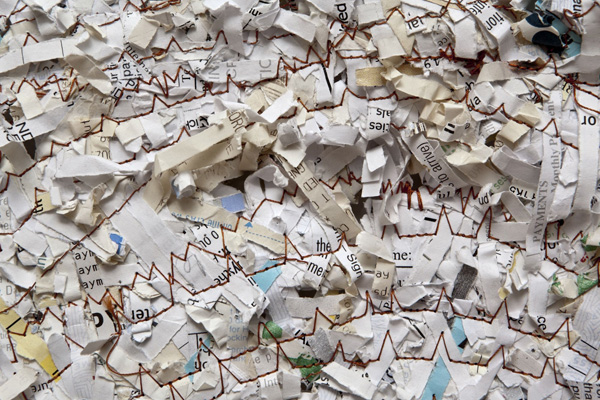
I have an affinity for working with materials that I can take apart and re-make. So I often take apart materials and then re-make them to make sculptural forms.
Which is your favourite fibre medium?
I don't have one favourite medium; what often seduces me is how a medium is used, the process in which something is made. I have an affinity for working with materials that I can take apart and re-make. I think it comes from a desire to hold onto, to keep things, and the loss I feel when I can't. So I often take apart materials and then re-make them to make sculptural forms. Also I often use discarded or used materials that are imbued with a past, or sense of history. I then re-present the materials to offer associations and to reveal the sense of history inherent in them.
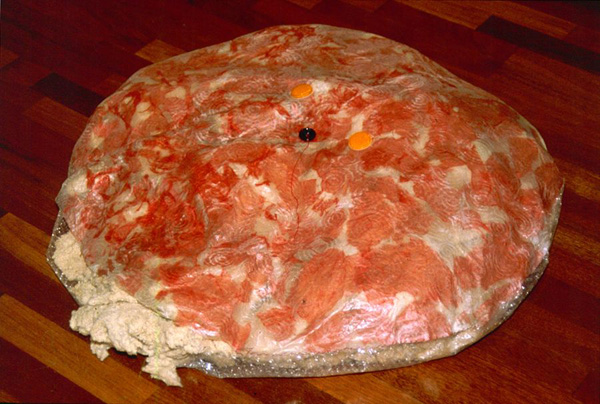
Much of my work involves an undoing and re-doing. For example, I worked with Japanese tissue and silk tissue for several years. I ripped the papers then joined them back together with rabbit skin glue or acrylic medium. That series started from a baby blanket which came from my great-grandmother. My mother gave this to me when my son was born. I became interested in how genetic and family history is passed on, and researched lace designs and genetic coding. I picked, punctured and/or burnt using a wood burning tool, lace designs, often referencing spinal forms into the glued layers of tissue papers, which from the layering and gluing, had become like skins.
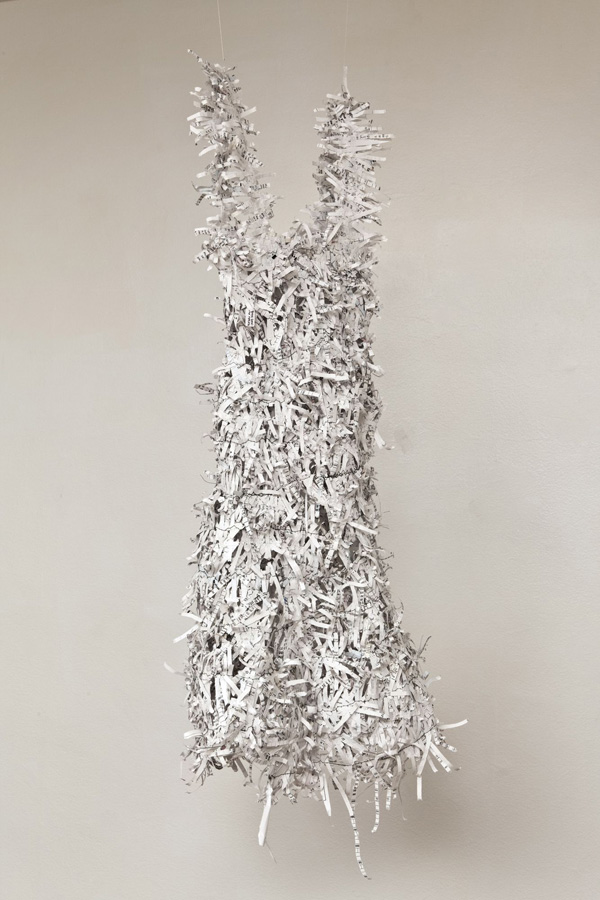
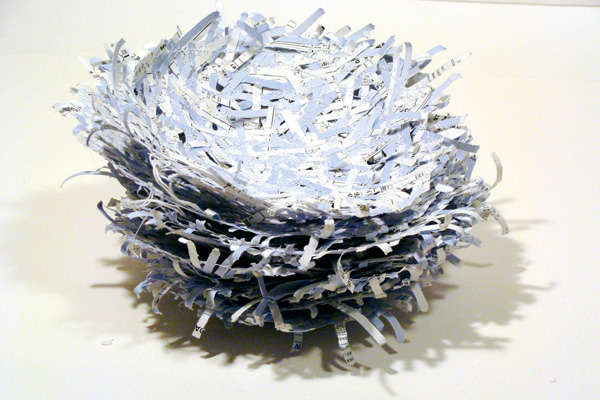
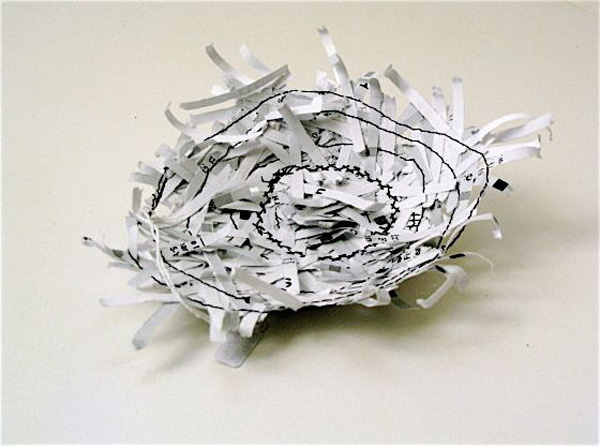
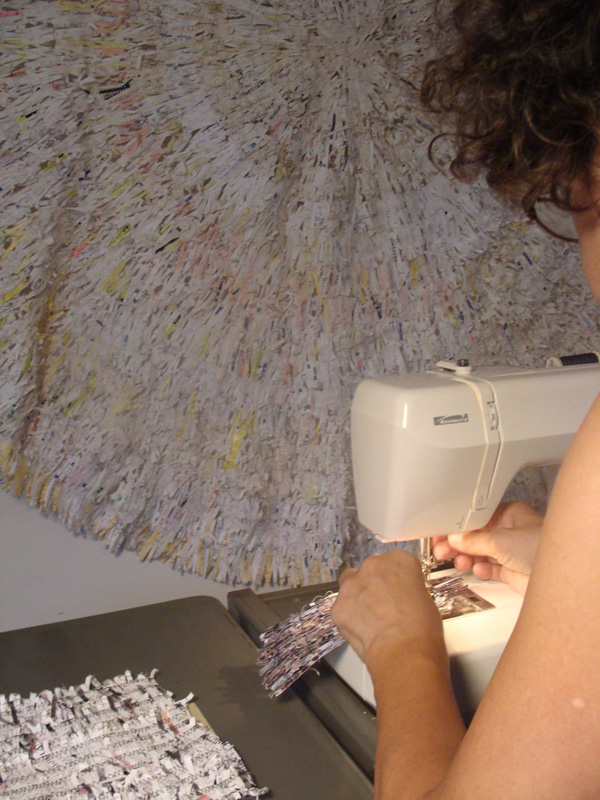
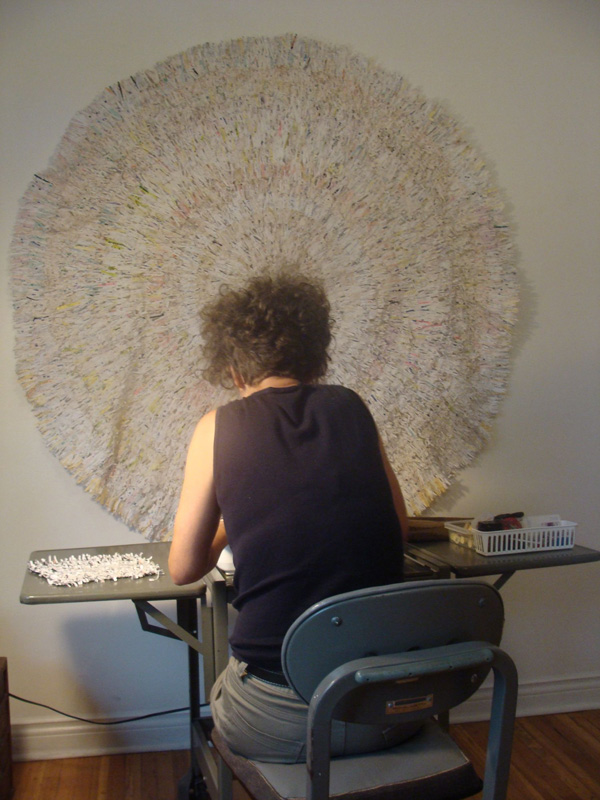
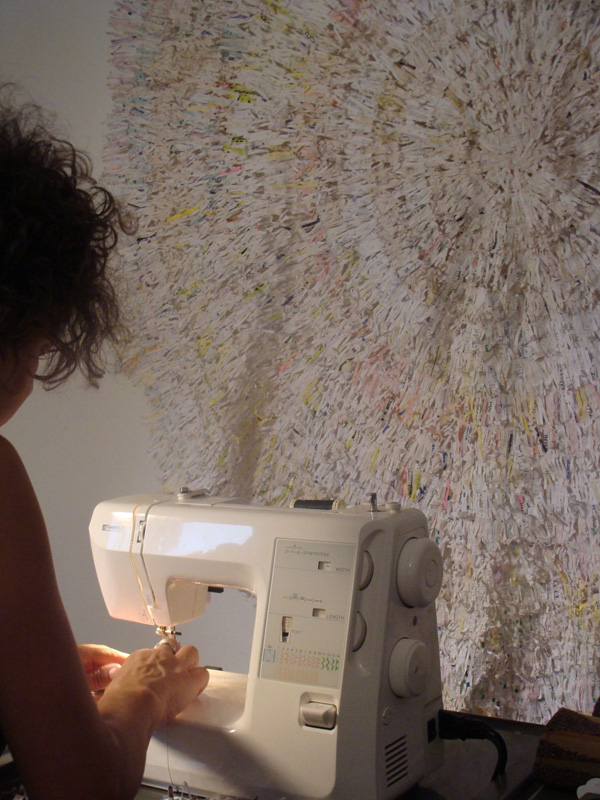
My current work is made from shredded paper. Overwhelmed by the never-ending accumulation of personal documents, such as credit card and ATM receipts, income tax returns, statements of earnings, after shredding them to eliminate personal data, I became intrigued by the shreds, which simultaneously revealed and obscured personal information. After shredding them, I used a sewing machine to sew them into sculptural forms. I like how the shreds are held together and formed by the sewing thread and how the works offer a kind of archive about my financial history. Some of the forms of the works such as rug, large rug, and Expenditures reference rag rugs, which historically were made from discarded clothing.
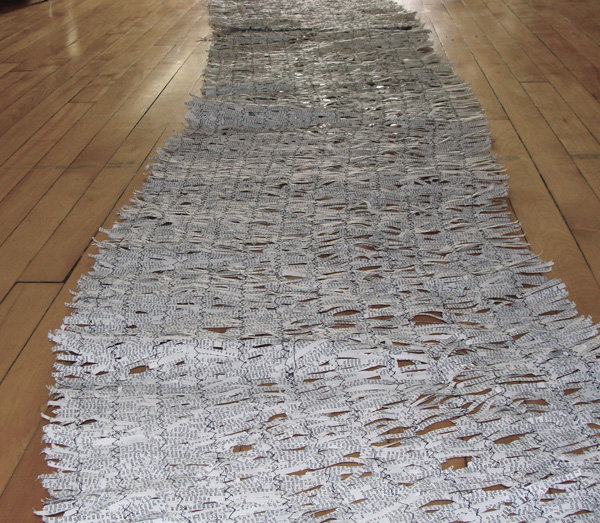
Other shredded works, such as Ulysses and words consider language. To make words, I shredded a dictionary and then sewed the shreds into a long river or path-like shape, which sits on the floor. This piece considers the changing nature of language; how language is not fixed. Taking apart the book structure of the dictionary removed the words from its static form. I am interested in how language changes, and how meaning shifts.
What other mediums do you work in, and how does this inform your fibre work?
I have worked with a variety of media. I am currently working on a series of drawings and a video. The process of my work, whether sewing or video, is usually additive or cut and paste. So it's sculptural, a process of adding, taking away. I love the editing process of video and it informs my process. It's a process of paring down, placing things in the right place, shifting things around until it's right, until it's meaning becomes apparent, and the work declares or communicates itself.
What specific historic artists have influenced your work?
Over the years, many artists have influenced my work. I love looking at artwork, going to galleries and museums.
Pre-historical art has been influential with its sense of touch, for example, the oxide hand -prints found in caves in France. It is amazing that some of the items our ancestors made for tools, or perhaps for rituals, or to record their world, have survived. There is a sculpture of a head from the Lepenski Vir Ib settlement that dates back to at least 7000 BC. I showed a slide of this head when I taught figurative sculpture to adults to link their art making with the history of human kind. Interestingly on the back of the head is a complex design which recalls textiles.
I first saw Eva Hesse's work in 1979 at Whitechapel Art Gallery in London. It was so different from anything I had seen previously, and the feeling of the fragility and language of the materials and processes has stayed with me. Her work often has a kind of humour and she has described her work to be about "the total absurdity of life".
Arte Povera artists, such as Penone also influenced my work. I like their openness and experimentation with process and materials, their exploration of the context of art making and the gallery, and the relationship between life and art.
What specific contemporary artists have influenced your work?
Although she has died, I consider Louise Bourgeois a contemporary artist who has influenced my work. Her parents had a tapestry restoration workshop and her use of clothing, textiles, and personal history is compelling and complex. In the early 2000's she did a series of collages using textiles she had collected over the years, as well, as a series of sculptures using clothing. It is also thought her use of the spider was a metaphor for her mother, who, like the spider, was an expert weaver and spinner.
I like how Christian Boltanksi explores consciousness and remembering, personal and collective memory. His installation Les Ombres, which has small tin figures suspended from a very insubstantial structure placed in the centre of a gallery, uses light to project shadows of the structure and figures onto surrounding walls. It's very haunting, magical, and elusive.
He is able to imbue the most banal materials with an emotional poignancy. He has used worn clothing in several installations. I saw his installation Reserve, Canada at The Ydessa Foundation in which he hung clothing from ceiling to floor, wall to wall in a room. I came into the gallery and there was a woman, another gallery viewer, weeping. The work was so powerful, evoking the loss of all the wearers of those clothes, in its reference to the warehouses the Nazis used to store the belongings of those arriving at a concentration camp.
Robert Gober's work I find fascinating; he often makes very innocuous everyday objects such as a sink, and arranges scenarios, like a foot emerging from a wall. They are eerie and evocative and although they borrow from different types of art (Folk, Pop, Surrealism) they operate with their own sense of language, questioning the "delusions of normalcy".
Work I'm often attracted to uses fibre as an intriguing material that often imparts memory, whether about its origin, or how it is made: work which reveals itself in its materiality.
What other fibre artists are you interested in?
I regularly visit The Textile Museum in Toronto to see work from different places as well as contemporary work. I like looking at functional textiles that offer a sense of the body, of the wearer, as well as the maker. Also there is often the history of culture in functional works.
Other artists I'm interested in who use fibre are Ann Hamilton and Rosemarie Trockel. Both consider aspects of gender and production. Ann Hamilton is an American artist who uses time as process and material. Her work often involves collaborative processes and an accumulation of materials. She was trained in fibre arts. Her recent work uses language as a material. Rosemarie Trockel is a German artist. Her work is complex and she works in a variety of media. Her "knitting pictures" were made of machine-knitted wool which had computer-generated designs or logos, mixing industrial methods with knitting. Other works, such as the ones that use hotplates, also refer to themes of feminine/masculine and domestic/industrial. She exploits simple materials in unexpected ways.
Tell us about your studio and how you work:
My studio is in my home. For many years I have had a studio in my house and I still prefer it to an outside studio, as it integrates the art and non-art aspects of my life. Also I like to putter, so often I'll come in to work in the studio for a short time while I have an idea or something I want to try. I also like to work early in the morning; so having the studio at home makes it easy to do that.
I usually start working with a material, trying out things, playing with it. Then I'll make notes, and sketches, and 'think' the material to see what I want to explore with it. Then I usually work on a series of work using that particular material.
What role do you think fibre art plays in contemporary art?
I think there is a wide range of fibre-based work, and its role depends on how the work is intended.
Work I'm often attracted to uses fibre as an intriguing material that often imparts memory, whether about its origin, or how it is made: work which reveals itself in its materiality.
What interests you about the World of Threads festival?
I like the variety of work on the website and that the artists come from many different places. It's interesting to hear how people talk about working in their studio and of their different concerns.