Artist Interview 4: Lorraine Roy
Dundas, Ontario, Canada
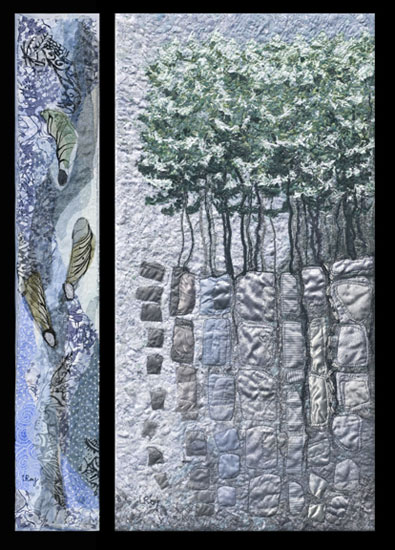
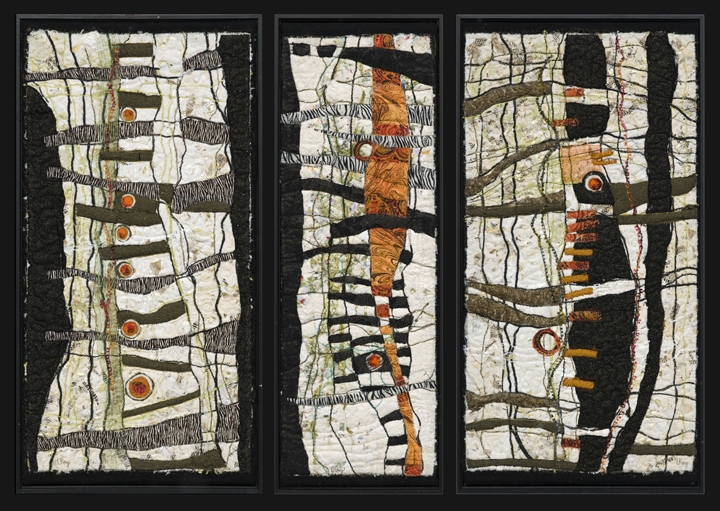
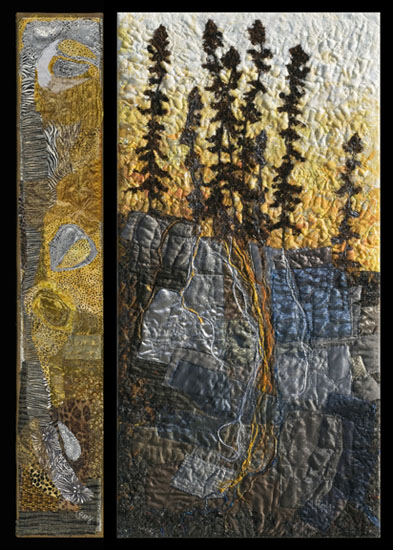
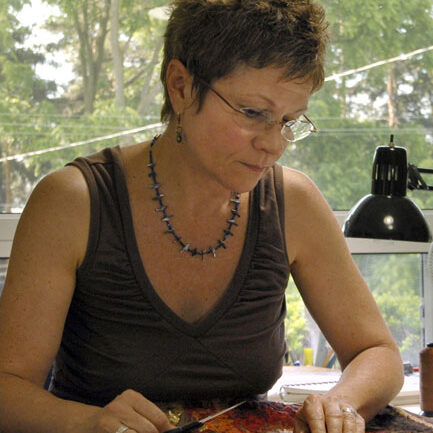
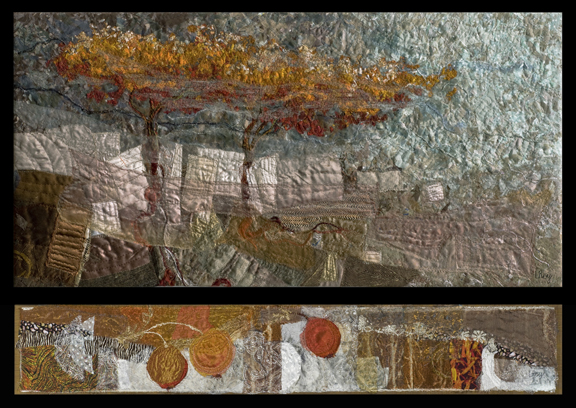
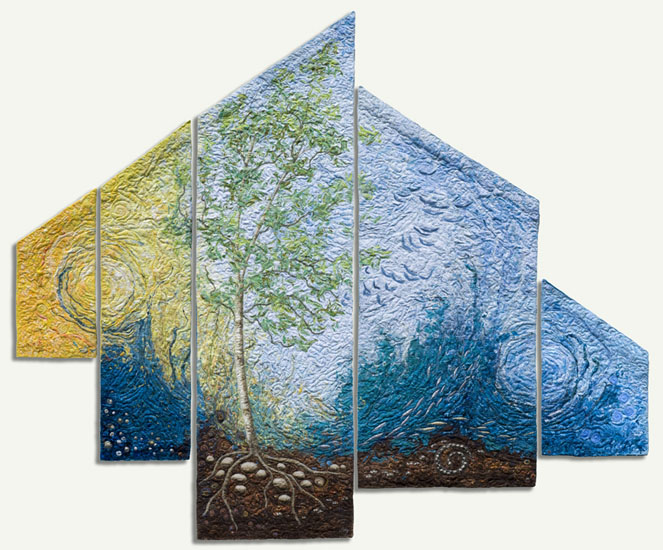
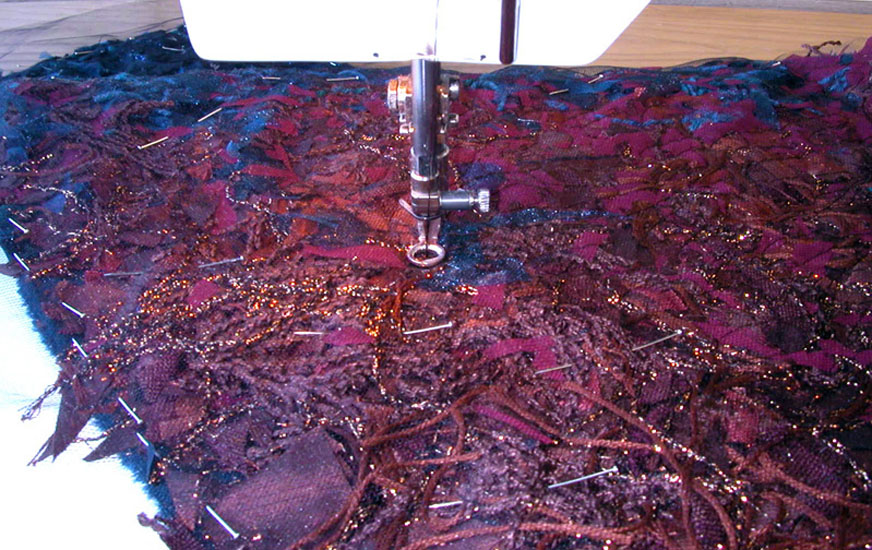
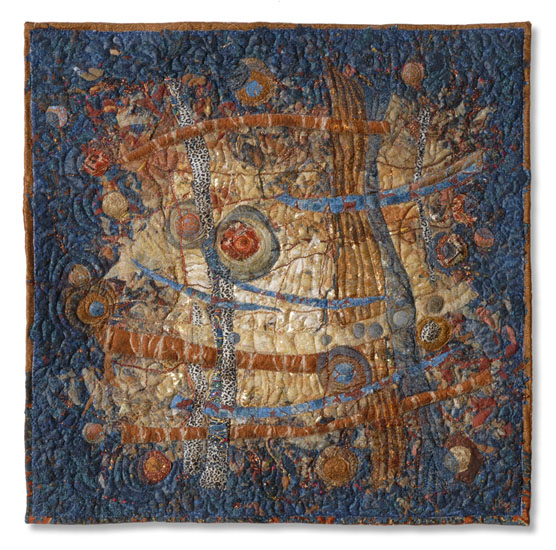
Lorraine Roy has been working with textiles in non-traditional ways. Originally devoted to hand-embroidery, she later developed a unique form of machine collage which allows her to 'paint' with fabric by using a unique mixture of techniques like sewing, collage, embroidery and quilting. She combines her passion for science and spirituality while exploring the earthy origins and surprising versatility of fabrics and threads.
Tell us about your work?
My first true love in textile was embroidery. Even though embroidery techniques were not taught in the area where I grew up, I sought out every possible source of information, including membership with the Canadian Embroiderers' Guild, and was able to master quite a few different types like canvas work and white work. Needless to say, these are slow painstaking methods of expression, and I wanted to work larger, faster, and in an even more painterly way. Over twenty years I developed the collage technique that I now use. Because my imagery is so strongly influenced by the linear and painterly character of embroidery, my hangings are rarely called 'quilts.' In fact I have never made a real quilt, and because French Canadians have a stronger tradition of weaving and rug hooking, I was never exposed to them while growing up.
In spite of this great interest in fabrics and art, in my professional education I opted for a BSc in Ornamental Horticulture. This choice is not as startling as one might guess, given my ongoing interest in the sciences and in nature. Eventually, it all came together in my art: love of fabrics, love of nature, and an abiding relationship with the spirit behind all things.
Previous World of Threads Exhibitions
Lorraine Roy has exhibited in five World of Threads Festivals: 2002, 2005, 2007, 2009 and 2018. In 2009 she was in the Common Thread International Part 2, and in the 2018 Festival she had a Solo Show.
Where do you get your inspiration?
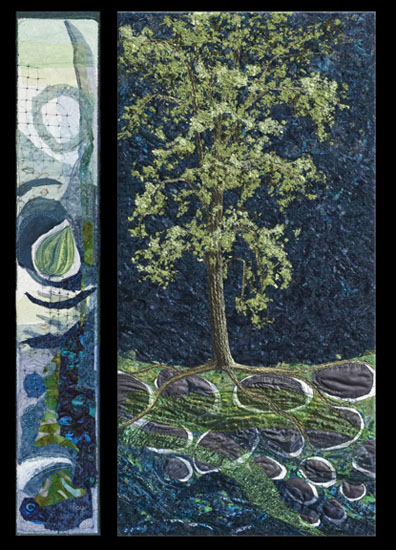
Long ago Mary Butts, who was one of my strongest supporters in textile art and a member of the Canadian Embroiders' Guild, gave me a book entitled "Patterns in Nature" by Peter S. Stevens. In it, the author discusses the science behind all manner of visual patterns, from minerals and molecules, to plant growth patterns, cell division, turbulence in water, and the movements of the stars. The following quote by Francis Bacon sums up the conclusions quite beautifully: 'So then always that knowledge is worthiest…which considereth the simple forms or differences of things, which are few in number, and the degrees and coordinations whereof make all this variety.'
All things are related in the cosmos. The source of the immense variety that nature creates comes from the working and reworking of only a few formal themes. Our attraction to the sources of pattern and repetition is innate, right down to our cells. The 'visual poetics of science' are about the intimate resonance between our souls and our physical natures.
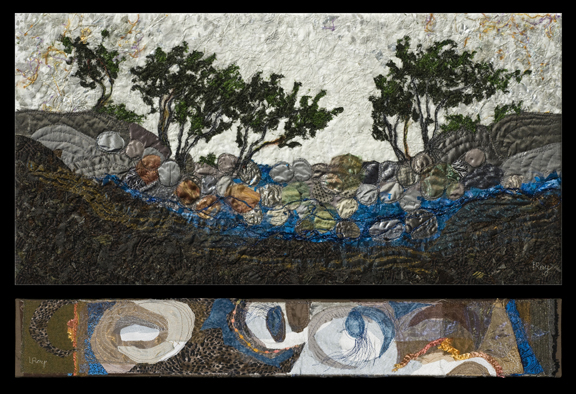
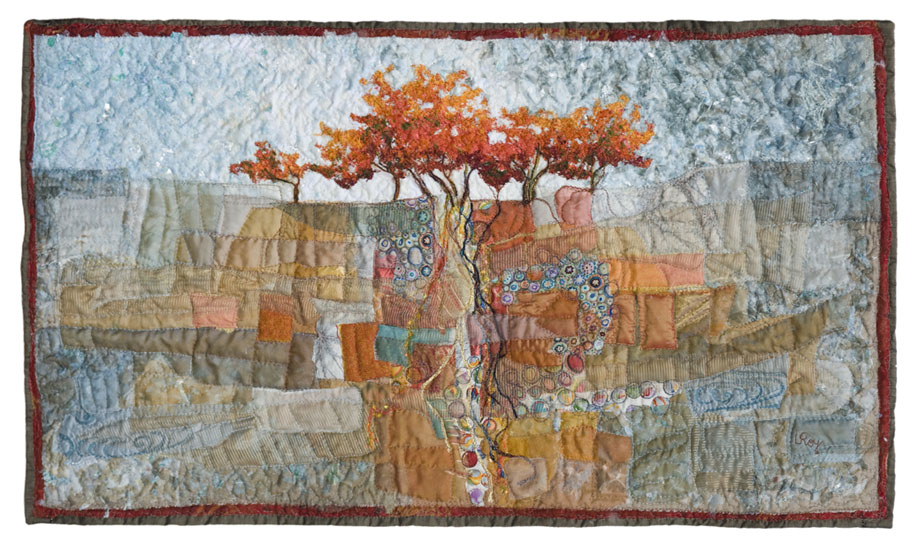
So, I look for this kind of response in myself, in choosing themes or devices in my own work. Rather, they choose me. Grids in all their forms have always elicited a gut reaction in me (it's an actual physical squeeze, just under my ribs), as well as branching shapes (like in plants, trees and river basins). I work with these devices over and over and over again, rarely getting bored or tired, amazed at the infinite permutations and combinations achievable in my medium. Why these particular things attract me I cannot say, only that perhaps they sum up the order and chaos of mortal life at its most noble, beautiful, and universal.
Why did you choose to go into fibre art?
I have never NOT worked in one way or another with fabrics, having learned to sew at my mother's knee from age six. Since then, I have tried nearly every possible textile process. I did not choose fibre art, it chose me!
Process definitely attracts me. Rhythmic motion and cycles in construction are part of the joy of process. I find peace sitting at my machine, listening to music and stitching away the hours. If the process was not enjoyable then I would probably change my medium, find another technique. A real fair-weather friend! But so far this evolving method of working suits me at all levels.
In the finished work, this love of pace and rhythm should shine through. After all, all living creatures need to breathe, feel their hearts beating, succumb to desire, reproduce, and make their peace with the seasons. Rhythm is so basic to life, even at the cellular level, that nothing and no one is untouched by it. It is natural that repetition of shapes and lines occurs in art: art is a vehicle for resonance. This is especially relevant with textiles that are themselves the product of rhythmic motion.
Of course, materials are also intensely attractive. As any textile artist will tell you, collecting bits and pieces over of the years is enormously satisfying in itself. Sometimes putting them together in fascinating new ways just feels like icing on the cake!
What other mediums do you work in, and how does this inform your fibre work?
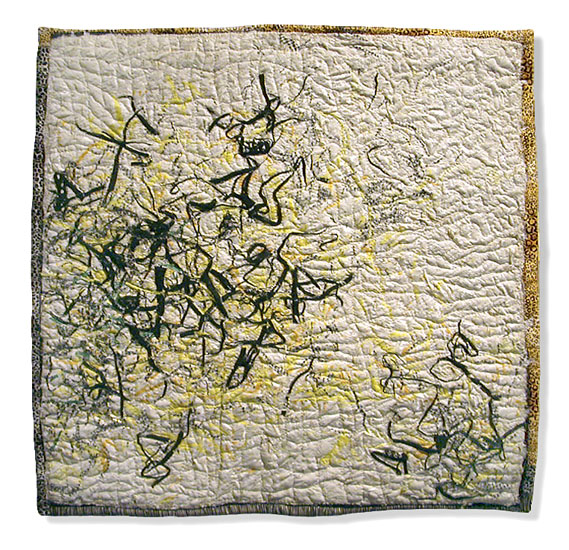
Lately I have been taking classes in paper and mixed media collage that I enjoy very much. I have had wonderful teachers who are fine artists in their own right. The various techniques involved for collage are liberating and fast, so I can work in a more immediate way. This has definitely influenced my work. I am far less persnickety about every little thing! This makes the work fresher and more powerful. Also, it has made me even more conscious of the painterly effects of transparency and perspective. Every time I learn something new in another medium, it translates in some way into my work, and keeps me engaged.
What specific historic artists and contemporary artists have influenced your work and what other fibre artists are you interest in?
In general I have been much more strongly influenced by contemporary painters than by existing textile artists, perhaps because my work does tend to be quite painterly. Over the years I've grown briefly attached to this or that artist, then let them go. Some of my abiding favourites are Rothko, Paterson Ewen, Hundertwasser, Klimt and Tom Thomson… as well as many less well known locals, too numerous to mention. You can see that I'm quite eclectic. For that reason, I'm also not certain how they've influenced my work except in their courage to be themselves in times when they were not universally accepted.
There are individual textile works that I consider powerful. Sometimes an artist works in a series that I like very much, where the whole grouping becomes a single voice. In general, I most appreciate courage and confidence, where major elements appear to be thrown together with passion, and details become almost an afterthought. They have a strong impact from a distance. The work of Nancy Erickson comes to mind. Believe it or not, when I first saw one of her quilts about 25 years ago (two capybaras and a seated woman), I hated it!
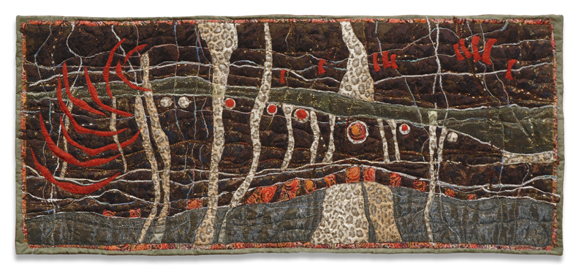
What that first Erickson quilt did was throw into disarray all my previous conceptions about quilts and quilt imagery. I thought it was terribly ugly. Those big awkward pieces of fabric, all out of alignment, bizarre colour, proportion and scale! Unreadable, menacing, uncompromisingly frank! It struck me as incomplete. And what was it all about? I went back to it over and over in despair. Why was this quilt in the exhibition?
Since then I have grown to respect Erickson's work and to love quilts made in this non-traditional genre. It has definitely influenced and informed my direction. And also because of this, I now pay as much attention to strong negative responses as I do to positive ones.
When I view a gorgeous, perfectly realized traditional quilt, it is like attending a fascinating lecture by an inspirational speaker.
Here is a comparison to explain my conclusion. When I view a gorgeous, perfectly realized traditional quilt, it is like attending a fascinating lecture by an inspirational speaker. I leave it a better person and carry with me the highlights, hopefully to apply them in my own life. But when I view a baldly frank quilt that invests more in ideas than in perfection, it becomes a conversation: there is room for me to move, it expects something of me. I walk away feeling slightly disturbed, and not knowing why, but wanting more. Return visits are a continuation of the conversation – I tell it that I don't understand, it tells me something I didn't know before. We grow together. With really great, powerful art textiles, that conversation never stops.
This 'thrown down' style of art-making is something I aspire to. I cut pieces less carefully, I use bits that are lying around rather than search for a particular one, I let surface disturbances be, accept unusual colours. To me, it signifies a direct and confident relationship between body and material, without ego and intellect in the way. Like the Automatistes, whose motions were recorded with paint, it captures an honest and active moment in the artist's progress. It's not as easy to achieve immediacy in fabric, but "man's goal should always exceed his grasp".
Because the fine art world is opening more doors to mediums outside traditional painting and sculpture, it behooves textile artists to be more proactive about exhibiting in public venues.
What role do you think fibre art plays in contemporary art?
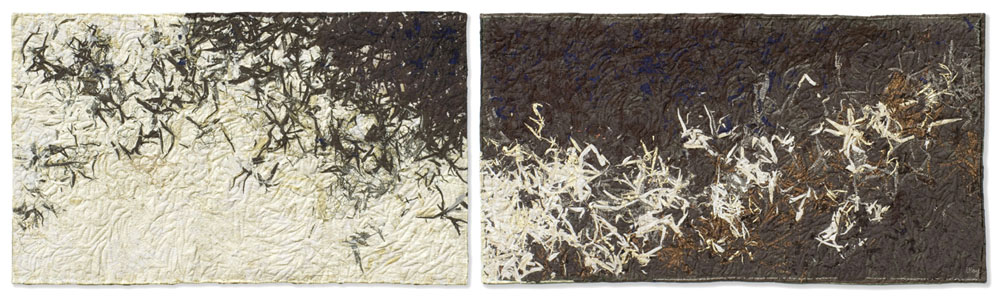
Because the fine art world is opening more doors to mediums outside traditional painting and sculpture, it behooves textile artists to be more proactive about exhibiting in public venues. Textile exhibitions are extremely well attended because they provide an entry point for many viewers who are not normally interested in fine art. Plus, pushing those boundaries increases respect for the female perspective in a world that has a growing need for a gentler, yet more socially and environmentally conscious voice.
Tell us about your studio and how you work:
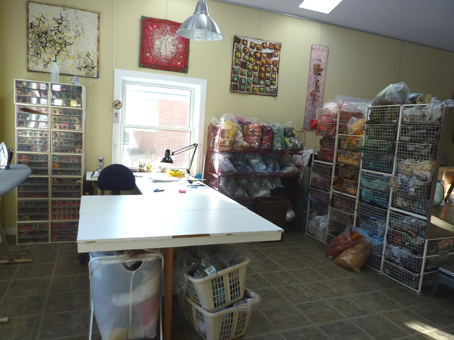
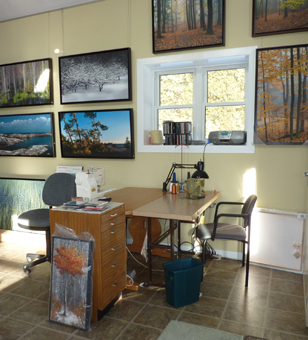
My husband and I just built a new heated studio on our property. It's 20x30', with 10' walls to display both our work (he is a professional photographer). There are lots of windows and two skylights. The building is surrounded by flower, herb and vegetable gardens (my other passion), and lot of trees and wildlife. I'm in the studio most days - it's a peaceful place with few distractions. We're open to the public some week-ends.
There I keep a huge collection of fabrics and threads: in bread bins, Ikea baskets, laundry baskets and cabinets. It's all in order - everything is separated by colour in clear plastic bags. I have two big tables - one for layout and one for my two Bernina sewing machines: a regular one and an industrial one, both old Swiss mechanical models: excellent machines! During the process everything is chaos, but it's all back in place after every project. I tend to work on only one piece at a time, unless it's a series of small ones.
Is there something else you would like us to know about you or your work?
Someone once told me I'm a driven kind of person, and it rang true. Nothing interests me as much as art and art making, and everything I see and experience is ultimately judged on that basis. I don't make distinctions over mediums – I could just as well be a painter, and I might yet. Or a writer, or a singer! I love it all.
Over time I've surrounded myself with the basic necessities to live this kind of life. It's a simple existence. Since my husband and I are both artists we rarely afford holidays but our home is a beautiful refuge with all the necessities. This to me is the ultimate kind of life… to be able to live in art, and to make art to live.