Artist Interview 38: Edith Meusnier
Aumont en Halatte, France
Edith Meusnier is a French textile and environmental artist. Her installations, in confrontation with the environmental sites, make up a paradoxical and random environment that questions the notions of sustainability and vulnerability.
Tell us about your work?
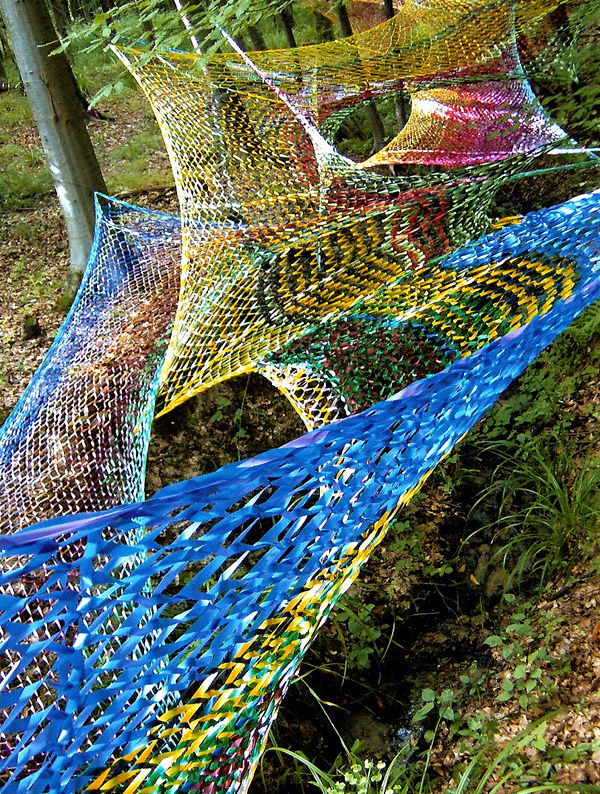
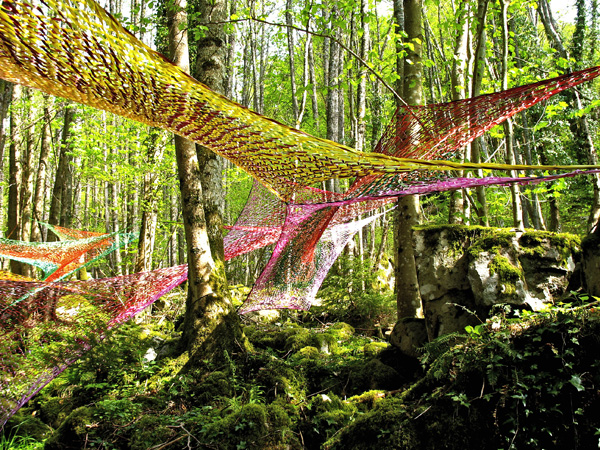
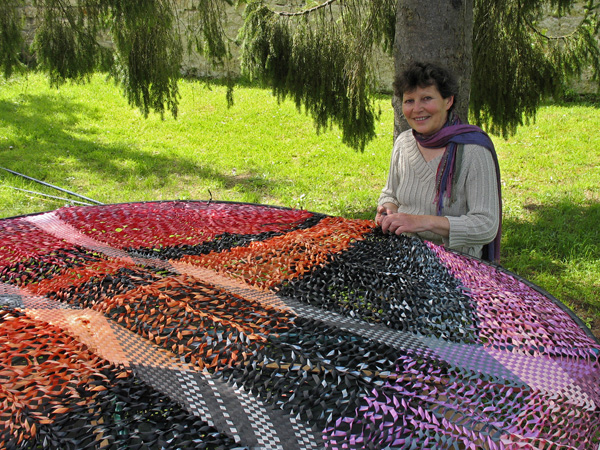
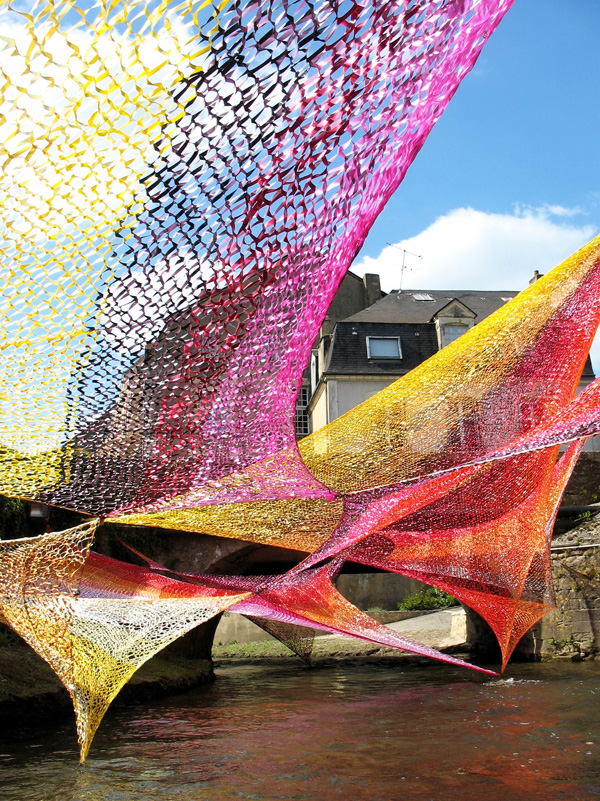
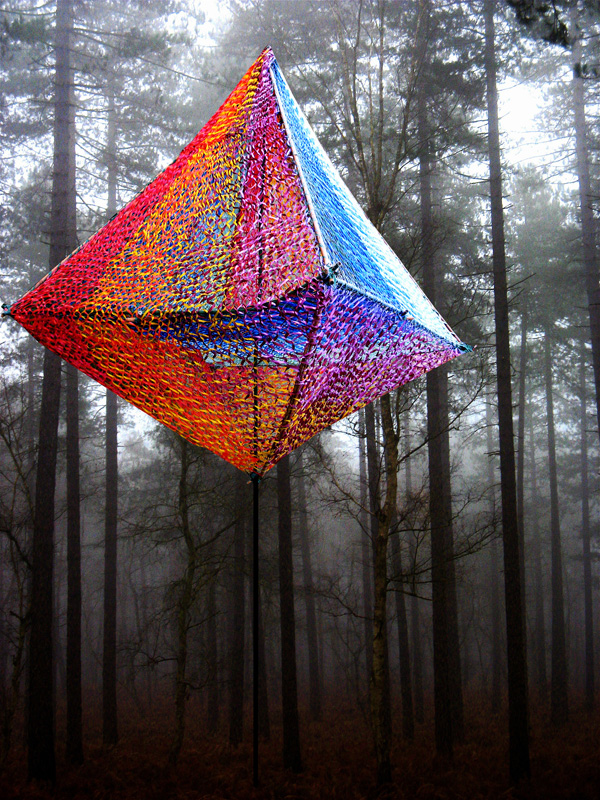
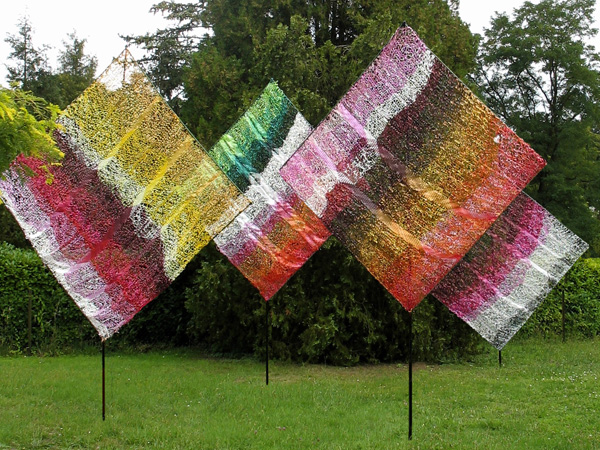
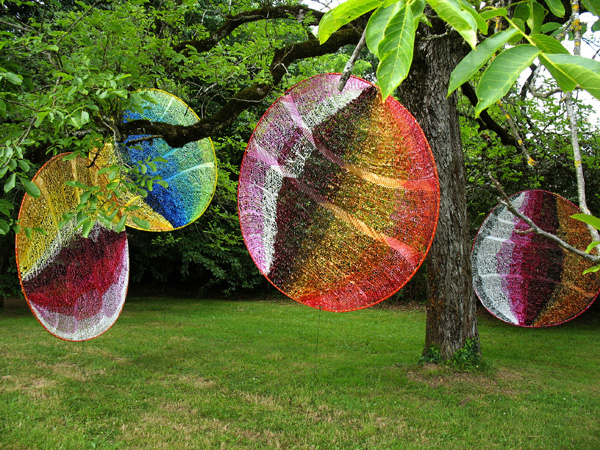
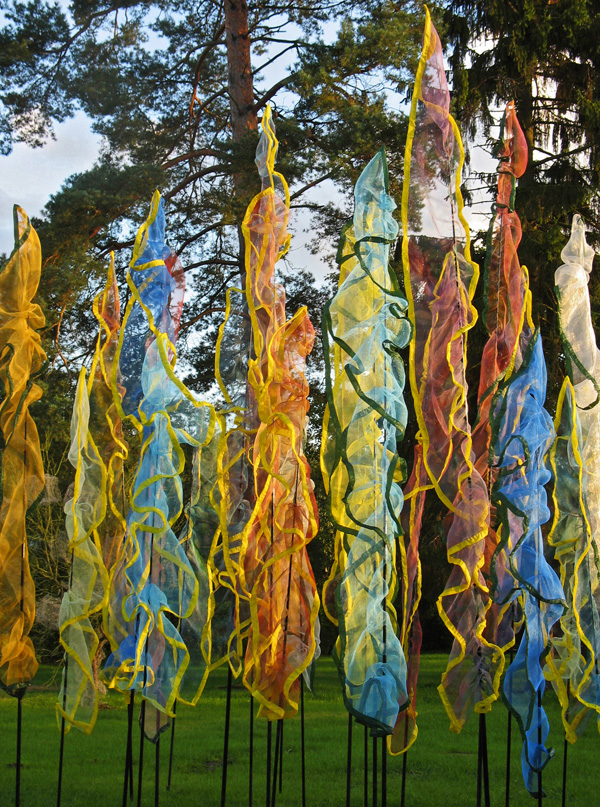
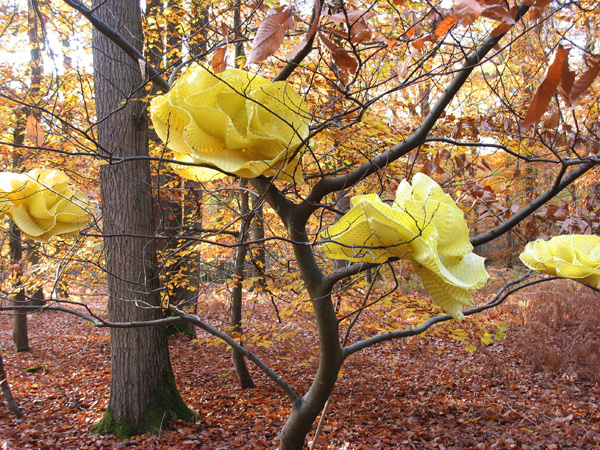
My work consists of designing ephemeral and artificial Installations within nature, in order to let the sun and rain increase the transparency effects and illusions.
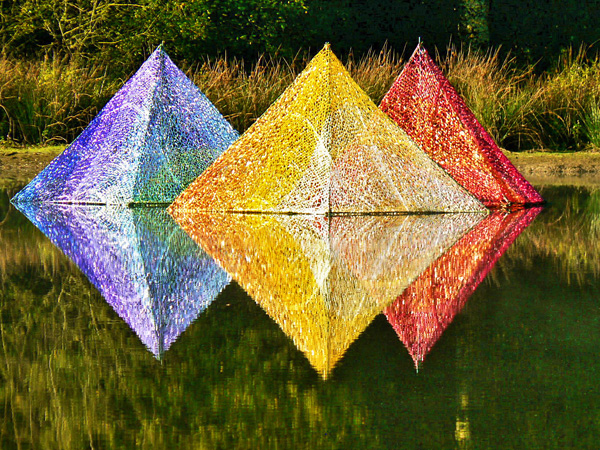
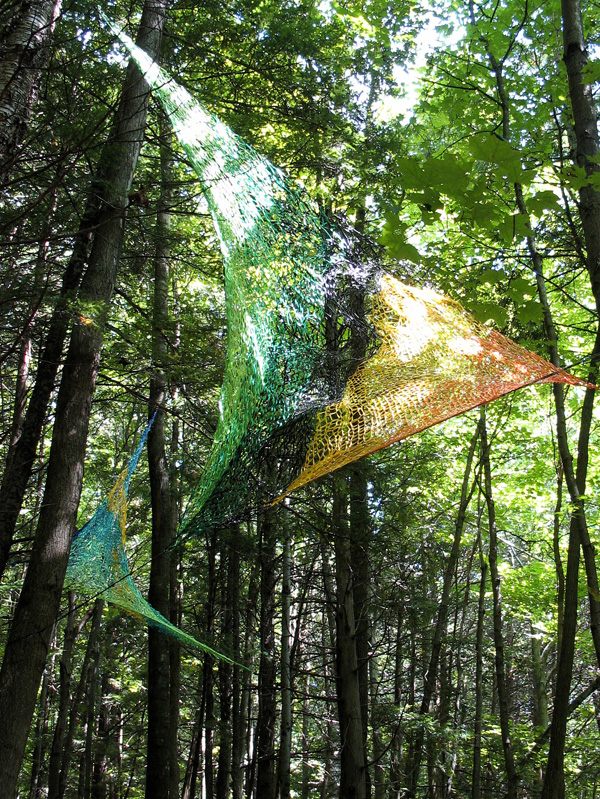
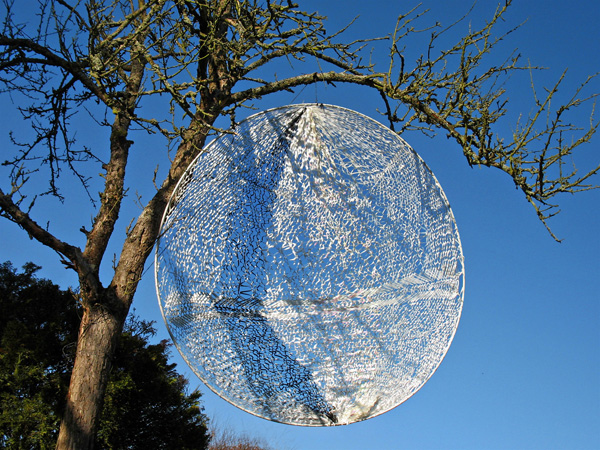
Successively, traps or offerings, screens or windows, my structures are never frozen; they vibrate between shadow and light, they move with the wind, in a succession of contradictory images, which reflect a plural reality. With plastic ribbons, I draw in space an unusual parenthesis that questions the ambiguous relationship between mankind and its environment.
I make a series of light shifts: moving a textile object in a public space, using a variety of materials, and putting a contemporary interpretation and using traditional techniques to give the wanderer a feeling of disorientation in his own landscape.
Where do you get your inspiration?
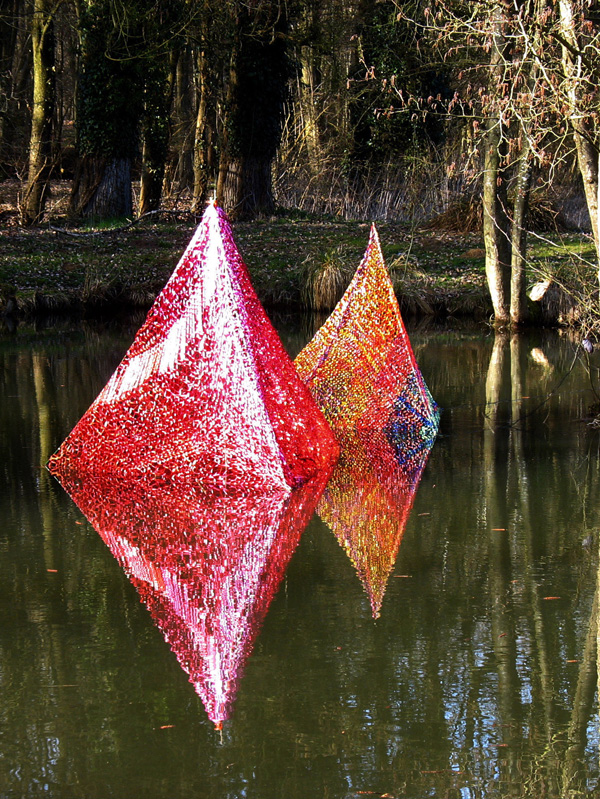
I start every new project with a specific site location and a particular cultural context in mind. It is this initial framework with its constraints and its mystery that stimulates me. I choose materials, colours and shapes depending on the terrain, climate, and light of the place. Forests, ponds, rivers, open spaces or enclosed, urban or rural, each proposal has a different answer: moving or stationary, anchored or floating.
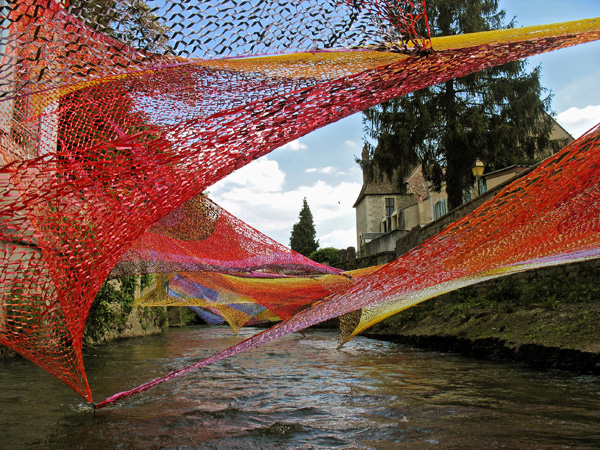
The nets are in turn sensors and protectors; they seep, they ripple, they get through space, dividing or revealing it. They embody a tension between reality and imaginary.
Why did you choose to go into fibre art?
I've always loved playing with fabrics, strings, ribbons and threads of any kind. I like the lightness and fluidity of fibres. I like to manipulate, transform, distort and fabricate textiles. After discovering the richness of pre-Columbian textiles, I became passionate about studying plaiting, weaving and dyeing techniques. Subsequently, I studied textile design and industrial creation, only to promote the freedom and simplicity of plaiting. Without tools, I can raise huge structures and I always feel a pleasure to make colours dance directly under my fingers, before deploying them in the landscape.
Which is your favourite fibre medium?
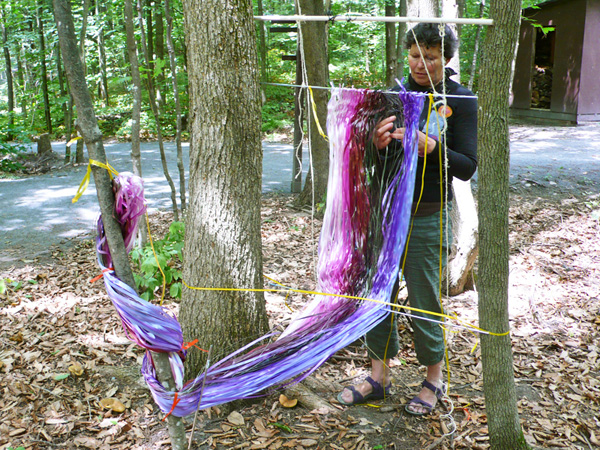
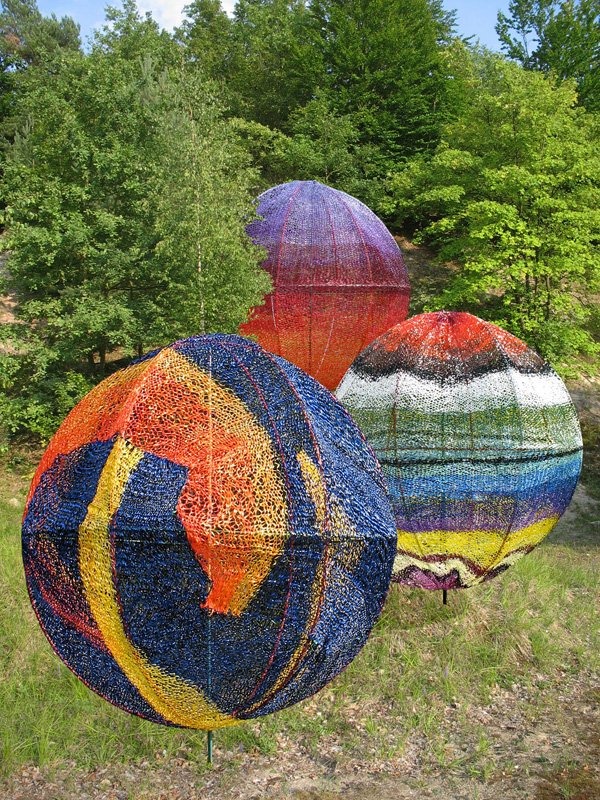
Currently, I plait (braid) multicoloured nets from gift ribbon using a "Sprang" technique.
The gift ribbon is very light, strong, economical and comes in an infinite number of colours. I play on the idea of a present and of celebration, but also the ridiculous aspect of the cheap shoddy goods that are indicative of a society that puts more importance on the packaging than on the content.
The nets are in turn sensors and protectors; they seep, they ripple, they get through space, dividing or revealing it. They embody a tension between reality and imaginary.
I am always fascinated by the result. This technique of plaiting dates back to the bronze age and has the magic particularity of a mirror repetition. I play with its exceptional elasticity and its various facets (net, weaving, lace).
What other mediums do you work in, and how does this inform your fibre work?
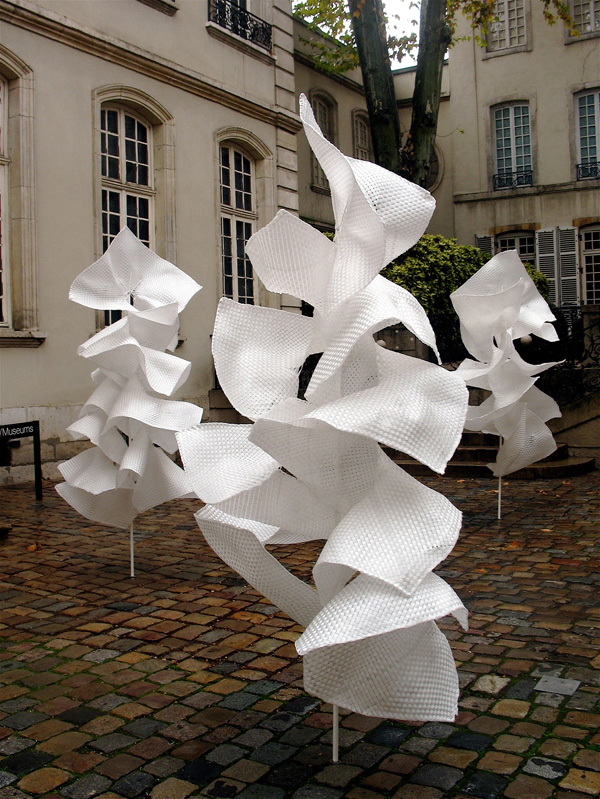
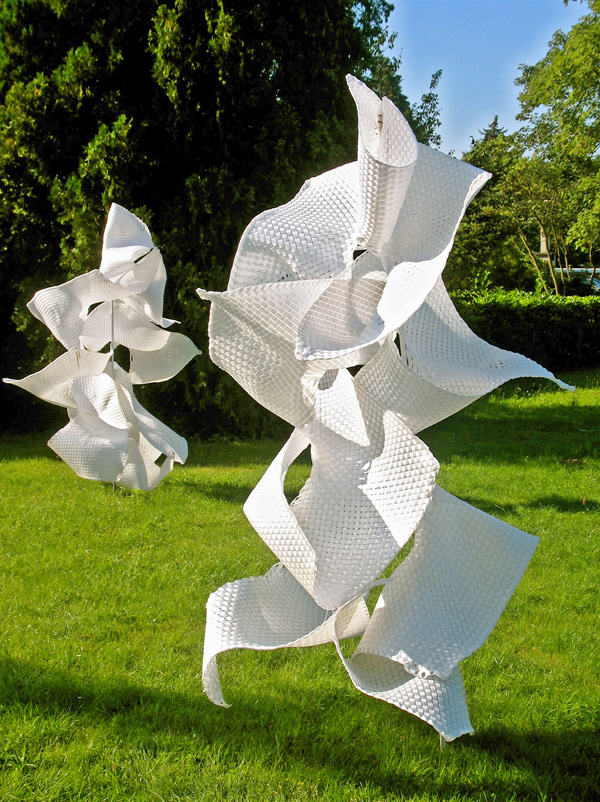
In my work I use other materials, not only textile and it takes place in several stages: identification and site pictures, sketches, fabrication, testing and finally installation.
I must ensure that the work will withstand the wind for several months. Depending on the case, I build flexible and flying modules that I stretch between the trees or I build rigid geometric structures with bamboo, metal or plastic pipes, fishing rods ... I assemble, I tinker...
What specific historic artists have influenced your work?
I think my whole approach was first influenced by the Bauhaus School founded in 1919, in Weimar, Germany, by the architect Walter Gropius. It was a great experimental laboratory based on the complementarity between architecture, design, art and craft, combining research and teaching. Many European avant-garde artists (Paul Klee, Wassily Kandinsky, Johannes Itten, Laszlo Moholy-Nagy, Gunter Stolz ... ) have taught and contributed to profoundly influence art and design of the twentieth century.
The magical aerial world of Calder, American sculptor, has always made me dream. His Mobiles reflect simplicity while at the same time are full of life. There is poetry, humour and desterity in his work
What specific contemporary artists have influenced your work?
I am very sensitive to the approach of Christo and Jeanne Claude, In Situ Art famous American artists. By wrapping an historical monument or by emphasizing a picturesque landscape with huge fabrics, in a very short time they are able to give a different identity to the chosen site. I saw the Pont Neuf transfigured in Paris in 1985, but I'm particularly fascinated by the "Surrounded Islands" conducted in 1983 near Miami, for their surprising and paradoxical beauty, especially as these islands are used as garbage dumps.
"Les Penetrables" of Jesus Rafael Soto, Venezuelan-born artist impressed me very much. With very simple means, suspended threads in space, Soto manages to immerse the viewer into a tactile and visual world, making him lose all its bearings.
I admire the talent of Issey Miyake, Japanese fashion designer. He was able to build bridges between fashion and art, using traditional techniques and new technologies, and between Japanese and Western cultures. The plastic dimension of his clothing reflects the originality of his approach and the complicity that he has established with many artists such as choreographer William Forsythe, the photographer Irving Penn or architect Tadao Ando.
I consider my work as ephemeral and do not keep it.
What other fibre artists are you interested in?
There are currently worldwide, an impressive amount of artists using the universality and flexibility of textile language. It is this excitement and the various eclectic approaches that fascinate me. For example, I would mention:
El Anatsui, a Ghanaian artist who talks about African culture through its sumptuous and monumental tapestries made of recycled metal caps.
The artist Majida Khattar, born in Morocco, which mentioned during sculpture-clothing walkways the ambiguous situation of Muslim women, before denouncing how ridiculous or tragic, the role of the universally oppressive feminine clothing is.
British artist Lucy Orta, which addresses the problems of contemporary society (the migration, survival, environment ...). She explores the notions of social interaction with her portable architecture and collective clothes, works both functional and poetic.
I find it funny and revealing, the peaceful, subversive and humourous practices of "yarn bombing" or "knit graffiti".
Tell us about your studio and how you work:
I do not have a studio and my work is seasonal. In winter I plait inside the house, and I go out as soon as time permits. In sprang, I use an old ladder to reach my threads and unroll as I need them. I rarely reuse the same module twice. I consider my work as ephemeral and do not keep it. I like to take my time, patiently plaiting, testing the resistance of structures to the elements, then take the final installation to discover a region and its people.
What role do you think fibre art plays in contemporary art?
In the current context where contemporary art is characterized by a mix of techniques and materials, textile art has the ability to sneak into the world of sculpture, architecture, but also dance, performance, and street art. I find it funny and revealing, the peaceful, subversive and humourous practices of "yarn bombing" or "knit graffiti". All over the world, anonymous groups are created to question the urban life, to repair its faults or to denounce the totalitarianism of video surveillance.
How did you find out about the World of Threads Festival?
From time to time, I research the web to find out what is new in the world of contemporary art, textiles or environmental, and it is in this context that I discovered the World of Threads Festival.
What Interests you about the World of Threads Festival?
I think it's a great idea to do interviews on the web. This allows others to discover new approaches and different perspectives on the textile thematic. I hope this will be achieved through exchanges and dialogues without any borders.