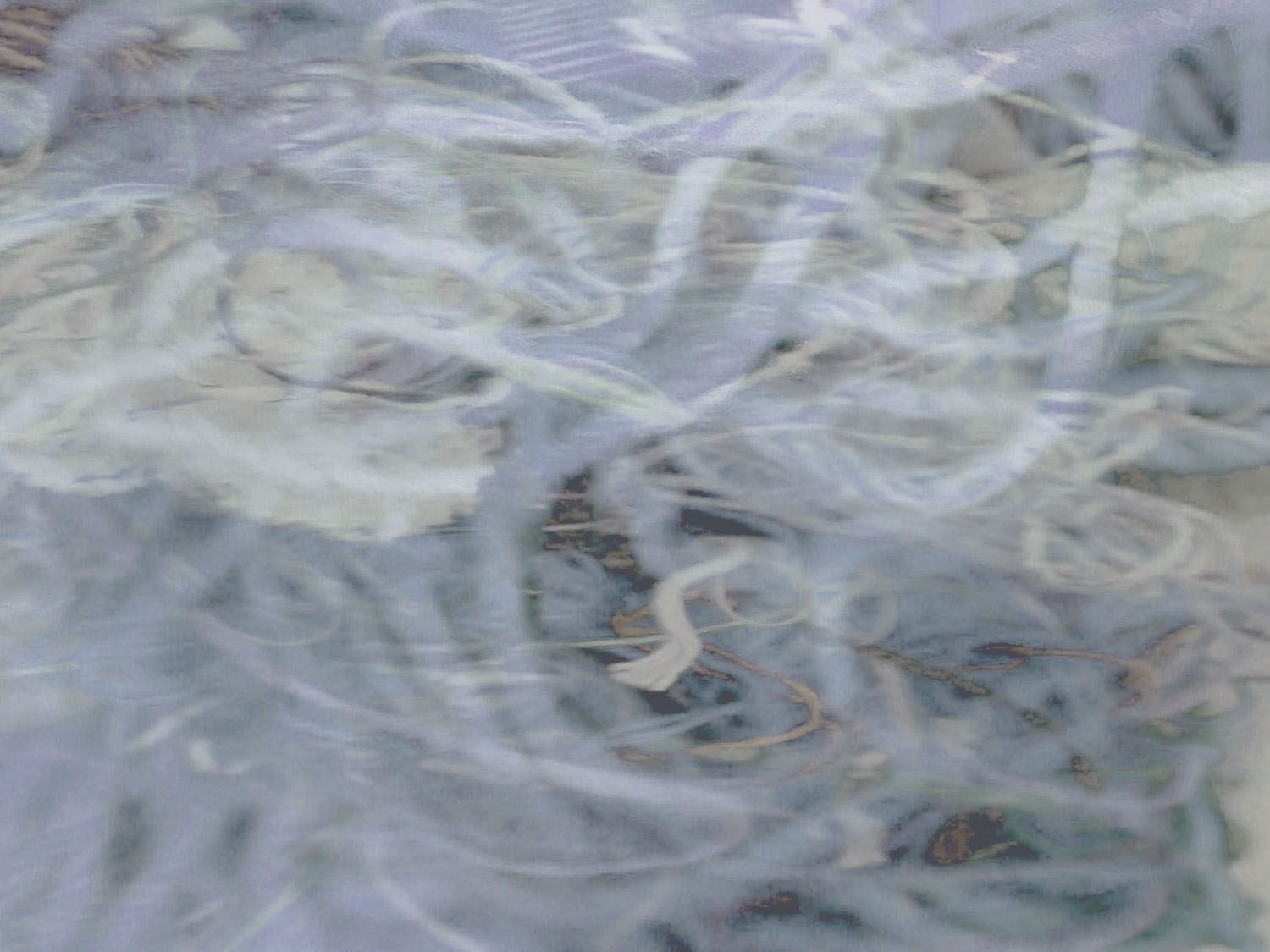
Toronto, Ontario, Canada
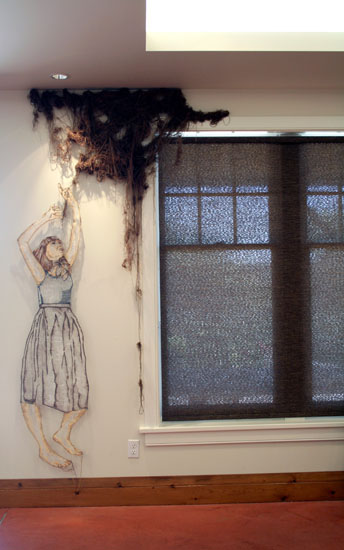
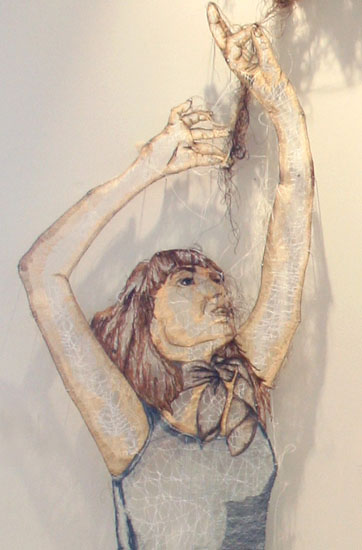
Amanda McCavour uses a sewing machine to create thread drawings and installations by sewing into a fabric that dissolves in water. She is interested in the vulnerability of thread, its ability to unravel, and its strength when it is sewn together.
Previous World of Threads Exhibitions
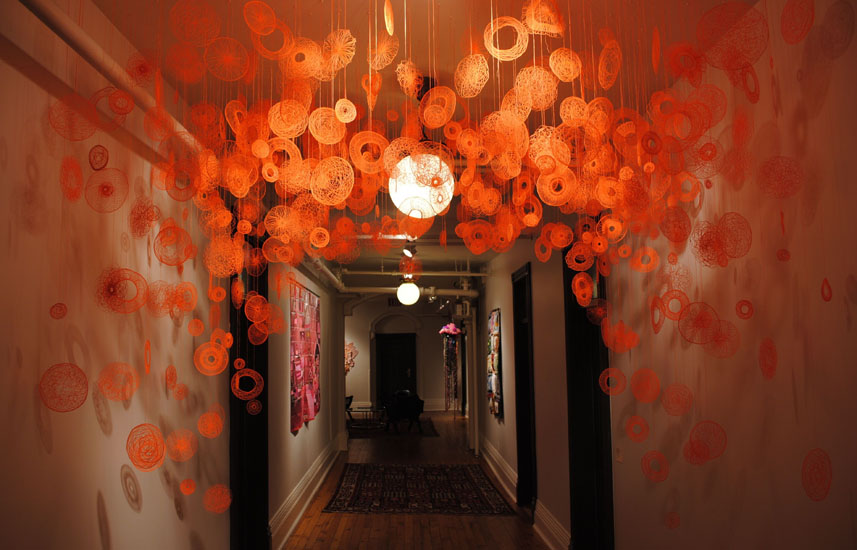
Amanda McCavour has exhibited twice in the Festival and co-curated an indipendent exhibition. She exhibited in the 2009's Common Thread International Exhibition Part 1 in Oakville, Ontario. In 2012 she co-curated the exhibition Material Connections at Lonsdale Gallery, Toronto. In 2014 she showed an installation in strung out and undone at The Gallery Space at the Living Arts Centre in Mississauga, Ontario.
I am interested in the vulnerability of thread in relation to the home, as both things feel temporary and fragile. I am interested in thread's ability to hold together and its strength.
Tell us about your work?
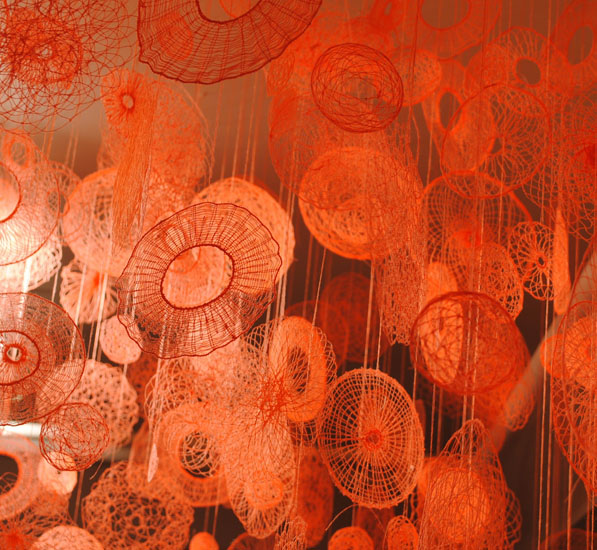
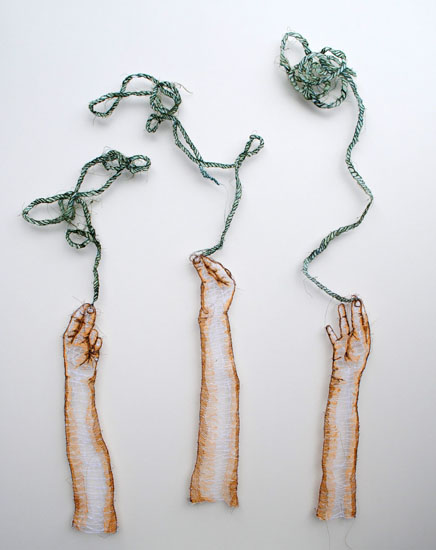
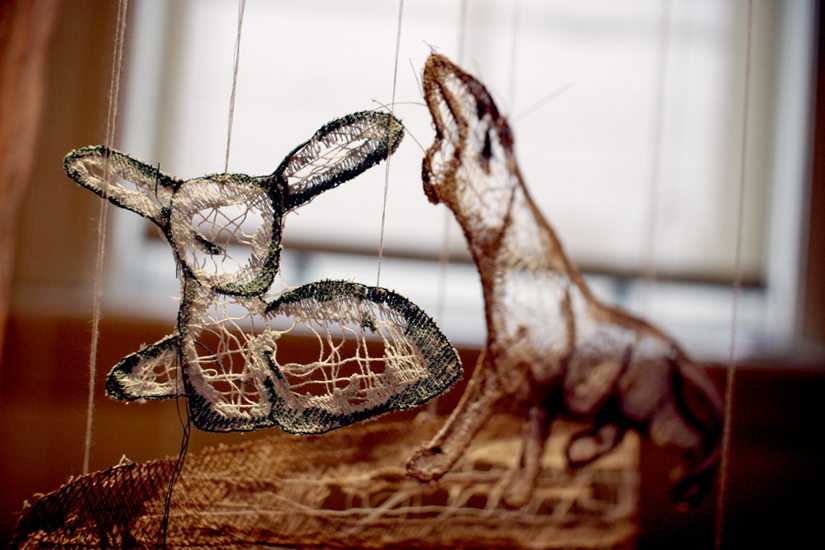
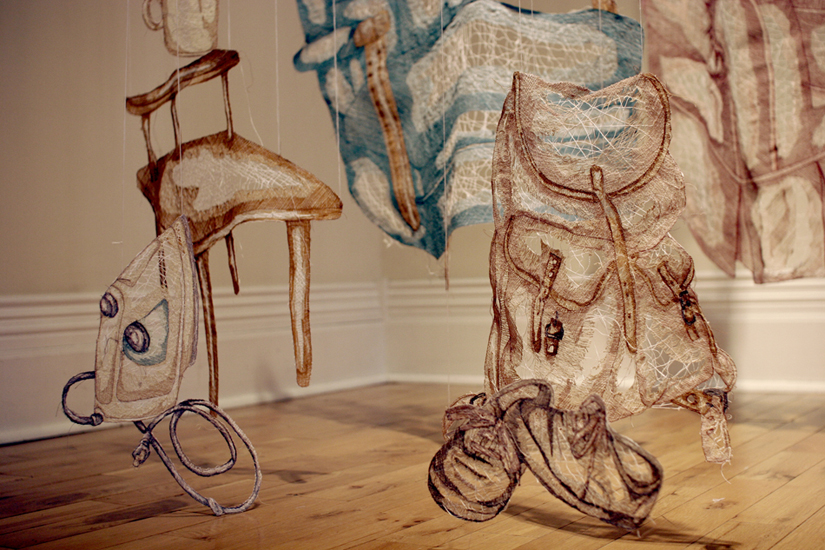
I would describe my work as being drawings that are made out of thread. In my work I use a sewing machine and water soluble fabric to create thread drawings that can hold together without a base. I am interested in thread line as it relates to drawing but also how my thread lines are also sculptural.
Where do you get your inspiration?
I think that there are a lot of things that influence my work. I really like diagrams of hands and exploded views of objects. I have had a Visual Dictionary for a long time which contains lots of interesting diagrams to look at. I also like office supplies, and paper.
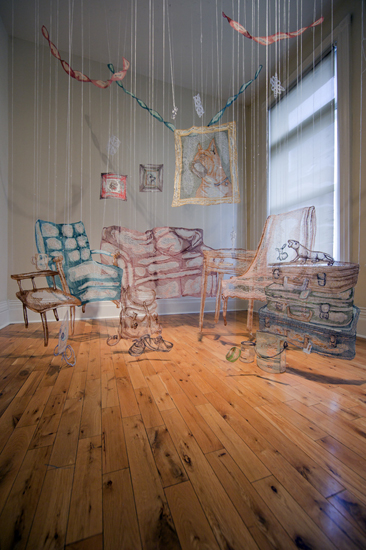
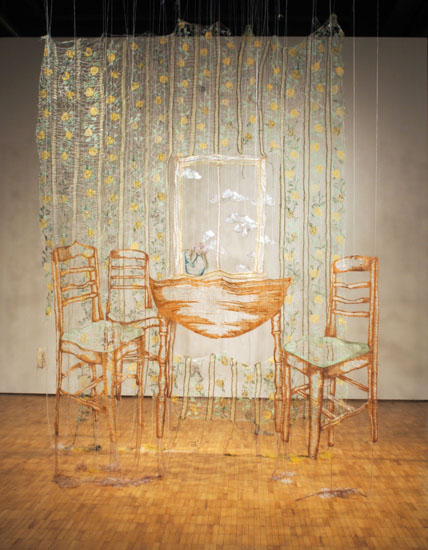
Lately I have been thinking a lot about ideas surrounding home and what these spaces contain. Do Ho Suh's fabric interiors were definitely of influence to me when I was making a piece called "Stand in for Home" which was a life sized recreation of my old kitchen. I am thinking about his pieces now as well as I am currently making a piece for Come Up to My Room an event at the end of January at the Gladstone Hotel based on my living room.
Recently I have been looking at a lot of frost and ice crystal forms, not only because of the cold weather and the frost on my apartment's windows but also because I will be doing a project in MADE's cooler/exhibition space in May relating to these forms. I have been looking at some of Janet Morton's work, specifically her piece, Early Frost and W. A. Bentley's photographs of snow crystals. I've been thinking about white work and cut paper snowflakes and sculptural works in paper, specifically Richard Sweeney's modular forms in paper
Why did you choose to go into fibre art?
I graduated from a fine art program at York University. I had always been interested in thread and fibre. At York I studied drawing and thought that it would be an interesting experiment to propose embroidery as drawing. I thought that it might be interesting also to have an embroidered drawing that wasn't on a fabric base. It was my interest in drawing that brought me to fibre and specifically thread.
Which is your favourite fibre medium?
Thread! I am interested in the vulnerability of thread in relation to the home, as both things feel temporary and fragile. I am interested in thread's ability to hold together and its strength. I am interested in thread as both drawn and sculptural line. Thread is my favourite.
Do you work in any other mediums, and how does this inform your fibre work?
I still do some sketching and drawing on paper. Drawing has been a big influence on my work as it was what brought me to the work that I am making today. I look at a lot of drawing still.
I am also interested in printmaking. I think that some ideas in printmaking are still present within my work. Ideas about multiples and repetition are things that I think about when making work. In the last installation that I made for Hard Twist: Chroma, the Gladstone Hotel's annual fibre exhibition, curated by Helena Frei and Chris Mitchell, I made more than 400 neon orange thread "scribbles" and hung each from the ceiling with a pin and a piece of thread. I was hoping that this repetitive imagery and action would create a mass of thread, a giant scribble. It was all of these similar repeating parts that created a larger whole. Some of the repetition in my work relates back to these ideas which are present in printmaking.
What specific historic artists have influenced your work?
Egon Schiele's drawings and paintings are works that have influenced me. I like the way that his figures sometimes seem to float on the page, disconnected from a place. The way that he paints, sometimes the paper becomes a part of the figure, the colour shining through. I like this kind of transparency within the figures that he draws. I also like the way that some things are left empty or missing. I've always liked the idea of things unraveling or falling apart. I think that's why I like to work with thread. Egon Schiele's drawings have this feeling.
What specific contemporary artists have influenced your work?
It was at school that I began working with thread, but it wasn't until I was awarded a residency at the Harbourfront Centre Textile Studio, after I graduated, that I was able to work with other artists and designers working in the same craft media as myself, along with other materials such as glass, metal and clay.
These are some of the people that I have worked alongside for the three years after I graduated. Thea Haines, Norah Deacon, Kate Jackson, Julie Moschenross, Shuyu Lu and Lizz Aston were great ladies to work alongside in the textile studio at Harbourfront Centre.
Margaret Lim and Adriana McNeely were metal smiths working at the Harbourfront metal studio that I collaborated with separately on two different projects. Margaret Lim and I collaborated on a project called "still" in the Harbourfront Centre vatrines where we explored small scale dioramas which explored layering different thread elements with metal elements. This project directly influenced a piece that I made last year called "Stand in for Home" which was a life sized thread diorama of the kitchen in one of my previous homes.
Adriana McNeely and I collaborated on a project in the Vatrines at Harbourfront Centre as well, in a show called "Glitter Beginnings". The work presented explored the connection between traditional kids-craft and the current craft practice of both artists today. I created a larger version of one of the pieces as well. Exploring ideas with other artists and collaborating with them in this way has influenced me a lot and led to more projects directly relating to our collaborations.
What other fibre artists are you interested in?
Dorrie Millerson of Toronto makes small needle lace sculptures. One of my favorites was a small streetcar that was installed on Queen Street in a small window exhibition space called Queen Specific. This piece related perfectly to the street space it was beside, and the slow moving streetcars. Dorrie Millerson manipulates thread in a way that is really intriguing to me.
Shi Jindian of Yuxi City, China, makes crochet sculptures out of steel wire. He works around objects and then removes the original object leaving the crochet behind. I am interested in his process as I think that it relates to my own process of working with a material to support the work and then later removing it. Shi Jindian's work with machines and motors is interesting to me as well. While I was in Dawson City doing a residency at the Klondike Institute of Art and Culture, I created a drawing of an old steam pump on a 1 to 1 scale. I am interested in the contrast between the heavy machine parts and the lightness and delicacy of the thread.
I like Orly Cogan's figurative embroideries on found linens. I was looking at her work a lot when I was making life sized self portraits when I first graduated from school. I liked how she was able to incorporate the found linen floral motifs into her compositions. The way that she drew figures overlapping was something I really liked as well.
What role do you think fibre art plays in contemporary art?
Lots of contemporary artists are using fibre in their artwork. I think that fibre can be an interesting medium to explore many different types of ideas. I think that fibre will play a surprising role in contemporary art as there are so many ways fibre can be manipulated and referenced in contemporary practices.
There are artists that are exploring scale through fibre. Althea Merback makes tiny pieces while Janet Echelman's pieces transform large spaces. There are also artists who are transforming industrial objects with fibre patterns. Cal Lane's work is really interesting to me as well, transforming industrial objects with lace motifs. I like the contrast between the industrial objects and the textile patterns. Lace Fence was designed by Demakersvan's Joep Verhoeven and transforms a regular chain link fence with lace motifs. Soft cloth is used to reference hard objects in Margarita Cabrera's 'vocho', a sculpture of a car made out of fabric and metal parts.
It seems to be that the possibilities for fibre in contemporary art are endless and that the role it might play is one of expanding and broadening the boundaries between art, craft and design. Because fibre carries with it a certain history of use, I think that it is an interesting medium to talk about ideas of touch or use. Because of the way that fibre has been used throughout history, of its association with both the handmade and industry, I think that there could be infinite ways for fibre to be used in contemporary art.
Tell us about your studio and how you work:
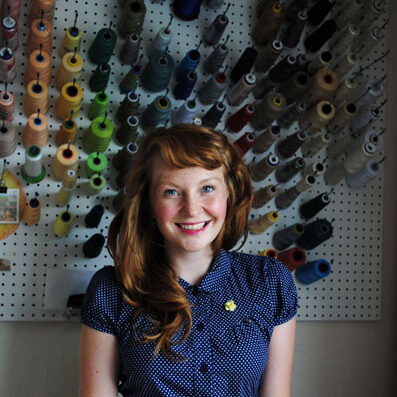
I am working from my home studio right now. My studio space consists of a table and my sewing machine with a peg board with lots of thread. I spend a lot of time with the sewing machine running so I think that I work LOUDLY most of the time.
In the past little while I have worked in a couple different studio environments. I recently completed a three year residency at Harbourfront Centre Textile Studio in May 2010. The Harbourfront studio was a shared space where I worked alongside other craftspeople and artists. Since finishing up the residency at Harbourfront, I have gone to do another residency in Dawson City, Yukon, where I worked in a historical home called McCaulay House.
What was your motivation for submitting your work to the World of Threads Festival?
I thought that the World of Threads Festival was an interesting mix of people working with many different kinds of fibre at lots of different levels. I was interested in this mix of people and the different ways that people are using fibre.
Where do you imagine your work in 5 years?
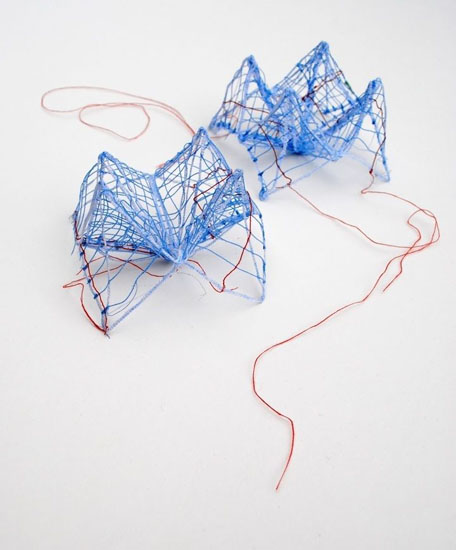
I would like to imagine my work expanding to different media in the next five years. I would hope that I would be exploring different ideas and processes. I would also like to create embroidered work with folds and explore different construction techniques.