Artist Interview 128: Christine Mauersberger
Cleveland, Ohio, USA
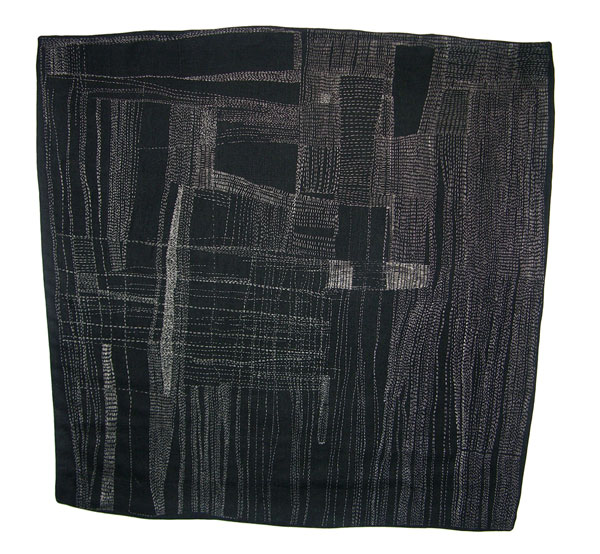
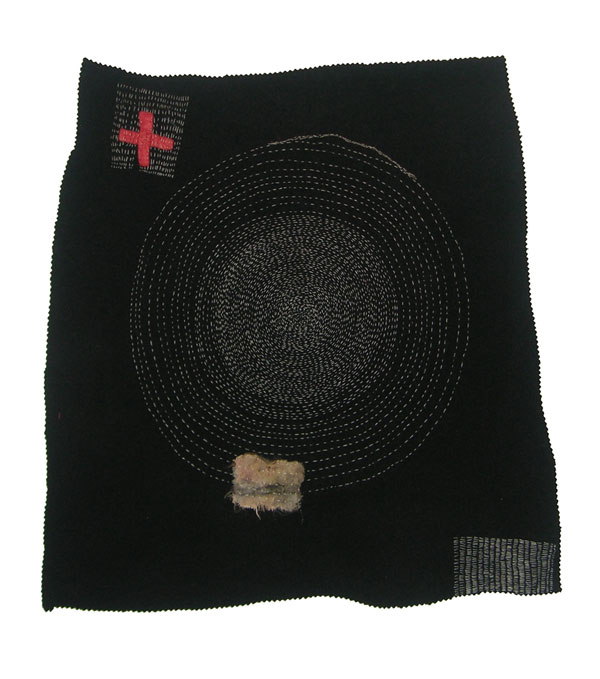
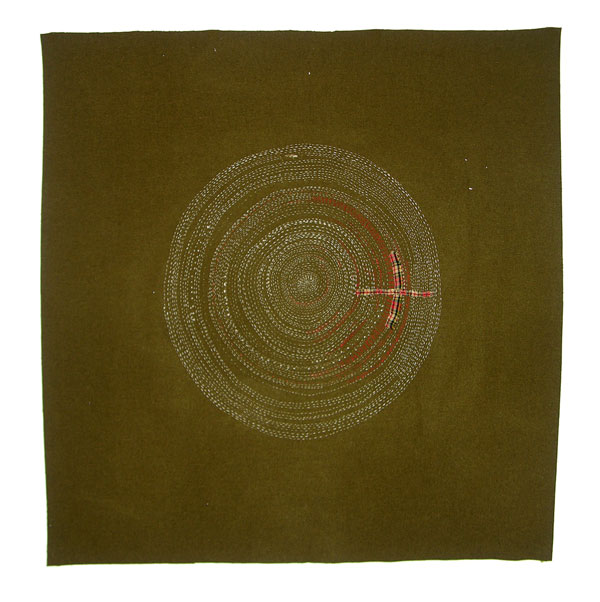
Christine’s work varies from small to room-sizes installation pieces. The main technique she uses is a simple running stitch, related to Japanese boro and West Indian Kantha stitching. She uses sketchbooks and journals to hold thoughts, drawings and marks as they come to her awareness. Sewing is a calming process for her.
Tell us about your work:
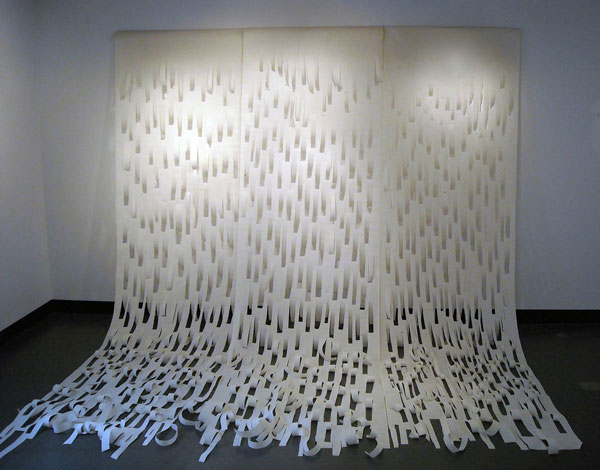
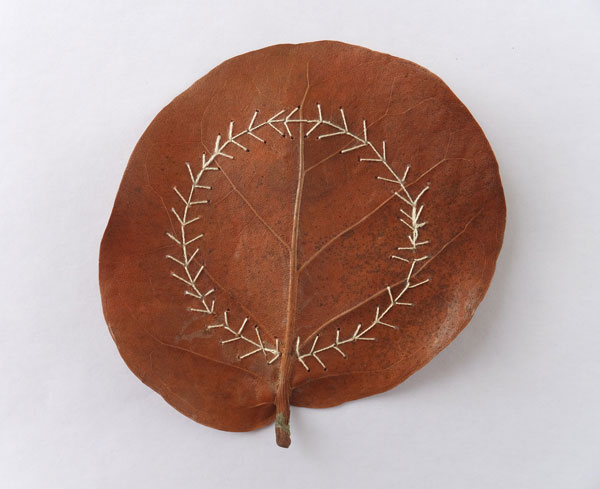
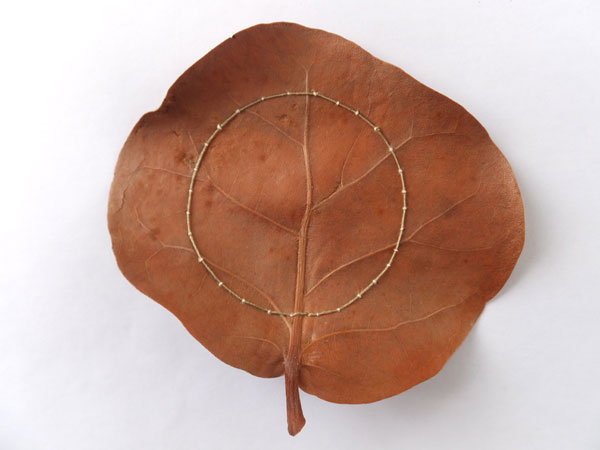
I make processed-based artwork and refer to the concept of time. I stitch, cut and draw onto a variety of surfaces: from linen, wool, and paper to plastic and found leaves. My artwork varies from very small and intimate to room-sized installation pieces. The technique I use most often is the simple running stitch and is related to Japanese boro fabric and West Indian Kantha stitching. The method of using the humble stitch in the language of embroidery is relevant to me today. The sound of my mom at her sewing machine was the sound of comfort in our home. When she was sewing, it meant that all was well in our home. It is no coincidence that sewing is a calming process for me.
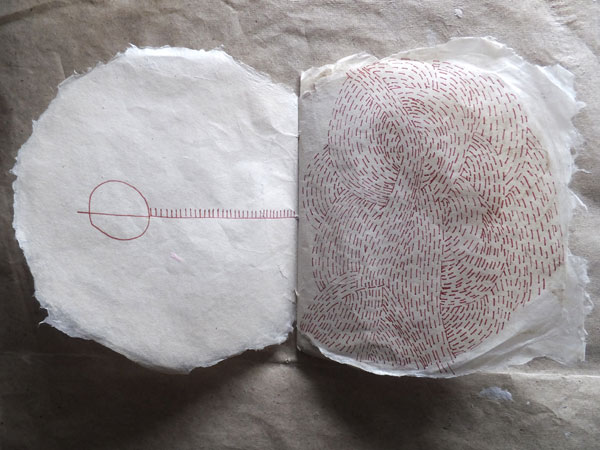
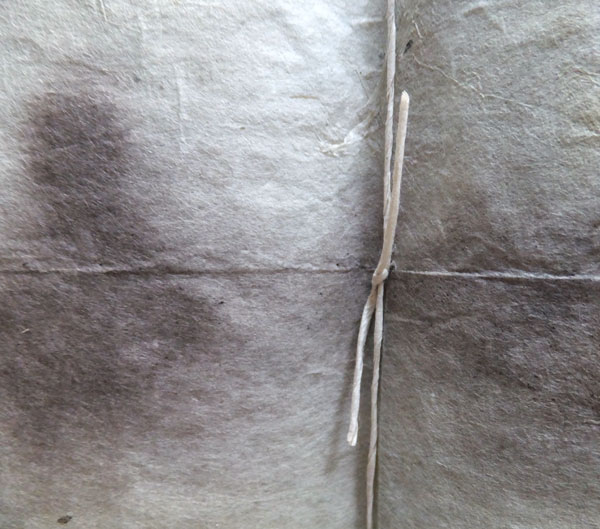
My art practice is related to yoga, I try to keep an empty mind and not interfere when inspiration arrives. I am an intuitive and empathic artist and use sketchbooks and journals to hold thoughts, drawings, and marks as they come to my awareness. I learn by observation, collection and reading. I collect most anything tactile that can fit in my pocket: leaves, rocks, bits of glass and whatnot. I habitually photograph shapes, marks and oddities observed on my walks and in my travels. The slow methodical nature of sewing is alluring to me. I strive to make beautiful work with simple marks.
Previous World of Threads Exhibitions
Christine Mauersberger exhibited in the 2014 Festival major exhibition The Red and the Black.
You work in both 2D and installation. Do you work equally with both and do you find that one takes precedence?
I work equally on ideas and concepts for both 2D and installation pieces by making sketches and drawings. The 2D work becomes realized most often since it is logistically and physically more accessible to create. The large installation work requires a venue and/or a large enough space to install and to be able to view the work.
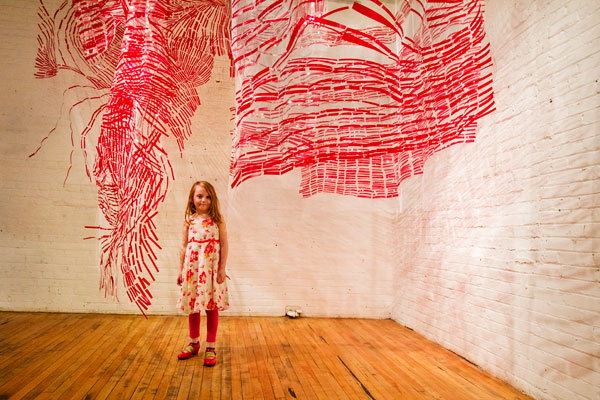
Installation work is more thrilling and self-fulfilling.
Which inspires you most and is that the one that gives you the most satisfaction?
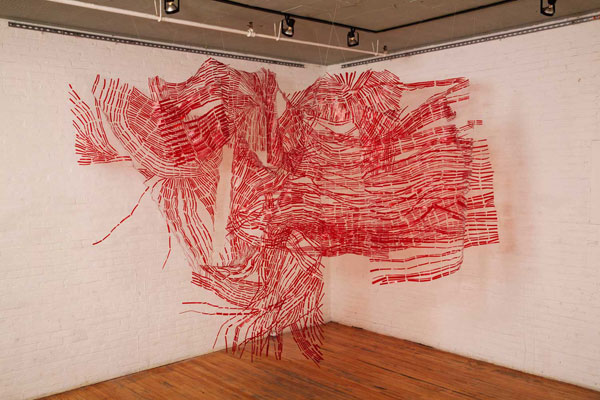
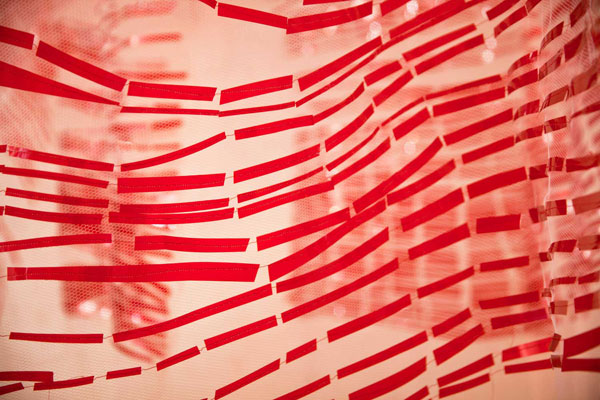
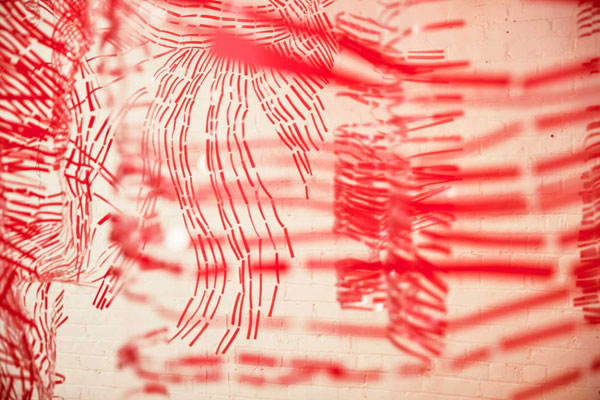
What makes me most happy is to form an idea using a limited selection of materials. It is endlessly gratifying to see the outcome. Both types of work are satisfying. However, the installation work is more thrilling and self-fulfilling. I make the installation art by accretion and don't get to see the final work until it's installed. It is temporary and ephemeral.
When you were a child, did you want to become an artist and did your parents encourage your creativity?
I am the 11th child born in a second-generation Polish/Slovak American family of 12. My mother told me that I was born with my eyes wide open. My 2nd grade teacher told me I would become an artist and I believed her. In high school, I saw Fiberworks 1977 at the Cleveland Museum of Art giving birth to my interest in textiles. My dad was a draftsman and my mom was a talented homemaker, they would help me design anything I desired to create. I thought that everyone had parents who knew how to sew, glaze a window, or run a band saw. It was just part of how our family functioned. They encouraged excellence in me, but they didn't know that a career in art would be feasible despite the awards I won in school and told me that I had 2 choices: attend the local college or learn to use a typewriter and get a job in business. There were many other priorities for them in our sizable family, my future as an artist didn't take precedence. Throughout my early working years as an accounting analyst, I found time to attend Marshfield School of Weaving in Vermont, Haystack in Maine, and to take evening art classes at the Cleveland Institute of Art. I finally completed a studio art degree at the age of 31. After which I worked in a string of art-related jobs ending as an assistant art curator until I was 49.
It took about 18 years for me to be true to myself and finally quit my job.
When & how did you realize that you had the confidence to proceed with your art?
For many years, I longed to make meaningful artwork. Art making languished while I worked a full time job. I felt I was undermining my own desire to create art. It took about 18 years for me to be true to myself and finally quit my job. First I began a daily drawing exercise to regain some of my studio art skills. The early drawings were filled with marks and resembled maps. I decided to hand stitch the likeness of the drawings onto fabric. The drawings and stitched work developed an interdependent relationship where one informed the other. This activity placed me on a trajectory of purposeful artwork.
The way I connected to discovering my voice was to be vulnerable to taking a risk. The writer and speaker, Brené Brown wrote, "Vulnerability is the birthplace of innovation, creativity and change." Her books are filled with useful advice to anyone seeking to make a positive change in ones life.
You say that your work is primarily about the act of making marks as a representation of time. Talk to us about this concept and how you feel your work represents time:
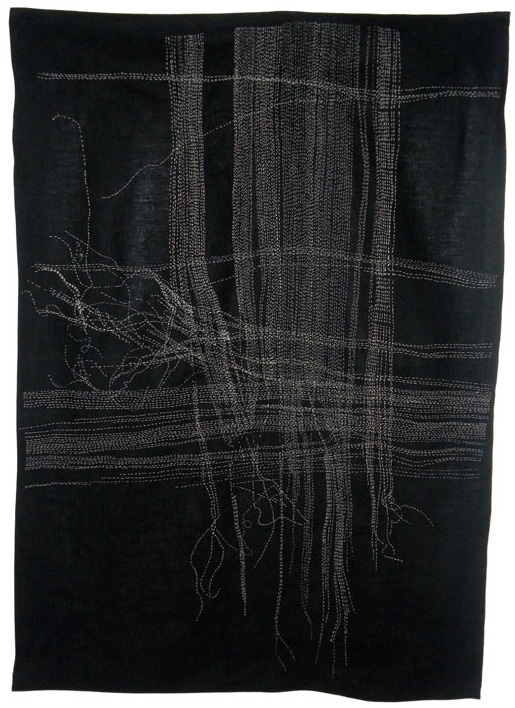
Time is a concept that we cannot see. We use Greenwich meantime as the global standard to mark the passing of time. Hatch marks are often used to tally units of time. The marks that my stitches make are related to the action of marking time. The concept of time itself is reflected in each stitched mark the viewer sees in my work.
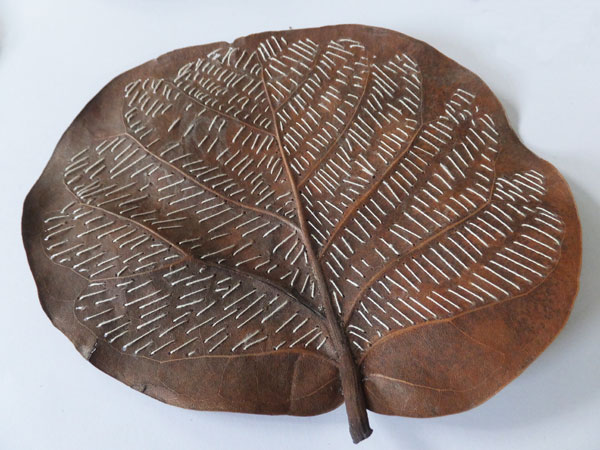
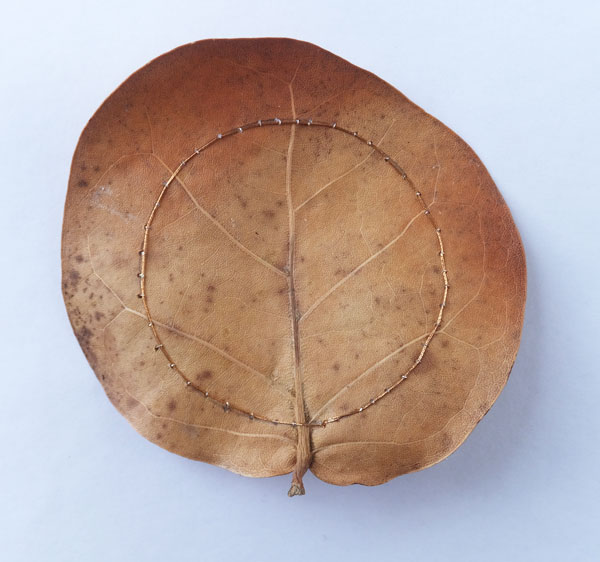
My ideas of movement range from creating small shifts in perception to larger more noticeable gestural motions.
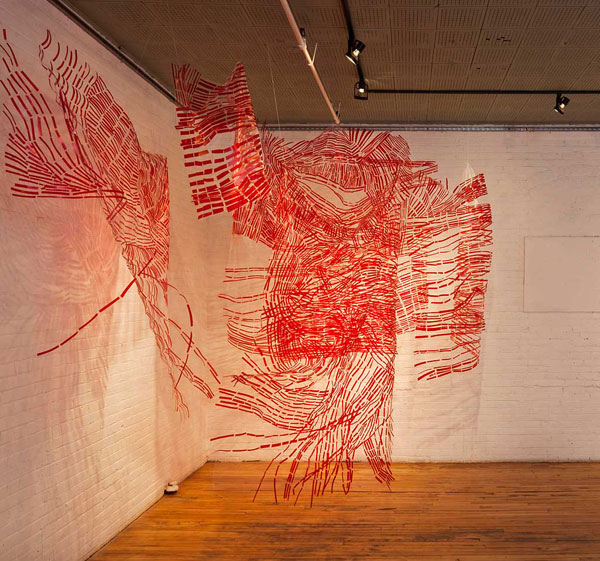
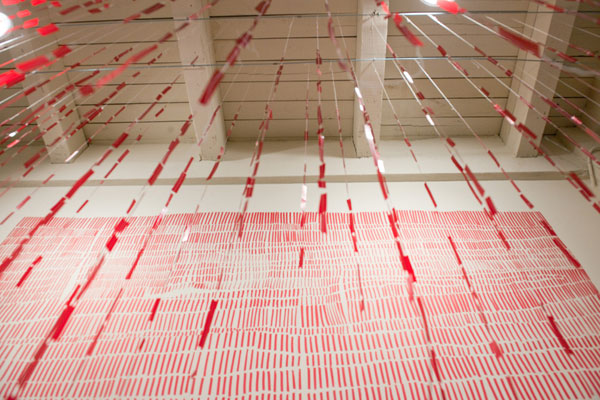
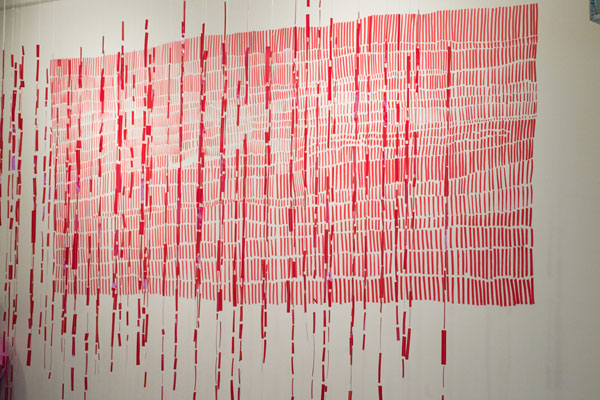
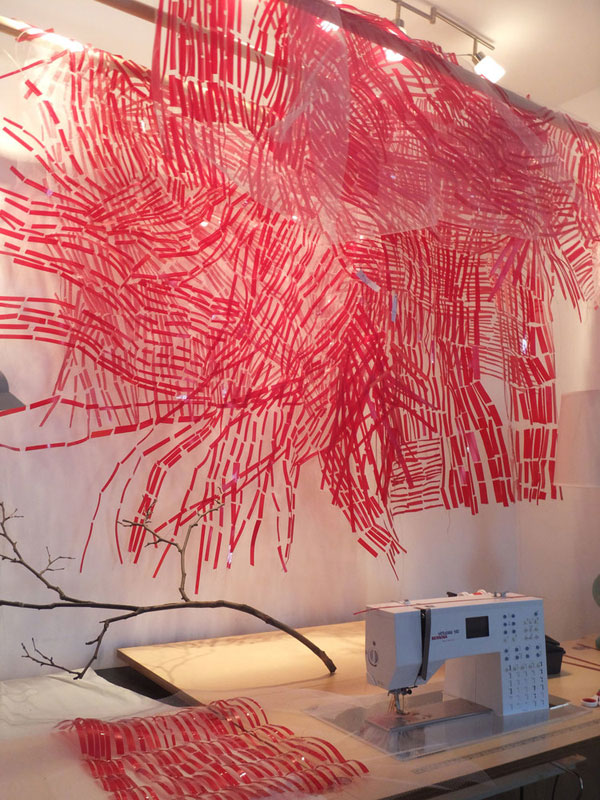
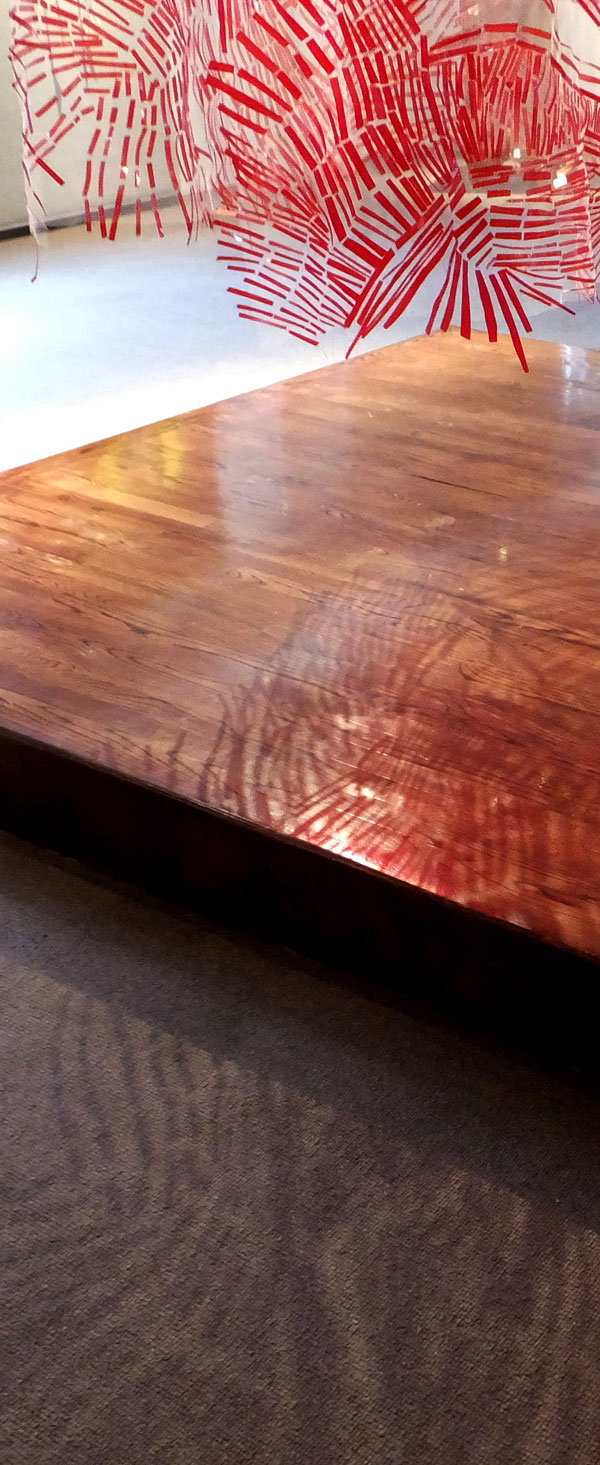
In Flow, the movement is less obvious and requires the viewer to notice how the wall drawing appears to move when walking past the installation. The wall drawing does not move, but the lines appear to shift. The suspended stitched lines of red in front of the wall make subtle movements as a person walks near it.
Push was made as a meditation of the fluidity of time. Where we can only know it in retrospect, meaning we can only know the exact duration of an experience until it has passed. The stitched red plastic lines move and undulate in space indicating a very active zone. When a viewer walks around or near the piece, her/his physical energy interacts with it and causes appreciable movement.
What role do you think fibre art plays in contemporary art?
I think that fibre art has major and minor roles in contemporary art. The major role occurred in late 1970's when Fibre Art was embraced as an art form with artists like Olga De Amaral, Magdalena Abakanowicz, Luba Krejci, and Lenore Tawney. However interest in it seemed to wane until the early 2000's when larger venues such as SOFA Chicago and Art Basel have included Fibre Art in their offerings. Now, technology has had a significant role in making it easier to find fibre artists through blogs, curated websites, and artist's websites. In as much as there are far more female fibre artists then male, I am disheartened to see women artists marginalized overall. Fibre Art has been dancing on the edges of the male-dominated fine art big league, but it's slowly creeping in.
What do you see as the biggest challenge facing fibre artists?
The biggest challenge for any artist is to be consistent with her/his voice and make good art. Beyond that, the challenge is to get the work made, seen and sold. That means educating oneself about how to be an artist with sustainable success. Creative Capital in Brooklyn, New York offers a professional development program to advance oneself. They host live webinars for strategic planning and promoting your work. How can you be successful if you are in your own bubble? Fibre artists should seek continued development to be seen and heard.
If you reflect on your career as a fibre artist, what achievement are you most proud of?
In 2013 I won two major arts grants: the Creative Workforce Fellowship for $20,000.00 which is a competitive award given to artists living in Cuyahoga county, Ohio, USA. And an Ohio Arts Council grant for $5,000.00. Winning these grants told me that the work I did has contemporary art value and it also put pressure on me to keep moving forward with the work.
You mention that American artist Mark Bradford's large works evoke the limitless boundaries you seek. Talk to us about that:
I saw Mark Bradford's work at the Wexner Center in Columbus Ohio in 2010. His work encompasses video, installation and room-sized collages with found materials, mostly trash. While our subject matter differs, I am inspired to make large work that stretches the boundaries of the fibre medium.
"Beauty is the mystery of life. It is not in the eye. It is in the mind. In our minds there is an awareness of perfection."
What intrigues you about the work of Agnes Martin?
I am intrigued by the writings and paintings of Agnes Martin. She wrote, "Beauty is the mystery of life. It is not in the eye. It is in the mind. In our minds there is an awareness of perfection." Martin's paintings are pared down to the most reductive elements using subdued colours. She celebrated the simple line. I myself am inspired to limit my resources in order to have nothing stand in my way. The purpose of my own work is to make something beautiful while simultaneously responding to what my inner mind is telling me to make. I prefer to think of my work as intuitive stitching. A repeated mark can be beautiful & we are intuitively drawn to the elegance of the stitch and its beauty.
Louise Bourgeois and her work has also had an influence on you and your art. Tell us about that:
Louise Bourgeois's sculptures and prints are infused with deep symbolism of her early childhood experiences. She had a consistent vocabulary for that history. Her anthropomorphic sculptures are simple but highly charged with themes of loneliness, frustration, conflict and vulnerability. I am inspired by the strong emotions and ideas that are conveyed by using pared-down elements. From her spare line drawings to her fabric collages made of fragments of her old clothing, I realize that I can make art with a restricted selection of objects or tools.
What interests you about the World of Threads Festival?
The level of expertise and the number of international fibre artists involved in the festival is exemplary. To have such a well-organized event for fibre artists is important to the contemporary art world.
You were accepted into the World of Threads Festival 2014. What was your motivation for submitting your work for consideration?
I was motivated to submit one of my installation works so that it could be seen at an international venue and to show my capabilities to work in fibre with non-traditional materials. My hope is to have other opportunities to create more installation work.
Is there a particular art related books that you refer to on a regular basis or from which you draw inspiration?
Cat Bennett's books, Making Art a Practice and The Confident Creative are 2 of my go-to books when I need to be re-energized about my own art practice.
Is there something else about you or your work that you would like us to know?
The work I make now is still new and developing. I continue to find ways to express my point of view in an organic fashion and hope to be making stronger and more flushed-out work as I grow in my practice. I feel an urgency to make art. Life is short but it's not too late to be fulfilling one's desires. Being a working artist can become a reality, someone told me that "You can get anywhere you can see", I know that's true. I will be 54 in October and think that I am just now beginning to make the art that is in my mind.
