Artist Interview 124: Rosemary Claus-Gray
Poplar Bluff, Missouri, USA
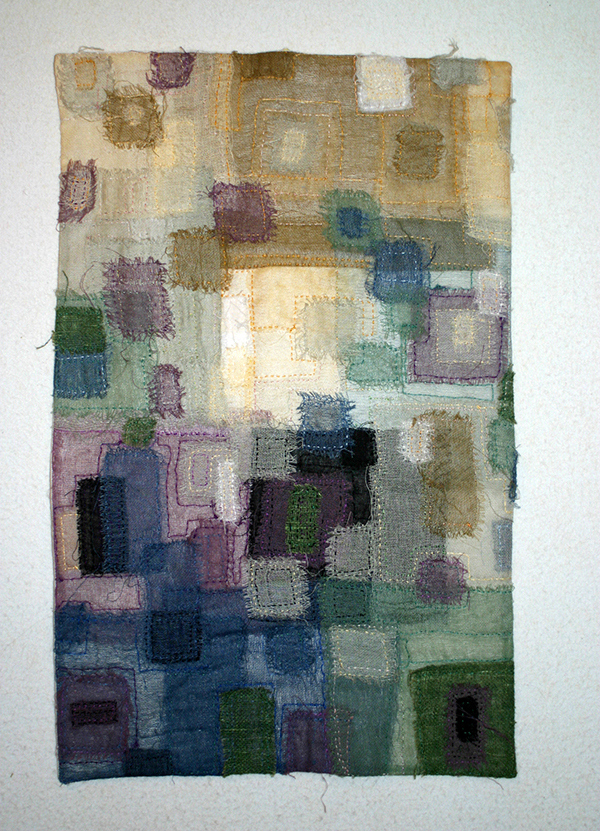
Moving forward from early quilt making, Rosemary uses machine and hand-stitching, often in the same piece. Translucency is an underlying component and using sheet fabrics and stitching to create a different look in her art quilts. She has incorporated hand-made paper, painted fabric and encaustic methods, but fibre is her primary art interest.
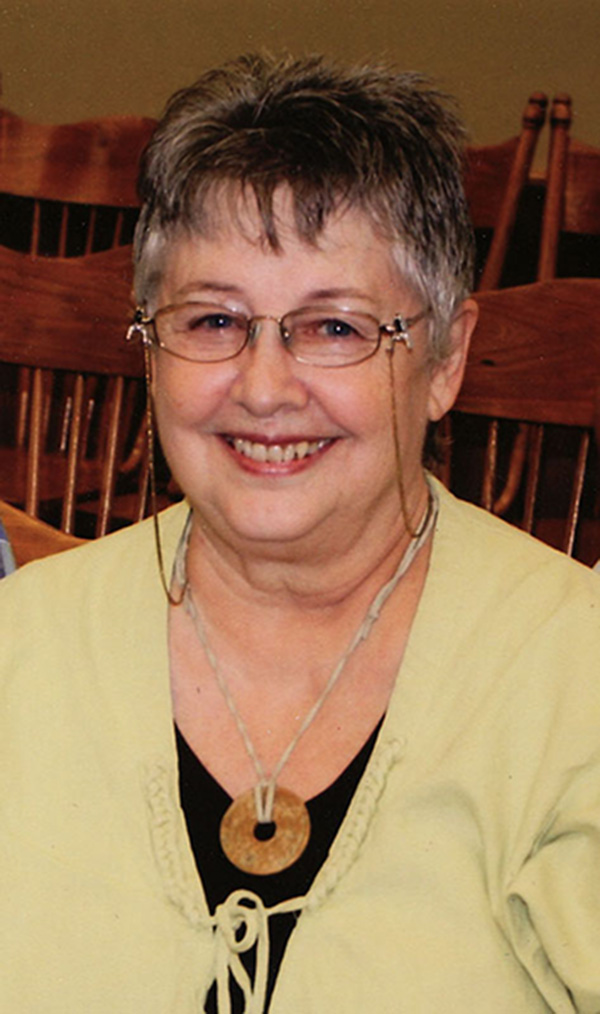
Rosemary Claus-Gray
Poplar Bluff, Missouri, USA
Artist Interview
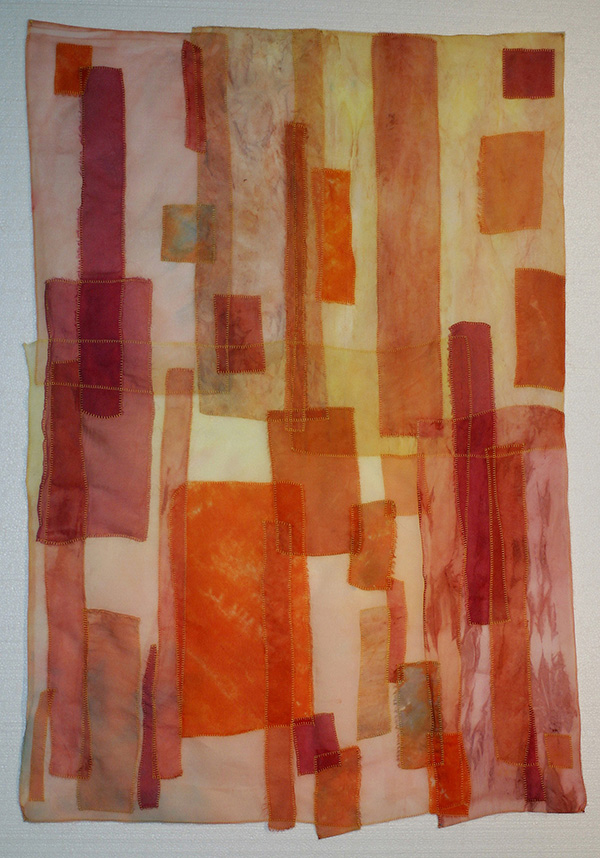
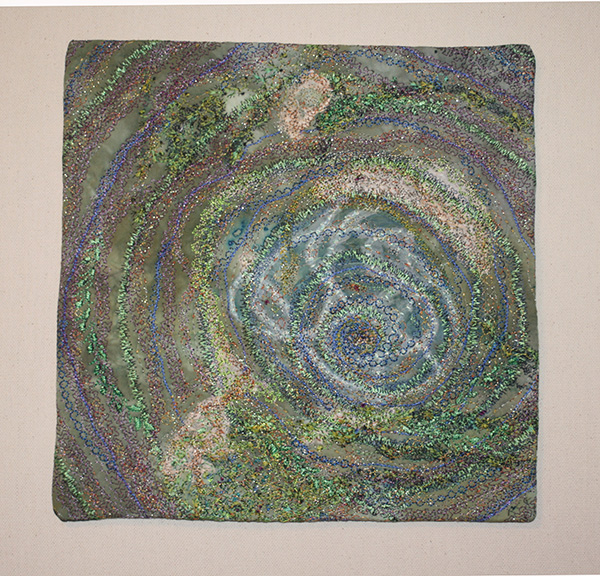
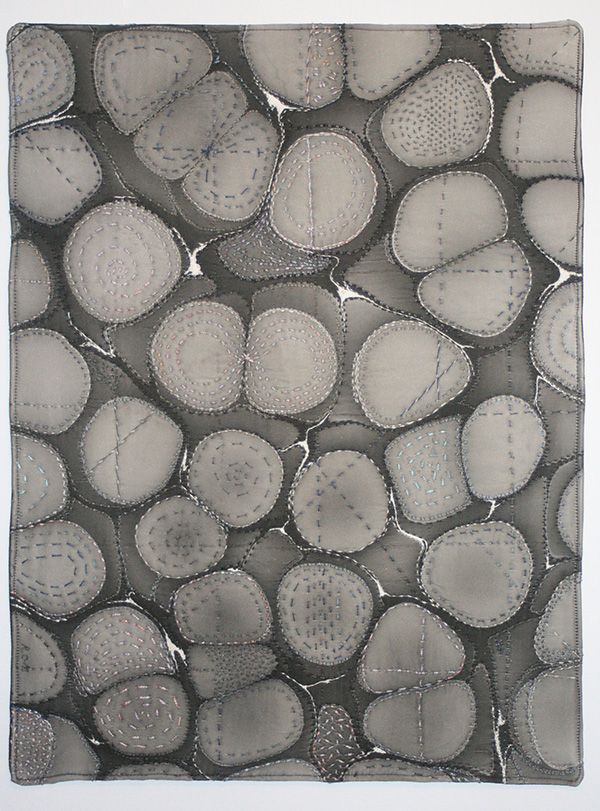
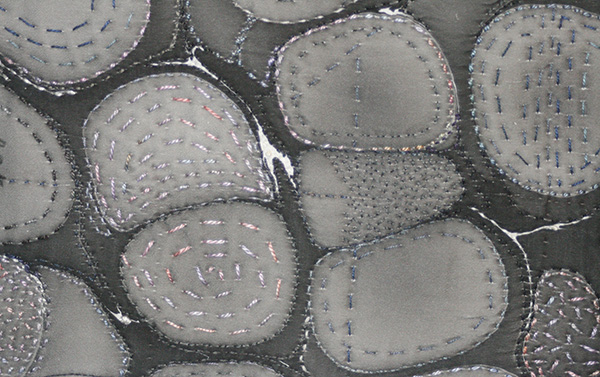
Rosemary Claus-Gray is a late blooming artist. The sleeping artist awoke as she neared retirement from a career as a clinical social worker. She creates abstract art in a painterly style, layering translucent fabrics creating value transitions. She paints sheer silk with an acrylic wash, creating lines through the use of resist techniques. Various colours of thick and thin threads are mark-making tools. Rosemary has exhibited regionally, nationally and internationally.
Dawne Rudman and Gareth Bate
Talk to us about your work?
My work is expressive, usually abstract, sometimes stylized. It's often serious, expressing my deepest feelings and fears. Other times, it's playful and sassy. I am often experimenting with design ideas, techniques or media. Translucency is an underlying fascination to me. I've been working with sheer fabrics for years, and continue to ask myself "what if…?", the question that leads to new projects.
The materials I select often lead my design decisions. The Craftsman movement used the term "truth to the materials", which is a guiding principle for my work. I'll study the materials I plan to use, ask myself what it is about it that I like and then I'll consider how I can present the material so the viewer may see and appreciate it, too.
I'll use any techniques known to me to capture my vision. I continually learn one more technique, one more variation of the use of my tools. I see techniques simply as tools, to use as appropriate to achieve my vision. One is not better than another. For instance, I see machine stitching and hand stitching as techniques. Both are of value, but each gives a different look. Often, I will mix the two methods of stitching in one piece. There is no better or worse about which tool I select to use, or a judgment about right or wrong. Whatever works to achieve my vision guides my choice.
To me, art is communication. I hope the work will communicate with the viewer as it had with me.
What inspires you?
Beautiful natural vistas make me pause and take in the colors, shapes, and lines. A clean, simple design is very appealing to me, as seen in Japanese Ikebana flower arrangements, and other Japanese aesthetics. Ancient art in the rock paintings around the world, African art, indigenous art in the Americas, and Australia all inspire me. The line drawings and repetitive shapes resonate with me.
I grew up in the Chicago area, surrounded by great architecture. I developed an appreciation for magnificence in buildings. Abstract sculptures, like those of Henry Moore, Brancusi, Picasso and Calder are inspiring to me.
The Impressionists could show light playing over water or a field of flowers in a magnificent way. It's been said they painted with light. Modern abstract expressionist art is a significant inspiration for me, particularly the simpler designs, such as a Rothko work.
Many of my friends are artists, and they are an inspiration to me. I've learned something from each workshop I've taken with skilled practitioners in the art community.
She told me to do the work of creating daily. She opened the world of art to me, as a creator, not simply a viewer.
Why did you choose to go into fibre art and how did you decide on this medium?
Focusing on fibre as art was a natural progression from creating things with my hands for my home, for clothing, and gifts, to creating expressive art.
One of my earliest memories was sitting on the front porch with my mother, making yo-yos for a quilt top. I got to stitch the edges of the circles, just like mom, then pull the thread to make a wrinkly circle. It was magic to me.
It took me a long time to think of myself as an artist. Once my children were grown, I started making traditional quilts, after America's bicentennial. Although I love quilts, I was bored with making the repeating blocks. My first art quilt class was with Caryl Bryer Fallert-Gentry. She gave hands on lessons in colour, and recognizing values. She said I had come to the right place to begin to create my own designs. She helped me begin to think like an artist.
As I explored learning about art quilts, Nancy Crow encouraged me to study composition. As an alternative to art school, she recommended I take workshops in other media led by skilled artists, to study art, design and composition from books, and to see as much fine art as possible in museums and galleries. She told me to do the work of creating daily. She opened the world of art to me, as a creator, not simply a viewer. To this day, I follow her recommendation.
Today, I work with fibre as my media simply because I like it. I have incorporated hand made paper, painted fabric, encaustic methods, but fibre, as art, is my primary interest.
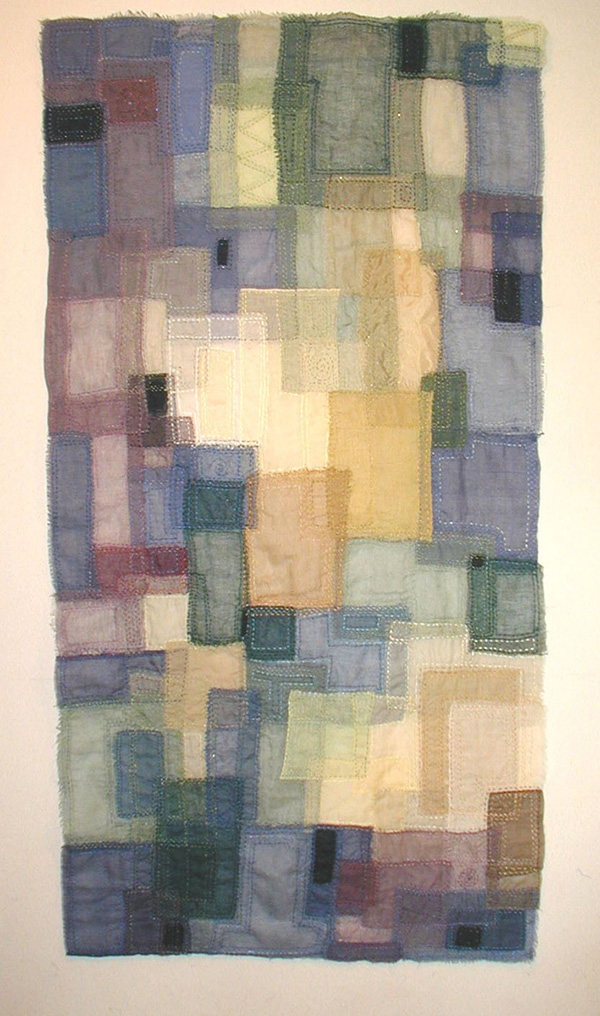
I imagined myself as an artist in an African village, given the task to make designs on a wall.
What specific historic artists have influenced your work?
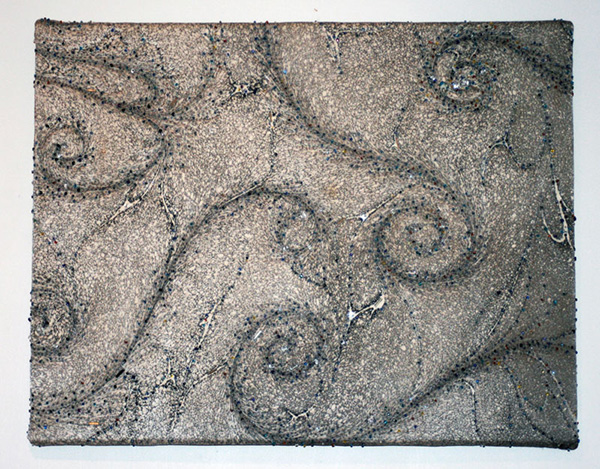
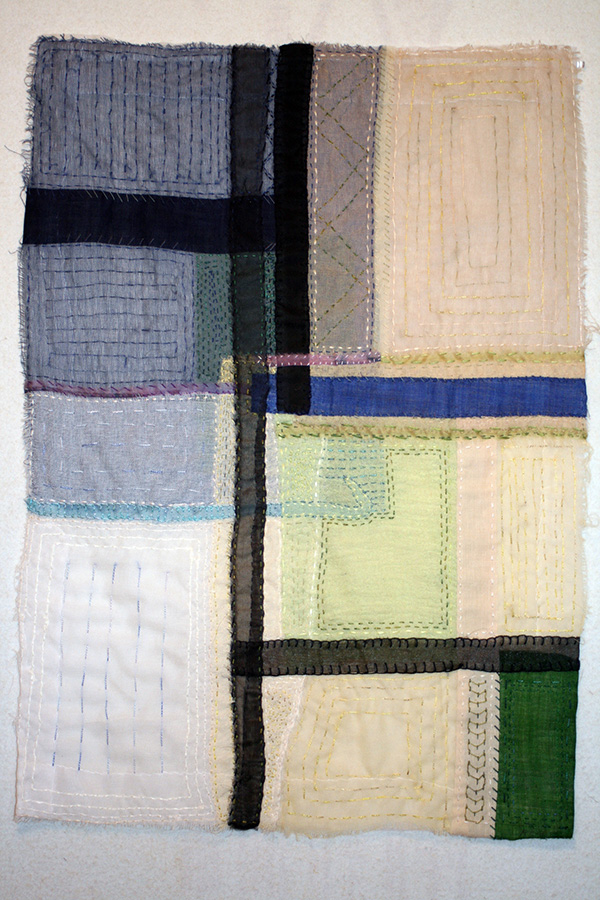
The ancient cave drawings influence my work with the eloquent lines, the simple shapes, and the story they tell us even today, centuries later. These primitive drawings, often using geometric shapes, encouraged me to not let my inability to draw well stop me. (Portals III, 2012)
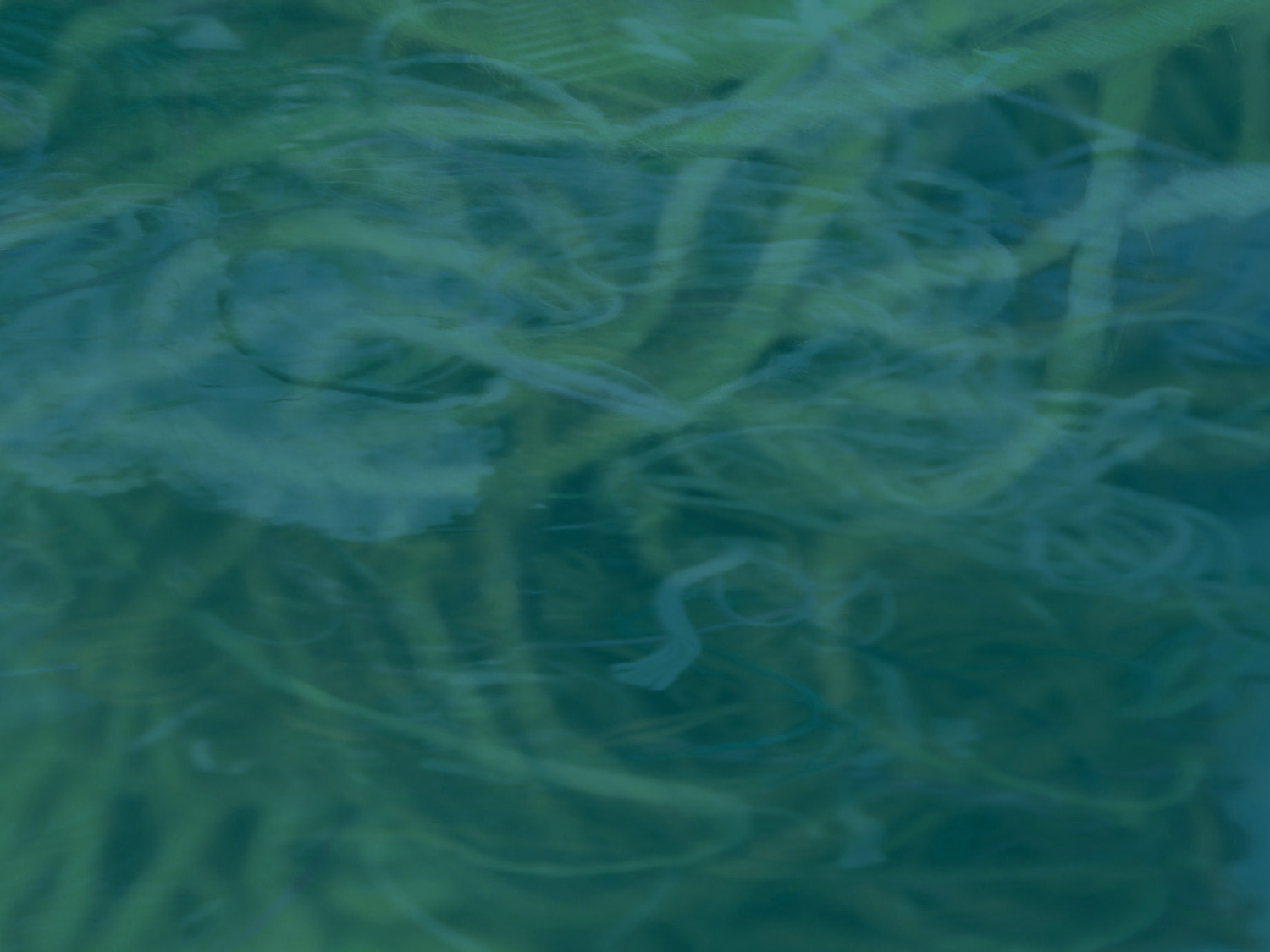
The Impressionists use of light and merging of values across a painting is an influence. When I overlap sheer fabrics, I am thinking of the Impressionists work. Claude Monet's Water Lilies and the Japanese Bridge over the lily pond capture a depth in the painting that is amazing to me. His Haystack series show the dramatic effect of light in a composition. (Glades, and close up)
I was dumbstruck by the power of Mark Rothko's abstract expressionist painting when I first saw one at the Art Institute in Chicago. When studying his works, I learned he used thin layers of paint to merge one colour into another. I was inspired to use thin layers of translucent fabric, or needle felted fabric to shift values in a work without a hard line. (River Oats, needle felted)
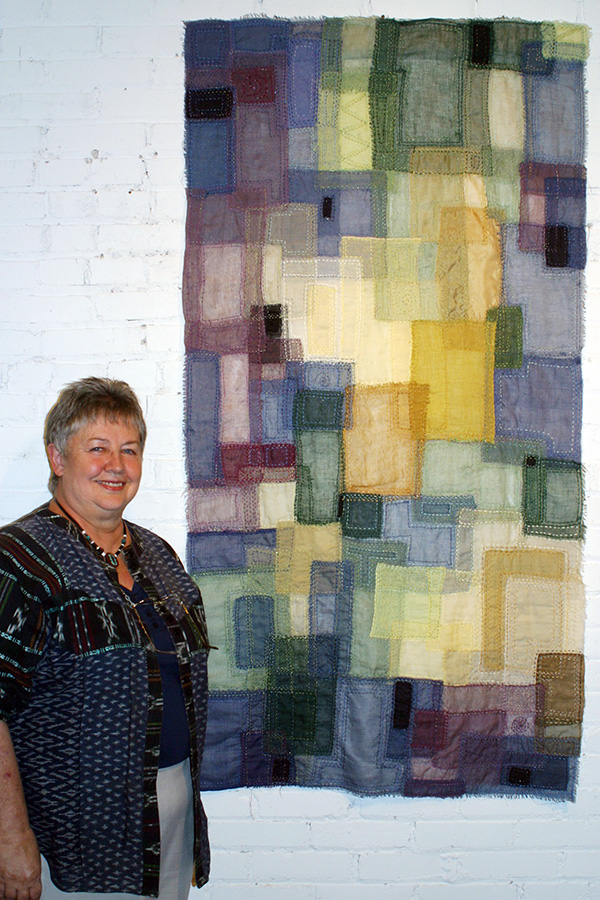
He worked large in many of his later works. I read at the Rothko Chapel in Houston, TX, that he visualized a person standing in front of his huge painting, and mentally entering it. I have worked large with some of my abstract work for the same reason. (Portals VIII, 2013)
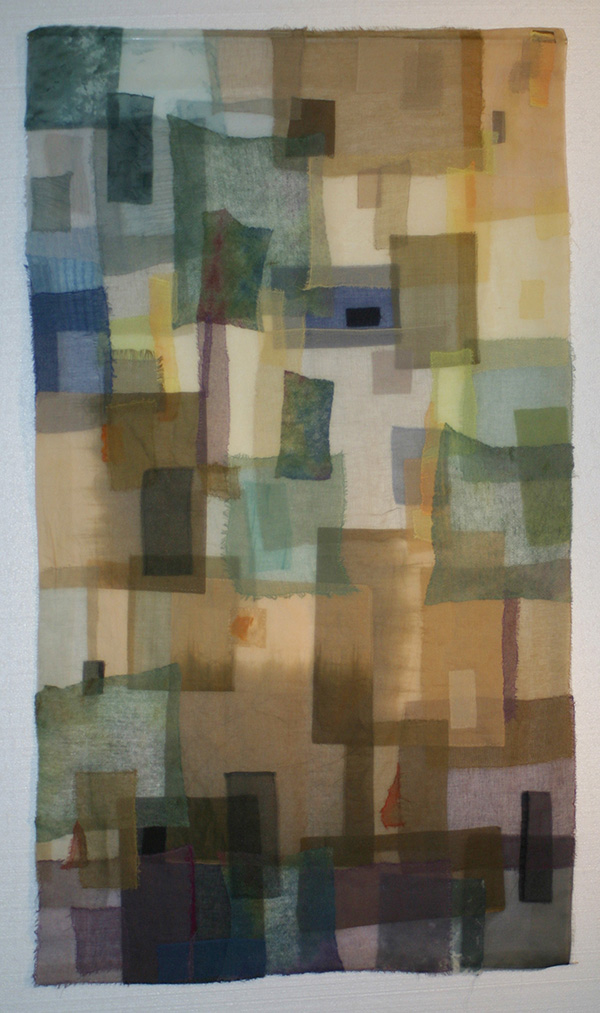
I had been studying African art, and the strong, primitive designs. As I created Façade XXII, I imagined myself as an artist in an African village, given the task to make designs on a wall. I created various geometric designs in the overlapping rectangles of scrim. I made X's, spirals, dots, and zigzags. The United States State Department, Art in Embassy's program purchased that piece for the American Embassy in the Congo, Africa. That sent chills through me, chills of amazement and delight. (Facade XXII, with detail)
That I create is more important than what I create.
When you were a child, did you want to become an artist and did your parents encourage your creativity?
My parents came to adulthood in the Great Depression. They encouraged their six children into practical careers. Art was not on the list, nor was it appreciated in our home. I've come to think the artist in me was hiding until it was safe to come out and explore what I could do. I'm a late bloomer, and loving every minute of creating.
What does your art mean to you?
It's vital. My work is the product of my NEED to create that is integral to who I am. Saying it is in every breath is not too great an exaggeration. The truth is that I do not feel well if I'm unable to create for a day or two. That I create is more important than what I create.
Yet, it is my playtime. It's my time out from the wear and tear of daily life. It's how I center myself, and calm myself. It's satisfying to create something that pleases me. I think my work succeeds if it communicates with another.
If a good friend were to describe your style, what would they say?
Ethereal is a word I hear people use in describing my work. They say it's soothing, calming and spiritual.
Have you experienced fluctuations in your productivity through the years?
Since the mid '90's, when I started creating from my heart and soul, it seems like my productivity has been fairly steady. The work might vary from serious to silly, but I'm usually working on something. Even when I don't know what to do, I'll make design studies, doodle, experiment, or straighten the studio. Pretty soon, I'm working on a project. The fabric has spoken to me.
What specific contemporary artists have influenced your work?
Andy Goldsworthy's (Scotland) ephemeral work in natural settings is thought provoking for me. As I contemplate whether something is archival, his work helps me realize that all is temporary. While on the Focus on FIber art retreat at the Atlantic Center for the Arts in New Smyrna Beach, FL, my friend, Pamela Allen (Canada) and I created a sculpture created from fallen palm fronds, moss, kelp and sea grape leaves from the beach. We used twine to hold it together, knowing it, too, would return to the environment. I thought of it as a feminine spirit in the scrub oak woods that would slowly disintegrate over a year or two, leaving her spirit behind. It was very satisfying to create this sculpture. (Feminine Spirit)
Robert Genn, a Canadian painter, writes a twice-weekly newsletter full of inspiration, philosophy and discussion around art issues. His comments inspire me, and help me realize I'm not so different, after all.
Artists like David Hockney, Richard Diebenkorn, Picasso, Matisse, van Gogh, Mondrian, Klee, Modigliani, and others produce work that impresses me and who influence me in indirect ways.
What role do you think fibre art plays in contemporary art?
It is important to recognize that terms like 'contemporary art' and 'fibre art' are imaginary constructs that help us understand how things work in the world. These are imaginary worlds, not a place with real doors that open or close for us.
My comments reflect my opinion after informing myself of available data and articles written by knowledgeable people. I see acceptance for fibre art in the contemporary art scene as an individual accomplishment, not as a group endeavour. There are some individual artists who have transcended into the fine art world, but they are few in number.
Very few artists in any media achieve fame and fortune in contemporary art. Generally, most artists are unknown beyond their own circle. It seems the reality is that a few artists become famous, some find ways to support themselves, while many struggle to find acceptance, recognition, or sales. This is true in all media. However, I do recognize that it is more difficult for a fibre artist simply to be considered for representation in a gallery than a painter. The lack of a secondary market is one reason why galleries shy away from fibre art. Patrons are reluctant to buy it, as it lacks investment appeal. The dominance of women in the fibre art field also is likely a reason it's harder to break into the male dominated art world. Terminology such as quilt, embroidery, tapestry, basketry and weaving, to name a few, carry a connotation that means to some people that what they are looking at is not art, but craft, and unfortunately, it is immediately discounted without consideration.
The organizations for fibre art offer many opportunities to exhibit within the boundaries of fibre related art, but to move from there to having recognition as a fine artist seems to be rare. I am happy to exhibit my work in galleries and art museums connected to a college or university, or a regional art museum in the USA. These exhibits often have a variety of media, and are not fibre specific. I also will enter fibre art exhibits, and make efforts to view them when possible.
There are a few fibre artists whose work, in my opinion, is at the level of fine art. Many artists are good, quite good, but not in an exceptional, extraordinary class of artist. Fibre art will likely continue to be a stepchild in contemporary art today. I think these factors are unfortunate, but it's a battle I don't care to fight. I simply want to create. I realize I can change myself, improve myself, but changing attitudes in the world is just too big a job. Doing the best I can on a daily basis is all I ask of myself.
What other fibre artists are you interested in?
I have many fibre artist friends. I like the work of many of them, and am inspired by some of them. I can only mention a limited few here, those who come to mind in the moment, and ask forgiveness from my friends if your name is not included in this extensive list.
Emily Richardson, from Pennsylvania, works with sheer fabrics, creating ethereal works of art. I had a workshop with her where I learned how to work with slippery silks. Later, I was in an exhibit at the Russ Gallery in the heart of Columbus, Ohio, where the curators paired teachers and student art to make the point that a student's work does not have to resemble a teachers art, for the student to grow as an artist. The curator paired my work with Emily's work. I learned important techniques from her, but my work is not a clone of hers.
I had some instruction in design from Michael James, Jason Pollen, and Rebecca Howdeshell, all of whom are fibre artists in the USA. The instruction was primarily with paper and pencil, ink, scissors and paste.
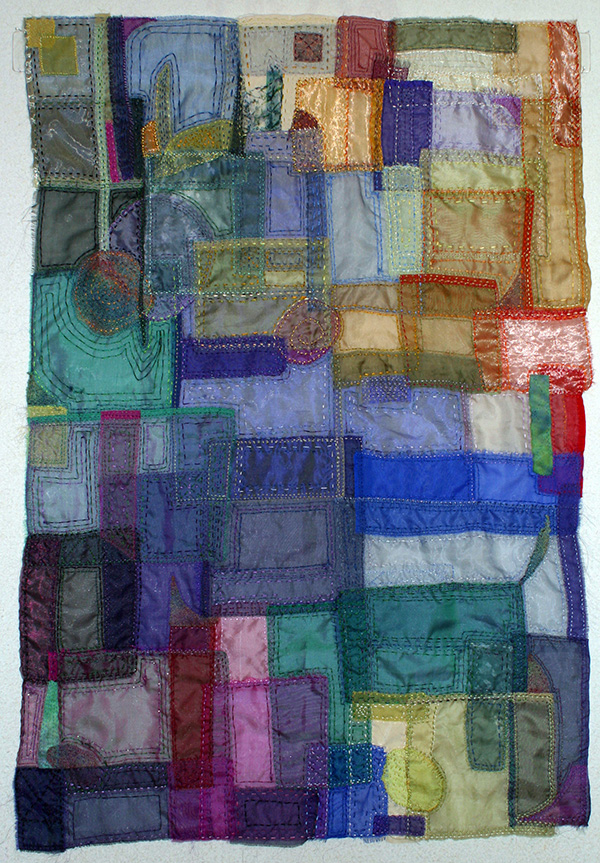
I am very drawn to the work of Chunghie Lee, from Korea and the USA, in her Pojagi work, which is one layer of sheer fabrics stitched together in geometric designs, based on ancient Korean wrapping cloths. I adapted the traditional techniques to create "Blue", and other sheer works.
Deborah Lacativa's fantastic beings encouraged me to be playful and outrageous in developing my "critters".
Artist's whose work interests me include, but are not limited to, Junco Sato Pollack (USA) whose work with sheers inspired me to work with translucent fabrics when I was beginning to dream about them. Jeanne Beck (USA) creates beautiful, evocative compositions, meticulously crafted. Maximo Laura (Peru) is a National Treasure in his home country. His tapestries are magnificent with color and symbolism from the past, and for the present.
Regina Benson (USA) creates large sculptural fibre art that I find very powerful. Jo Stealey (USA) creates with natural materials and excellence of composition in ways that are breath-taking for me. Judy Martin (Canada) does hand stitching in a spiritual manner, writes with philosophical insight, and involves her community in meaningful ways. Carol Zeman (USA) creates sculptures with paper pulp from plants she gathered, and often will include a poem about the piece. Her work is deep and meaningful, as well as beautiful. Leandra Spangler (USA) is a master paper maker, and creates amazing shapes using her cast paper techniques. Elaine Quehl (Canada) creates eloquent organic lines in her meticulous quilts, often of close ups of Hosta leaves. Robyn Daniel (USA) works with felt and wire, creating a series on miscommunication that I find meaningful and original. Kathy Loomis (USA) creates large pieces that have a strong presence and powerful meaning. Linda Colsh (Belgium) uses a symbolic person in her compositions that draws me in, much like the cave drawings. There is something eternal about her work.
Some artists were generous mentors for me as I was a budding artist. I thank Paula Scaffidi for all her teaching, and patience with my millions of questions. Pamela Allen (Canada) is a friend and support for me, guiding me to "think like an artist." We've had the best discussions!
I appreciate the Internet, as I live in a rural area, with limited access to art and cultural activities. I treasure my conversations today with artist friends I admire. This helps bridge the isolation of my rural environment, and is very important to me. This is a physically beautiful place, with good people, but few artistic souls.
Exhibits, like the World of Threads Festival, are innovative and showing bold use of materials, excellence in workmanship, with meaning conveyed to the viewer. It's very exciting and inspiring for me to see this strong fibre work.
Groups, like the Missouri Fiber Artists, help me become aware of the variety of art that can be created with various fibrous materials and techniques.
SAQA and SDA offer networking and exhibit opportunities, and other resources.
At the end of a piece, I'll take a day or two and not look at it, then I'll critique it in terms of principles of design and composition.
Tell us about your studio and how you work:
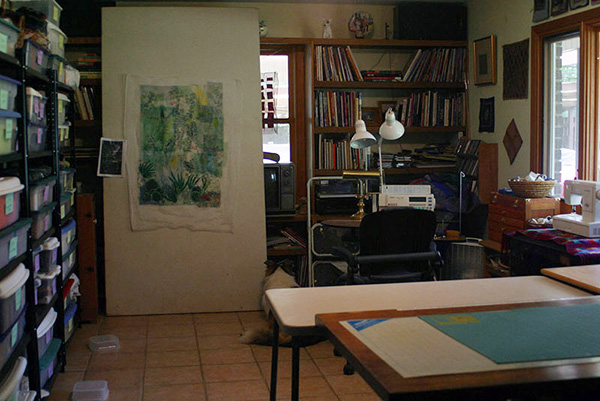
My supplies were spreading through the house, taking over every flat surface, closets and under the bed storage. I had a business trip to France, which included an outing to Monet's home at Giverny. In a tour of his farmhouse, in which he and his wife raised many children, I learned that the living room was his studio. After talking it over with my husband, we agreed to make the living room a designated studio. (studio photo) If Monet could do it, so could I.
Thus, I work in my home, surrounded by my fabrics, threads, worktables and design walls. I paint fabric outside, and have an encaustic studio downstairs. (outside work table photo)
Generally, I'll do a little sketching of a composition, and make a decision about the size of the finished work. I ask myself, what is my intent? Selection of materials begins at that point, making choices about the palette. Then, I begin cutting fabric and pinning to my design wall to create the composition. Often I'll have several pieces in the works, so there is always something a bit different to do if one activity becomes tedious or I need a break from it. I think of creating the composition as a little dance between the fabric, colours, and me.
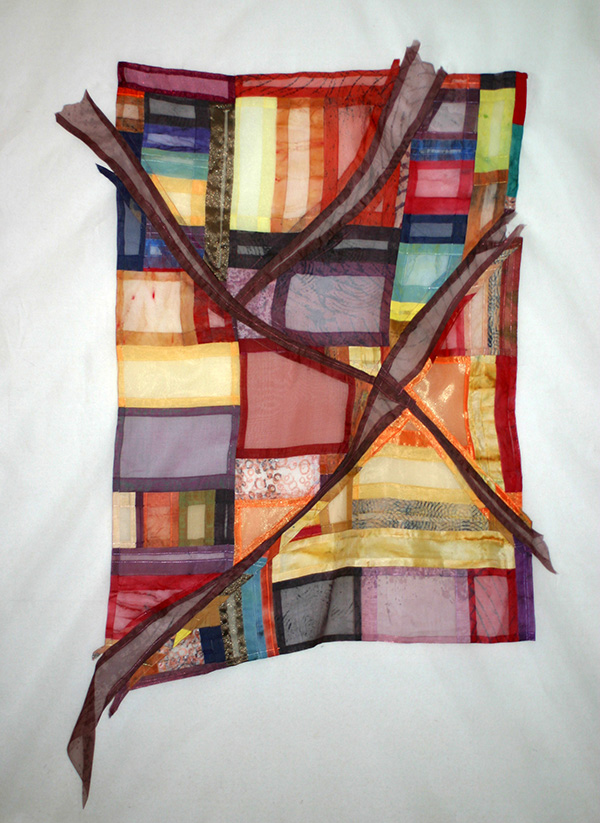
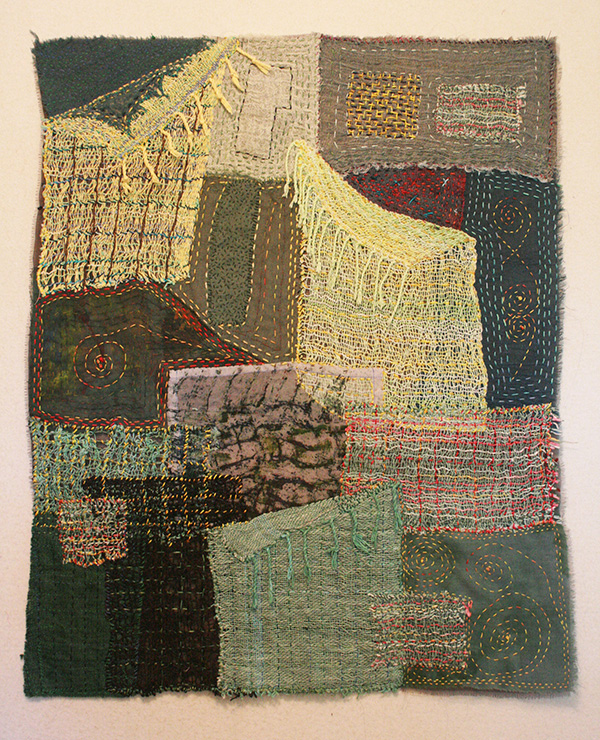
The closer I am to finishing a piece, the more difficult the decisions become about what belongs, and what does not. While I start with an intention of what I am creating, there is a dialogue that begins with the piece that influences the outcome, and the meaning. I may start with a superficial meaning, such as working with negative space and a variety of squares and circles, and then realize there is a deeper meaning. In "Balance I", I was working with those design principles, trying to achieve a compositional balance, when I realized it was a metaphor for me trying to achieve balance in my life. At times, a meaning emerges that occasionally surprises me. (Fractured)
At the end of a piece, I'll take a day or two and not look at it, then I'll critique it in terms of principles of design and composition. I'll make changes then, as needed. Once the composition is acceptable to me, I'll begin the stitching and the dance continues. Nothing is done by rote. Each step must fit with the whole composition. Edge finishes, types of stitching, what threads to use, how to present the piece when it's done are all choices. I consider every alternative known to me, and I'll try new ones. Nothing is right or wrong as it was when I learned my craft of quilting or embroidery. I'm creating art now. I have learned and practiced the rules, and can now give myself the freedom to break rules if it is right for the piece.
What interests you about the World of Threads festival?
The quality of the fibre art exhibited is mind expanding. I was thrilled when I saw the exhibit on line. I am humbled to be interviewed along with so many artists whose work I admire.
I'm grateful for the opportunity to present my art and myself in this respected public forum and thanks to those who read through my interview. Thank you.